



Bruceantinol

Based on 1 Customer Validation
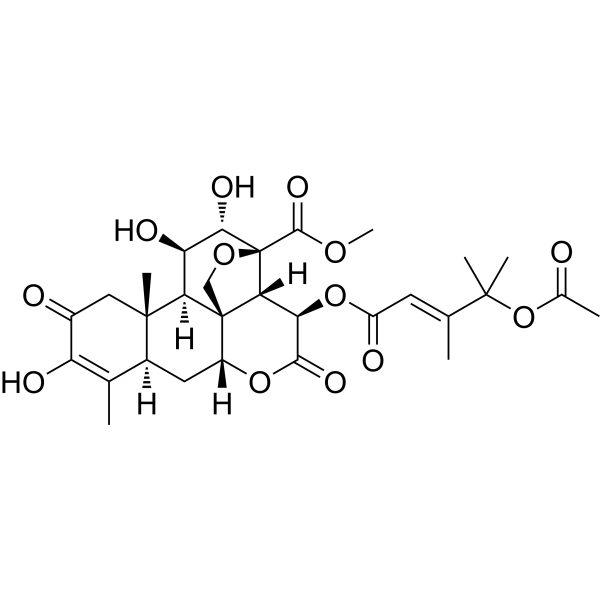
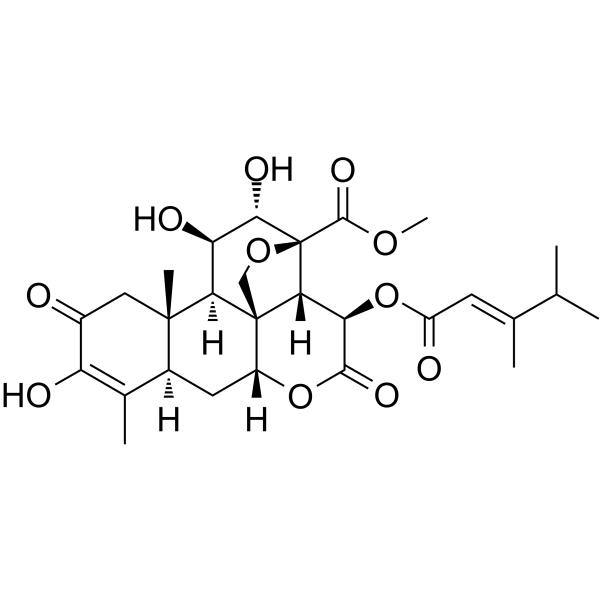
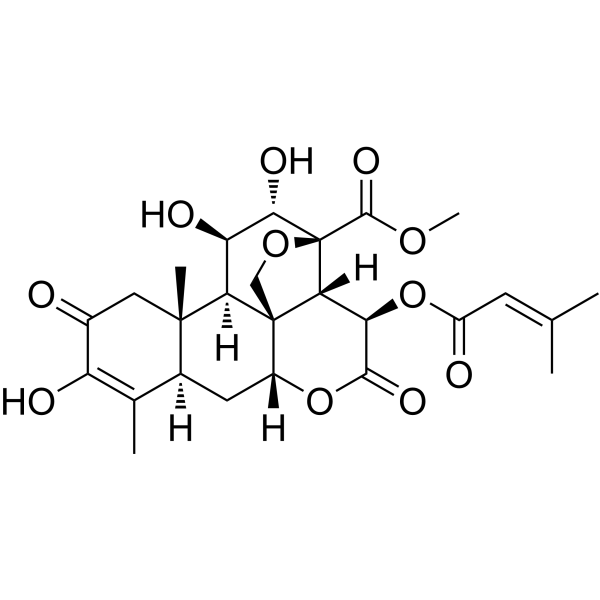
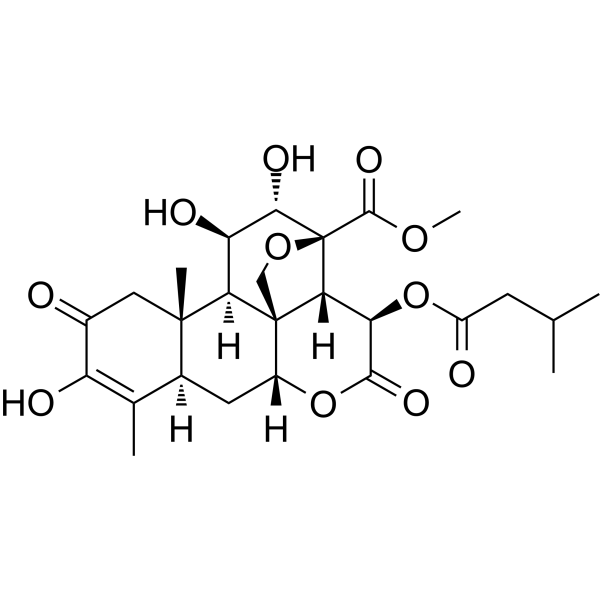
Bruceantinol is a quassinoid that can be isolated from Brucea javanica, inhibits pepper mottle virus (PepMoV) in pepper. Bruceantinol is a STAT3 inhibitor demonstrating potent antitumor activity in in vitro and in vivo human colorectal cancer (CRC) models. Bruceantinol has potent anti-leukemic activity. Bruceantinol strongly inhibits STAT3 DNA-binding ability (IC50 = 2.4 pM), blocks the constitutive and IL-6-induced STAT3 activation, and suppresses transcription of MCL-1, PTTG1, survivin and c-Myc. Bruceantinol binds with CDK2/4/6 to facilitate protein degradation through proteasome pathway. Bruceantinol can dose- and time-dependently reduces the cell growth, impede cell proliferation, disrupts the cell cycle, and induces necrosis in MCF-7 cells and apoptosis in MDA-MB-231 cells.
商品は「研究用試薬」です。人や動物の医療用・臨床診断用・食品用の製品ではありません。
研究用途以外に使用した場合、当社は一切の責任を負いかねます。
- 純度 : 98.89%
- CAS 番号: 53729-52-5
- 分子式: C30H38O13
- 分子量:606.61
-
保管条件:Powder -20°C, 3 years , 4°C, 2 years ; In solvent -80°C, 6 months , -20°C, 1 month

To place orders, for customer services and technical support, please contact: MedChemExpress USA
Tel: 609-228-6898 E-mail: [email protected] [email protected]


-
 生物活性
生物活性
-
化学情報
-
溶剤 & 溶解度
- プロトコル
- 純度とドキュメンテーション
- 参考文献
-
 Help & FAQs





生物活性
製品説明
IC50 & Target
IC50: 2.4 pM (STAT3 DNA-binding ability)[2]
Cellular Effect
|
Cell Line

|
Type | Value | Description | References |
|---|---|---|---|---|
| HCT-116 | IC50 |
0.05 μM
Compound: 9e
|
Antiproliferative activity against human HCT-116 cells incubated for 72 hrs by WST-1 assay
Antiproliferative activity against human HCT-116 cells incubated for 72 hrs by WST-1 assay
|
[PMID: 33289552] |
| HCT-116 | IC50 |
18.7 μM
Compound: 46; BOL
|
Cytotoxicity against human HCT-116 cells measured after 72 hrs by WST-1 assay
Cytotoxicity against human HCT-116 cells measured after 72 hrs by WST-1 assay
|
[PMID: 38142509] |
| MCF7 | IC50 |
0.063 μM
Compound: 9e
|
Cytotoxicity against human MCF-7 cells incubated for 72 hrs by MTT assay
Cytotoxicity against human MCF-7 cells incubated for 72 hrs by MTT assay
|
[PMID: 33289552] |
| MDA-MB-231 | IC50 |
0.088 μM
Compound: 9e
|
Cytotoxicity against human MDA-MB-231 cells incubated for 72 hrs by MTT assay
Cytotoxicity against human MDA-MB-231 cells incubated for 72 hrs by MTT assay
|
[PMID: 33289552] |
体外実験
Bruceantinol (Compound 4) (5-40 μM) shows strong inactivation effect against PepMoV with a minimum inhibitory concentration of 10 μM in C. annuum[1].
Bruceantinol (Compound BOL) (0-100 nM, 24 h) significantly decreases colony formation in a dose-dependent manner across the human CRC cell line panel (HCT116, HCT116 p53-/-, HCA-7, H630 and H630R1)[2].
Bruceantinol (300 nM, 24 h) alters the expression of 25 proteins (p-STAT3, MCL-1, c-Myc, and cleaved caspase-7) in HCT116 cells, in which the STAT3-mediated signal pathway is significantly suppressed[2].
Bruceantinol (30 nM, 0-24 h) inhibits STAT3 phosphorylation in HCT116 cells[2].
Bruceantinol (10-300 nM, 24 h) potently suppresses IL-6-induced activation of STAT3 in CRC cells[2].
Bruceantinol (0-1000 nM, 24 h) significantly decreases expression of MCL-1, c-Myc, and surviving in a dose-dependent manner[2].
Bruceantinol (0-1600 nM, 24-48 h) reduces breast cancer cell (MCF-7 and MDA-MB-231) growth[3].
Bruceantinol (100-400 nM, 24 h) results in a gradual decrease in the number of cells in G0/G1 with a corresponding increase in the cell numbers in S and G2/M in MCF-7 and MDA-MB-231 cells[3].
Bruceantinol (100-400 nM, 10 h) decreases CDK2/4/6 protein levels dependently on the proteasome pathway in MCF-7 and MDA-MB-231 cells[3].
MedChemExpress (MCE) has not independently confirmed the accuracy of these methods. They are for reference only.
-
Cell Line:HCT116, HCT116 p53-/-, HCA-7, SW480, SW48, SW48G12D, RKO, H630 and H630R1
-
Concentration:0, 10, 30, 100 nM
-
Incubation Time:24 h
-
Result:Suppressed cell growth to the greatest extent across the human CRC cell line panel.
体内実験
MedChemExpress (MCE) has not independently confirmed the accuracy of these methods. They are for reference only.
-
Animal Model:Athymic nude female mice (6-7 w) bearing HCT 116 xenografts[2]
-
Dosage:2 and 4 mg/kg
-
Administration:Intraperitoneal injection (i.p.) thrice a week
-
Result:Inhibited p-STAT3 expression 32% and 80% with 2 and 4 mg/kg, respectively.
Exhibited potent suppression of the STAT3-associated targets, c-Myc, and surviving.
Resulted in a significant reduction in Ki67 expression and increased TUNEL staining in a dose-dependdent manner.
- Annexin V plus membrane-impermeant dye apoptosis staining
- BrdU Incorporation Assay
- Somatic Cell Culture
- CFSE Dye Dilution Proliferation Assay
- Dye-dilution cell tracking and proliferation staining
- CCK-8/WST-8 Cell Proliferation Assay
- Protocol for Cell Cycle
- Cell Counting-Based Growth Curve Assay
- Colony Formation (Clonogenic) Assay
- Cell Viability Determination by MTT Colorimetric Assay
- EdU Incorporation Assay (Click Chemistry-Based DNA Synthesis Measurement)
- Ki-67 Immunostaining Proliferation Assay
- Detection of Apoptosis
- TUNEL staining for apoptotic DNA fragmentation
- PCNA Immunodetection Proliferation Assay
- Flow cytometric DNA-content cell-cycle staining
- Protocol for Cell Counting and Cell Density Analysis
- Apoptosis Solutions
- Subcutaneous Cell-Line-Derived Xenograft
- MTT Cell Proliferation Assay


化学情報
-
CAS 番号 53729-52-5
-
性状 Solid
-
分子量 606.61
-
分子式 C30H38O13
-
Color White to light yellow
-
SMILES
COC([C@]12[C@@]3([H])[C@@]4(CO2)[C@@]([C@H]([C@@H]1O)O)([H])[C@@]5([C@@](C(C)=C(C(C5)=O)O)([H])C[C@@]4([H])OC([C@@H]3OC(/C=C(C)/C(C)(C)OC(C)=O)=O)=O)C)=O
-
Structure Classification
-
輸送条件
Room temperature in continental US; may vary elsewhere.
-
保管条件
Powder -20°C 3 years 4°C 2 years In solvent -80°C 6 months -20°C 1 month


溶剤 & 溶解度
体外:
DMSO : 50 mg/mL (82.43 mM; Need ultrasonic; Hygroscopic DMSO has a significant impact on the solubility of product, please use newly opened DMSO)
Please refer to the solubility information to select the appropriate solvent. Once prepared, please aliquot and store the solution to prevent product inactivation from repeated freeze-thaw cycles.
Storage method and period of stock solution: -80°C, 6 months; -20°C, 1 month. When stored at -80°C, please use it within 6 months. When stored at -20°C, please use it within 1 month.
Please refer to the solubility information to select the appropriate solvent. Once prepared, please aliquot and store the solution to prevent product inactivation from repeated freeze-thaw cycles.
Storage method and period of stock solution: -80°C, 6 months; -20°C, 1 month. When stored at -80°C, please use it within 6 months. When stored at -20°C, please use it within 1 month.
濃度 (開始) × 体積 (開始) = 濃度 (終了) × 体積 (終了)
体内:
Select the appropriate dissolution method based on your experimental animal and administration route.
- For the following dissolution methods, please ensure to first prepare a clear stock solution using an In Vitro approach and then sequentially add co-solvents:
- To ensure reliable experimental results, the clarified stock solution can be appropriately stored based on storage conditions. As for the working solution for In Vivo experiments, it is recommended to prepare freshly and use it on the same day.
- The percentages shown for the solvents indicate their volumetric ratio in the final prepared solution. If precipitation or phase separation occurs during preparation, heat and/or sonication can be used to aid dissolution.
Add each solvent one by one: 10% DMSO 40% PEG300 5% Tween-80 45% Saline
Solubility: ≥ 1.25 mg/mL (2.06 mM); Clear solution
This protocol yields a clear solution of ≥ 1.25 mg/mL (saturation unknown).
Taking 1 mL working solution as an example, add 100 μL DMSO stock solution (12.5 mg/mL) to 400 μL PEG300, and mix evenly; then add 50 μL Tween-80 and mix evenly; then add 450 μL Saline to adjust the volume to 1 mL.
Preparation of Saline: Dissolve 0.9 g sodium chloride in ddH₂O and dilute to 100 mL to obtain a clear Saline solution.
Add each solvent one by one: 10% DMSO 90% (20% SBE-β-CD in Saline)
Solubility: ≥ 1.25 mg/mL (2.06 mM); Clear solution
This protocol yields a clear solution of ≥ 1.25 mg/mL (saturation unknown).
Taking 1 mL working solution as an example, add 100 μL DMSO stock solution (12.5 mg/mL) to 900 μL 20% SBE-β-CD in Saline, and mix evenly.
Preparation of 20% SBE-β-CD in Saline (4°C, storage for one week): 2 g SBE-β-CD powder is dissolved in 10 mL Saline, completely dissolve until clear.
In Vivo Dissolution Calculator
Please enter the basic information of animal experiments:
-
-
-
-
Recommended: Prepare an additional quantity of animals to account for potential losses during experiments.
Please enter your animal formula composition:
-
%DMSO +
Recommended: Keep the proportion of DMSO in working solution below 2% if your animal is weak.
-
%+
-
+%Tween-80 + +
-
%Saline +
The co-solvents required include: DMSO, . All of co-solvents are available by MedChemExpress (MCE). , Tween 80. All of co-solvents are available by MedChemExpress (MCE).
Working solution concentration: 0.22 mg/mL
Method for preparing stock solution: mg drug dissolved in μL DMSO. Stock solution concentration: mg/mL.
1. Take μL DMSO stock solution;
2. Add μL .
μL , mix evenly;
3. Then add μL Tween 80, mix evenly;
4. Then add μL
Please ensure that the stock solution in the first step is dissolved to a clear state, and add co-solvents in sequence. You can use ultrasonic heating (ultrasonic cleaner, recommended frequency 20-40 kHz), vortexing, etc. to assist dissolution.


純度とドキュメンテーション
-
データシート (281 KB)
-
SDS (393 KB)
- English - EN (393 KB)
- Français - FR (393 KB)
- Deutsch - DE (393 KB)
- Norwegian - NO (393 KB)
- Español - ES (393 KB)
- Swedish - SV (393 KB)
- Italian - IT (393 KB)
- Korean - KR (393 KB)
- Portuguese - PT (393 KB)
-
取扱説明書 (2659 KB)
参考文献
[1]. Seung Mok Ryu, et al. Quassinoids isolated from Brucea javanica inhibit pepper mottle virus in pepper. Virus Res. 2017 Jan 2;227:49-56. [Content Brief]
[2]. Ning Wei, et al. Targeting colon cancer with the novel STAT3 inhibitor bruceantinol. Oncogene. 2019 Mar;38(10):1676-1687. [Content Brief]
[3]. Sun, L., et al., (2024). Bruceantinol works as a CDK2/4/6 inhibitor to inhibit the growth of breast cancer cells. Chemico-biological interactions, 395, 110999. [Content Brief]


Complete Stock Solution Preparation Table
Please refer to the solubility information to select the appropriate solvent. Once prepared, please aliquot and store the solution to prevent product inactivation from repeated freeze-thaw cycles.
Storage method and period of stock solution: -80°C, 6 months; -20°C, 1 month. When stored at -80°C, please use it within 6 months. When stored at -20°C, please use it within 1 month.
| Optional Solvent | Concentration Solvent Mass | 1 mg | 5 mg | 10 mg | 25 mg |
|---|---|---|---|---|---|
| DMSO | 1 mM | 1.6485 mL | 8.2425 mL | 16.4851 mL | 41.2126 mL |
| 5 mM | 0.3297 mL | 1.6485 mL | 3.2970 mL | 8.2425 mL | |
| 10 mM | 0.1649 mL | 0.8243 mL | 1.6485 mL | 4.1213 mL | |
| 15 mM | 0.1099 mL | 0.5495 mL | 1.0990 mL | 2.7475 mL | |
| 20 mM | 0.0824 mL | 0.4121 mL | 0.8243 mL | 2.0606 mL | |
| 25 mM | 0.0659 mL | 0.3297 mL | 0.6594 mL | 1.6485 mL | |
| 30 mM | 0.0550 mL | 0.2748 mL | 0.5495 mL | 1.3738 mL | |
| 40 mM | 0.0412 mL | 0.2061 mL | 0.4121 mL | 1.0303 mL | |
| 50 mM | 0.0330 mL | 0.1649 mL | 0.3297 mL | 0.8243 mL | |
| 60 mM | 0.0275 mL | 0.1374 mL | 0.2748 mL | 0.6869 mL | |
| 80 mM | 0.0206 mL | 0.1030 mL | 0.2061 mL | 0.5152 mL |


Bruceantinol 関連分類
HY-N8146 関連分類
 Powered by Bioz