19 Results for "

CEL

" in MedChemExpress (MCE) Product Catalog:
Products (19)

19 Results for "CEL" in MCE Product Catalog:

16
16 Publications Verification
Cat. No.: HY-R04602
Target:  

MicroRNA

Research Areas:  

Cancer

MicroRNA Mimic Negative Control is a miRNA mimic of 21-nucleotides, and can be used as a negative control. The sequence of MicroRNA Mimic Negative Control is derived from cel-mir-239b. It has minimal sequence identity with miRNAs in human, mouse, and rat.
11
11 Cited Publications
Cat. No.: HY-RI04602
Target:  

MicroRNA

Research Areas:  

Others

MicroRNA Inhibitor Negative Control is a full-length nucleotide 2'-methoxy modified oligonucleotide, and can be used as a negative control. The sequence of MicroRNA Inhibitor Negative Control is derived from cel-mir-239b. It has minimal sequence identity with miRNAs in human, mouse, and rat.
3
3 Cited Publications
Cat. No.: HY-RI04602A
Target:  

MicroRNA

Research Areas:  

Others

MicroRNA Antagomir Negative Control is a chemically-modified oligonucleotide (2 phosphorothioates at the 5' end, 4 phosphorothioates at the 3' end, 1 cholesterol group at the 3' end, and full-length nucleotide 2'-methoxy modification), and can be used as a negative control. The sequence of MicroRNA Antagomir Negative Control is derived from cel-mir-239b. It has minimal sequence identity with miRNAs in human, mouse, and rat.
1
1 Cited Publications
Cat. No.: HY-R04602A
Target:  

MicroRNA

Research Areas:  

Others

MicroRNA Agomir Negative Control is a chemically-modified double-strand miRNA mimic, and can be used as a negative control. The sequence of MicroRNA Agomir Negative Control is derived from cel-mir-239b. It has minimal sequence identity with miRNAs in human, mouse, and rat.
Cat. No.: HY-R04602F
FAM-MicroRNA Mimic Negative Control is a FAM labeled FAM-MicroRNA Mimic Negative Control (HY-R04602). MicroRNA Mimic Negative Control is a miRNA mimic of 21-nucleotides, and can be used as a negative control. The sequence of MicroRNA Mimic Negative Control is derived from cel-mir-239b. It has minimal sequence identity with miRNAs in human, mouse, and rat.
Cat. No.: HY-158099
CAS No.: 2609685-71-2
Purity:  95.20%
Synonyms: CELastrol-Biotin
Research Areas:  

Cancer

Biotin-Cel (Celastrol-Biotin) is a biotin-labeled Celastrol (HY-13067). Celastrol exhibits antitumor, anti-inflammatory, and anti-obesity activities. Biotin-Cel can be used in biotin-affinity pulldown assay to identify the molecular target of Celastrol in hepatocellular carcinoma cells .
Cat. No.: HY-N0278
CAS No.: 508-44-1
Synonyms: Pulsatilla camphor; Anemonine; trans-Anemonin
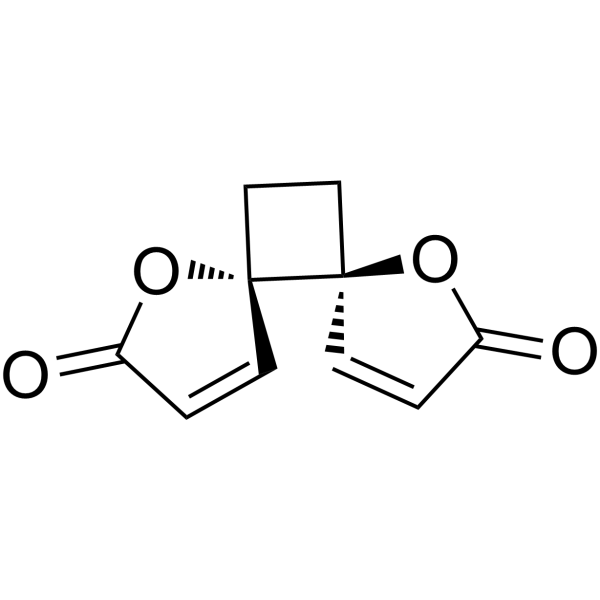
Anemonin (Pulsatilla camphor), a selective iNOS inhibitor, is also a PKC-θ inhibitor. Anemonin can significantly inhibit the translation or protein stability of PKC-θ protein. Anemonin also ameliorates dextran sodium sulfate-induced acute ulcerative colitis (UC) in mice. Anemonin can be used in the research of inflammation-related diseases .
Cat. No.: HY-171130
Target:  

MicroRNA

Research Areas:  

Others

Cy3 MicroRNA Antagomir Negative Control is a Cy3-labeled MicroRNA Antagomir Negative Control (HY-RI04602A). The sequence of MicroRNA Antagomir Negative Control is derived from cel-mir-239b. It has minimal sequence identity with miRNAs in human, mouse, and rat .
Cat. No.: HY-R04602F1
Target:  

MicroRNA

Research Areas:  

Cancer

Cy5-MicroRNA Mimic Negative Control is a Cy5 labeled MicroRNA Mimic Negative Control (HY-R04602). MicroRNA Mimic Negative Control is a miRNA mimic of 21-nucleotides, and can be used as a negative control. The sequence of MicroRNA Mimic Negative Control is derived from cel-mir-239b. It has minimal sequence identity with miRNAs in human, mouse, and rat.
Cat. No.: HY-RI04602C
Target:  

MicroRNA

Research Areas:  

Others

FAM-MicroRNA Inhibitor Negative Control is a FAM labeled FAM-MicroRNA Inhibitor Negative Control (HY-RI04602). MicroRNA Inhibitor Negative Control is a full-length nucleotide 2'-methoxy modified oligonucleotide, and can be used as a negative control. The sequence of MicroRNA Inhibitor Negative Control is derived from cel-mir-239b. It has minimal sequence identity with miRNAs in human, mouse, and rat.
Cat. No.: HY-P991647

Target:  

CXCR

Research Areas:  

Cancer

ALX-0651 is a biparatopic humanized monoclonal antibody inhibitor targeting CXCR4. ALX-0651 inhibits hematopoietic stem cell trafficking, tumor progression and metastasis. ALX-0651 can be used for non-Hodgkin’s lymphoma and multiple myeloma research .
Cat. No.: HY-RS02454
Research Areas:  

Others

CEL Human Pre-designed siRNA Set A contains three designed siRNAs for CEL gene (Human), as well as a negative control, a positive control, and a FAM-labeled negative control.

Cat. No.: HY-RS17119
Research Areas:  

Others

Cel Mouse Pre-designed siRNA Set A contains three designed siRNAs for Cel gene (Mouse), as well as a negative control, a positive control, and a FAM-labeled negative control.

Cat. No.: HY-RS23564
Research Areas:  

Others

Cel Rat Pre-designed siRNA Set A contains three designed siRNAs for Cel gene (Rat), as well as a negative control, a positive control, and a FAM-labeled negative control.

Cat. No.: HY-162407
CAS No.: 2891500-11-9
Target:  

Btk

Research Areas:  

Cancer

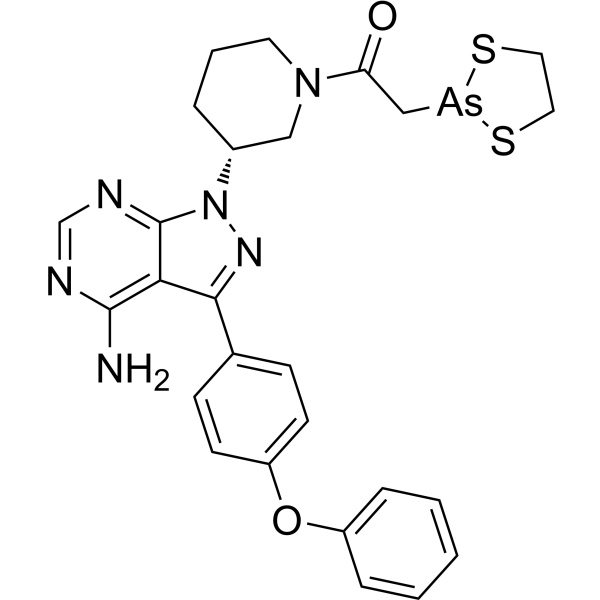
I-As-1 is a potent inhibitor of Bruton’s tyrosine kinase (BTK), with the IC50 of 2.35 nM. I-As-1 shows antiproliferative activities among Ramos cells and OCI-LY10 cells with IC50s of 0.52 μM and 0.11 μM, respectively .
Cat. No.: HY-P74352
Purity:  ≥ 90%, as determined by reducing SDS-PAGE.
Synonyms: Bile salt-activated lipase; BAL; BSSL; CEL; Lip1
Species:  
Source:  
Cat. No.: HY-R04638
Target:  

MicroRNA

Research Areas:  

Others

cel-miR-39-3p mimics are small, chemically synthesized double-stranded RNAs that mimic endogenous miRNAs and enable miRNA functional analysis by up-regulation of miRNA activity.
Cat. No.: HY-186140
SHP1‑IN‑2 is a selective and orally active SHP1 inhibitor. SHP1‑IN‑2 covalently binds to Cys480 of SHP1. SHP1‑IN‑2 elicits potent antitumor immunity and suppresses syngeneic tumor growth. SHP1‑IN‑2 blocks tumor progression in a svngeneic cancer model by activating natural killer cells and cytotoxic CD8 T cells, along with reduced T cel l. SHP1‑IN‑2 can be used for cancer‑related research .
  • 1

