5 Results for "

Complex III-IN-2

" in MedChemExpress (MCE) Product Catalog:
Products (5)

5 Results for "Complex III-IN-2" in MCE Product Catalog:

2
2 Cited Publications
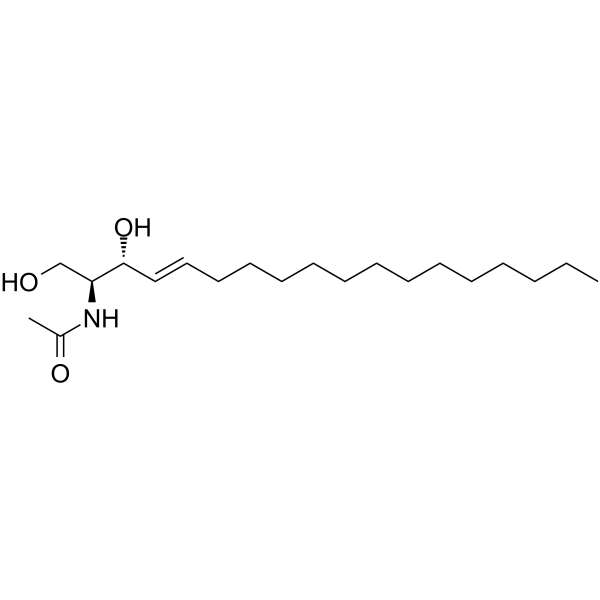
Cat. No.: HY-101180
CAS No.: 3102-57-6
Purity:  99.85%
Synonyms: Ceramide 2
C2 Ceramide (Ceramide 2) is the main lipid of the stratum corneum and a protein phosphatase 1 (PP1) activator. C2 Ceramide activates PP2A and ceramide-activated protein phosphatase (CAPP). C2 Ceramide induces cells differentiation, autophagy and apoptosis, inhibits mitochondrial respiratory chain complex III. C2 Ceramide is also a skin conditioning agent that protects the epidermal barrier from water loss .
loading...
    loading...
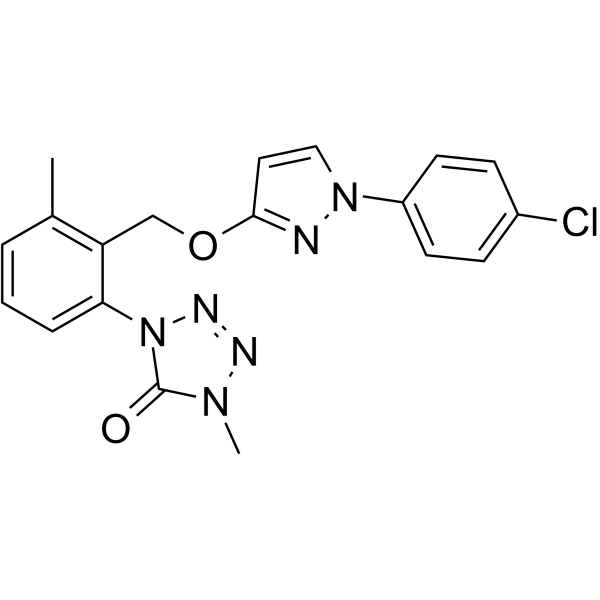
Cat. No.: HY-146145
CAS No.: 1472649-01-6
Purity:  99.53%
Research Areas:  

Infection

Metyltetraprole is a promising fungicide with EC50 values of both 0.002 ppm against sensitive wild-type and G143A mutant of Zymoseptoria tritici. Metyltetraprole is effective against QoI (quinone outside inhibitor) resistant strains. Metyltetraprole inhibits the respiratory chain via complex III .
loading...
    loading...
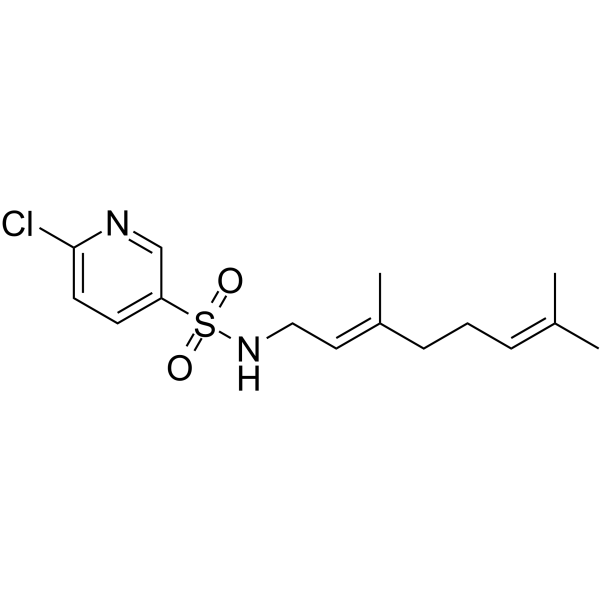
Cat. No.: HY-115946
Research Areas:  

Infection

Complex III-IN-2 (Compd 4d-2) is a complex III inhibitor. Complex III-IN-2 shows antifungal activity with an EC50 of 29.98 mg/L and 29.31 mg/L against sclerotinia sclerotiorum and R. solani, respectively .
loading...
    loading...
Cat. No.: HY-W012232
CAS No.: 3558-69-8
Research Areas:  

Others

2,6-Diphenylpyridine is a proton acceptor (log(P) = 5) and a tridentate [C^N^C] dianionic ligand. 2,6-Diphenylpyridine efficiently transfers protons through a direct pathway at the interface of two immiscible electrolyte solutions. 2,6-Diphenylpyridine as a tridentate ligand and can form mononuclear and binuclear complexes with gold(III). 2,6-Diphenylpyridin is applicable to research in electrochemical ion transfer kinetics and organometallic chemistry .
loading...
    loading...
Cat. No.: HY-129795
CAS No.: 119433-80-6
Research Areas:  

Cancer

Thiazolylalanine is a synthetic non-protein amino acid containing a thiazole heterocycle. Thiazolylalanine exhibits dual activities of stimulating protein synthesis and inducing protein degradation in rat reticulocytes, but exerts no effects on protein metabolism or the thermolability of phosphoenolpyruvate carboxykinase in hepatoma cells. Thiazolylalanine can serve as the N-terminal component of tripeptide ligands for the synthesis of various organometallic complexes such as gold, mercury, CyRu (II) Cl2, and Cp*Rh (III) Cl2. Thiazolylalanine finds wide application in the research of breast cancer and other related diseases .
loading...
    loading...

