8 Results for "

KYSE-30

" in MedChemExpress (MCE) Product Catalog:
Products (8)

8 Results for "KYSE-30" in MCE Product Catalog:

Cat. No.: HY-120548
CAS No.: 1143863-69-7
Purity:  99.52%
Research Areas:  

Cancer

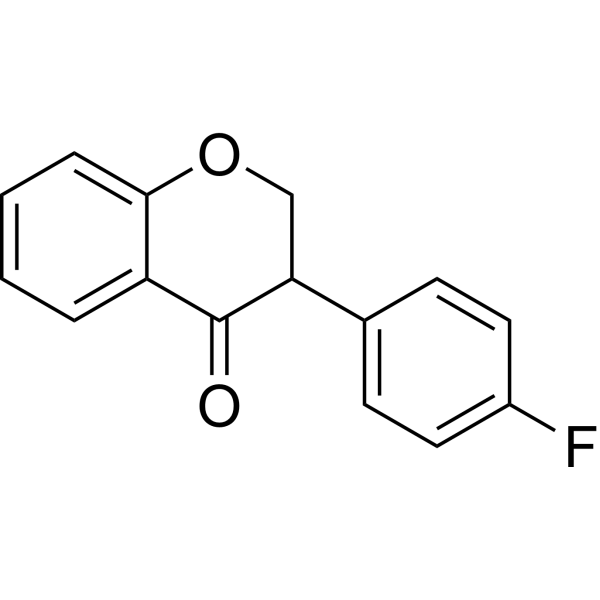
KBU2046 is an orally active transforming growth factor-β (TGF-β1) inhibitor. KBU2046 reduces integrin family protein expression, decreases Raf, RIPK1 and ERK phosphorylation to deactivate the ERK signaling pathway, and down-regulates genes linked to TGF-β1 maturation. KBU2046 suppresses tumor cell motility, impedes cancer invasion and metastasis, and inhibits human ESCC growth and metastasis in a murine model. KBU2046 can be used for the researches of triple-negative breast cancer and esophageal squamous cell carcinoma .
loading...
    loading...
Cat. No.: HY-178962
Target:  

Drug Metabolite

Research Areas:  

Cancer

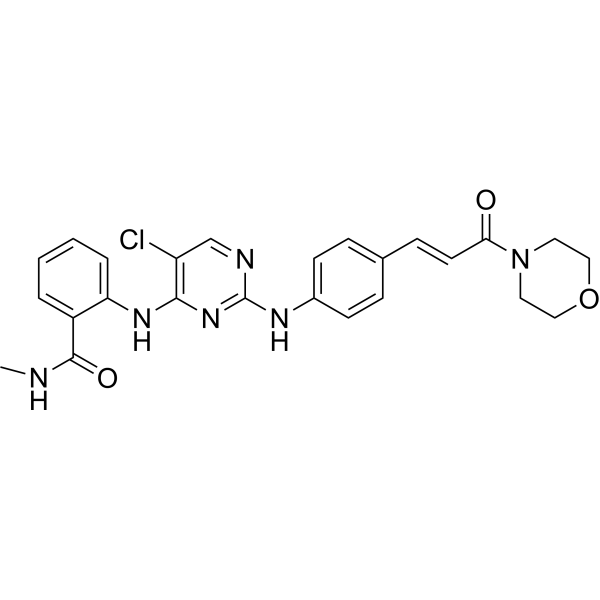
Antitumor agent-207 (compound 10K) is a Pt(IV)-NO prodrug with high lipid solubility, good stability, and excellent tumor targeted release ability. Antitumor agent-207 has significant anti proliferative activity in various cells such as TE-1 (IC50 = 1.79 μM), TE-10 (IC50 = 1.95 μM), KYSE-30 IC50 = 5.99 μM), KYSE-520 (IC50 = 5.53 μM) cells. Antitumor agent-207 can significantly enhance intracellular Pt accumulation and DNA platformization levels, and effectively release NO. Antitumor agent-207 can be used for research on cancers such as esophageal cancer .
loading...
    loading...
Cat. No.: HY-156334
Target:  

FAK

Research Areas:  

Cancer

FAK-IN-12 (Compound 12S) is a FAK inhibitor (IC50 = 47 nM). FAK-IN-12 inhibits MGC-803, HCT-116 and KYSE30 cell proliferation (IC50: 0.24, 0.45, 0.44 μM). FAK-IN-12 induces apoptosis and cellular senescence .
loading...
    loading...
Cat. No.: HY-170936
Target:  

FAK Hippo (MST) YAP

Research Areas:  

Cancer

MY-1576 is a FAK inhibitor with an IC50 of 8 nM. MY-1576 can activate the Hippo pathway, thereby blocking the regulation of YAP/TAZ. MY-1576 also effectively inhibits tumor growth in the KYSE30 xenograft mouse model, demonstrating good safety, and effectively downregulates the autophosphorylation of FAK and the levels of YAP/TAZ in vivo .
loading...
    loading...
Cat. No.: HY-172878
CAS No.: 3062141-62-9
Research Areas:  

Cancer

HDAC/PSMD14-IN-1 (Compound 8B) is a thiolutin derivative. HDAC/PSMD14-IN-1 is a orally active dual-target inhibitor of PSMD14/HDAC1 (IC50 238.7 nM/141.2 nM, respectively). HDAC/PSMD14-IN-1 has good cytotoxicity against ESCC cell lines (IC50: 30-250 nM) and effectively reverses epithelial-mesenchymal transition (EMT). HDAC/PSMD14-IN-1 can induce apoptosis. HDAC/PSMD14-IN-1 has anti-tumor activity in a KYSE30 cell mouse xenograft model. HDAC/PSMD14-IN-1 can be used in anti-esophageal cancer research .
loading...
    loading...
Cat. No.: HY-169412
CAS No.: 2848599-79-9
MAPK-IN-3 (Compound 4a) is an anti-proliferative agent that shows particularly strong inhibitory effects on KYSE 30, HCT 116, and HGC 27, with IC50 values of 0.57 μM, 3.27 μM, and 2.28 μM, respectively. MAPK-IN-3 blocks the cell cycle via a p53-dependent mechanism and induces cell apoptosis through a p53-independent mechanism. MAPK-IN-3 downregulates the expression of cell cycle-related proteins like Cyclin D1 and cyclin B1, upregulates pro-apoptotic proteins such as cleaved PARP, cleaved caspase-7, and cleaved caspase-9, and reduces the expression of anti-apoptotic proteins like Bcl-2. Additionally, MAPK-IN-3 increases the intracellular level of ROS in KYSE 30 cells and upregulates the expression of members of the MAPK signaling pathway associated with ROS, such as p-ERK, p-p38 and p-JNK .
loading...
    loading...
Cat. No.: HY-163524
Target:  

Apoptosis

Research Areas:  

Cancer

NAE-IN-2 (compound III-26) is N2–(1-benzylpiperidin-4-yl)quinazoline-2,4-diamine derivative, and inhibits Cullin1 and Cullin3. NAE-IN-2 inhibits migration and induces cell apoptosis of gastric cancer cells .
loading...
    loading...
Cat. No.: HY-184535
CAS No.: 3008320-14-4
PDIC-DPC is a HMGA1 inhibitor and lung-targeting agent. PDIC-DPC upregulates STING expression and enhances STING-mediated immune signaling. PDIC-DPC inhibits the TGFβ-Smad pathway and activates AMPK. PDIC-DPC forms nanocomplexes with fibrinogen β chain and vitronectin, and achieves lung-specific accumulation by binding to pulmonary endothelial receptors. PDIC-DPC reverses established pulmonary fibrosis, reduces collagen deposition, restores alveolar structure, improves pulmonary function, and inhibits in situ ESCC growth. PDIC-DPC can be used for the research of esophageal squamous cell carcinoma and idiopathic pulmonary fibrosis .
loading...
    loading...

