1. Search Result
Search Result
Results for "

RET-driven cancers

" in MedChemExpress (MCE) Product Catalog:
Cat. No. Product Name Target Research Areas Chemical Structure
  • HY-132846

    TAS0953/HM06

    RET Apoptosis Cancer
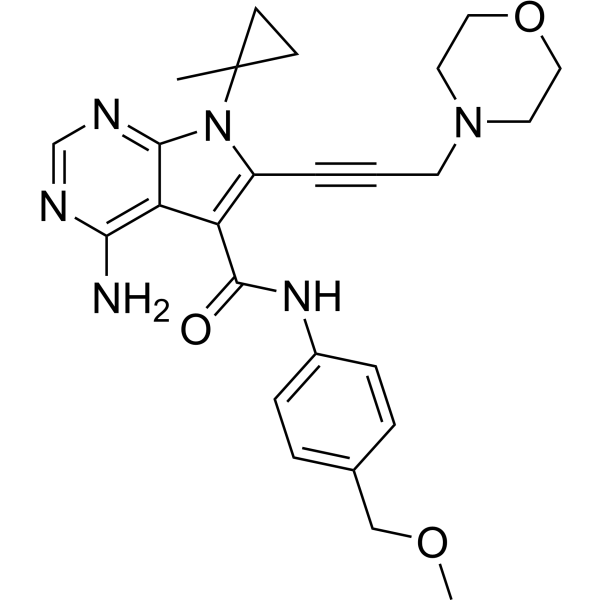
    Vepafestinib (TAS0953/HM06) is a next-generation brain-penetrant, selective and orally active RET inhibitor with an IC50 value of 0.33 nM. Vepafestinib inhibits the phosphorylation of RET and its downstream signaling pathways, thus blocking the growth and signal transduction of tumor cells and inducing cell cycle arrest and apoptosis. Vepafestinib can be used in the research of various RET-driven cancers, such as non-small cell lung cancer, thyroid cancer and other disease areas .
    Vepafestinib
  • HY-178061

    ERK RET Cancer
    APS03118 is an orally active, potent and selective rearranged during transfection (RET) inhibitor. APS03118 broadly inhibits RET fusions and mutations (including G810, V804, L730, and Y806 variants), with IC50 values predominantly below 1 nM (0.095 nM for WT; ranging from 0.00438 to 5.72 nM for mutants), and demonstrates marked superiority against RET G810 mutations. APS03118 inhibits the entire RET signaling pathway (including RET, Shc, and ERK1/2), with >20-fold selectivity over most off-target kinases (except FLT3 and YES). APS03118 induces complete tumor regression in KIF5B-RET and CCDC6-RET V804 M patient derived xenografts (PDXs) and significantly prolongs survival in an intracranial CCDC6-RET metastasis mice model. APS03118 can be used for selective RET inhibitor (SRI)-resistant, RET-driven cancer research .
    APS03118
  • HY-174993

    RET Cancer
    FHND5071 (1H) is a selective inhibitor targeting the RET (rearrangement during transfection) tyrosine kinase. FHND5071 (1H) is promising for research of RET-driven cancers (such as thyroid cancer, lung cancer, etc.) .
    FHND5071 (1H)
  • HY-170855A

    PROTACs RET Cancer
    YW-N-7 (TFA) is a PROTAC that targets both the inhibition and degradation of RET kinase, with a DC50 of 88 nM. YW-N-7 (TFA) exhibits antitumor activity in a KIF5B-RET-driven xenograft mouse tumor model and can be used in the area of cancer (Structure: red part represents the target protein ligand: HY-170856; blue part represents the E3 ligase ligand: HY-1708557; black part represents the linker; E3 ligase ligand + linker: HY-170858) .
    YW-N-7 TFA
  • HY-181895

    RET Cancer
    PROTAC HyTTD Degrader-1 (Compound B2) is a hydrophobic tag tethered degrader (HyTTD) targeting RET, as well as a degrader of the CCDC6-RET fusion protein. PROTAC HyTTD Degrader-1 induces the degradation of the CCDC6-RET fusion protein via the ubiquitin-proteasome pathway. PROTAC HyTTD Degrader-1 is applicable to the research of RET-driven cancers .
    PROTAC HyTTD Degrader-1
  • HY-183931

    RET VEGFR Trk Receptor c-Fms Cancer
    NPA101.3 is an orally active RET receptor tyrosine kinase and VEGFR2 inhibitor (RET IC50 = 0.001 μM, RET V804M IC50 = 0.008 μM, VEGFR2 IC50 = 0.003 μM). NPA101.3 inhibits purified TRKA (IC50 = 32 nM) and CSF1R (IC50 = 46 nM). NPA101.3 completely suppresses tumor formation in RET /C634Y-transformed cells and also attenuates tumor formation in HRAS /G12V-transformed cells. NPA101.3 can be used in the research of RET-driven cancers .
    NPA101.3
  • HY-183684

    RET VEGFR PDGFR Akt ERK Endocrinology Cancer
    RET-IN-33 (Compound CN-3) is a moderately selective inhibitor of RET mutants. RET-IN-33 potently inhibits G810 mutants, with IC50 values of 4.43 nM (G810R), 3.28 nM (G810C) and 0.51 nM (G810S), respectively. RET-IN-33 also inhibits other RET mutants: V804M (IC50 0.73 nM), V804L (IC50 0.36 nM), Y806H (IC50 0.74 nM) and M918T (IC50 0.55 nM). RET-IN-33 also inhibits other kinases, with an IC50 of 1.50 nM against VEGFR2 and 1.60 nM against PDGFRα. RET-IN-33 blocks the autophosphorylation of RET mutants and the downstream SHC/AKT/ERK signaling pathway. RET-IN-33 selectively inhibits the proliferation of RET-driven cell models without affecting non-RET-dependent or normal cells. RET-IN-33 exhibits dose-dependent antitumor efficacy in RET-driven xenograft models. RET-IN-33 can be used for the research of medullary thyroid carcinoma, papillary thyroid carcinoma and non-small cell lung cancer .
    RET-IN-33

Inquiry Online

Your information is safe with us. * Required Fields.

Salutation


Country or Region *

Applicant Name *


Organization Name *

Department *


Email Address *


Product Name *

Cat. No.


Requested quantity *

Phone Number *


Remarks

Inquiry Online

Inquiry Information

Product Name:
Cat. No.:
Quantity:
MCE Japan Authorized Agent:

