12 Results for "

TLR+agonists

" in MedChemExpress (MCE) Product Catalog:
Products (12)

12 Results for "TLR+agonists" in MCE Product Catalog:

3
3 Cited Publications
Cat. No.: HY-101929
CAS No.: 2109805-75-4
Purity:  99.00%
Research Areas:  

Inflammation/Immunology Cancer

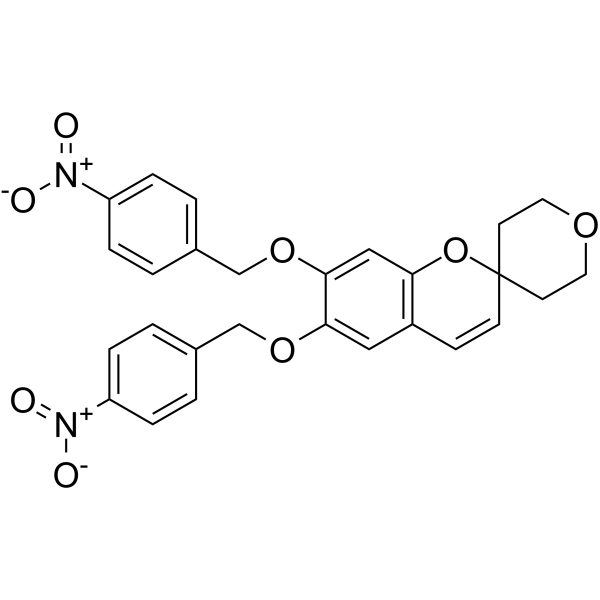
CU-CPT17e is a potent multi-Toll-like receptor (TLR) agonist that activates TLR3, TLR8, and TLR9.
loading...
    loading...
1
1 Cited Publications
Cat. No.: HY-W782032
CAS No.: 1699735-79-9
Synonyms: 3D-MPLA-5
3D-Monophosphoryl Lipid A-5 (3D-MPLA-5) is a TLR agonist that serves as a vaccine adjuvant and enhances the immunogenicity of vaccines .
loading...
    loading...
Cat. No.: HY-148555
CAS No.: 2479277-22-8
Research Areas:  

Cancer

AXC-879, a TLR agonist (EC50: 157.2 nM). AXC-879 is an ADC Cytotoxin and can be used for ADC synthesis .
loading...
    loading...
Cat. No.: HY-W782032A
CAS No.: 1465797-24-3
Synonyms: 3D-MPLA-5 free acid
Research Areas:  

Inflammation/Immunology

3D-Monophosphoryl Lipid A-5 (free acid) is a TLR agonist that can be used as a vaccine adjuvant to enhance the immunogenicity of vaccines .
loading...
    loading...
Cat. No.: HY-159671B
Synonyms: 3D-MPL (14) ammonium
Research Areas:  

Inflammation/Immunology

3D-Monophosphoryl Lipid (14) (3D-MPL (14)) ammonium is a TLR agonist that can be used as a vaccine adjuvant to enhance the immunogenicity of vaccines .
loading...
    loading...
Cat. No.: HY-159913
CAS No.: 3031612-92-4
Research Areas:  

Inflammation/Immunology

AYK004-C1 is a TLR agonist. AYK004-C1 can be used to prepare immune adjuvants .
loading...
    loading...
Cat. No.: HY-W782032B
Synonyms: 3D-MPLA-5 triethylamine
Research Areas:  

Inflammation/Immunology

3D-Monophosphoryl Lipid A-5 (3D-MPLA-5) triethylamine is a TLR agonist that can be used as an adjuvant for vaccines to enhance their immunogenicity .
loading...
    loading...
Cat. No.: HY-P990239

Research Areas:  

Inflammation/Immunology Cancer

Anti-Human/Mouse GRP78 Antibody (N88) is an anti-human/mouse GRP78 IgG1 monoclonal antibody. Anti-Human/Mouse GRP78 Antibody (N88) can activate the Akt signaling pathway. Anti-Human/Mouse GRP78 Antibody (N88) can inhibit the expression of inflammatory factors and plasminogen activator inhibitors induced by TLR agonists. Anti-Human/Mouse GRP78 Antibody (N88) can be used for research on inflammation conditions. Anti-Human/Mouse GRP78 Antibody (N88) can be used for immunoprecipitation .
loading...
    loading...
Cat. No.: HY-159753
Research Areas:  

Inflammation/Immunology

HS105 is a vaccine adjuvant and a key component in vaccines. Adjuvants can be divided into immunostimulants and delivery systems. Adjuvants can not only enhance the intensity and durability of immune responses, but also affect the type of immune responses. On the one hand, immunostimulants promote the production of antigen signals and co-stimulatory signals by targeting Toll-like receptors (TLRs) and other pattern recognition receptors (PRRs), leading to the maturation and activation of antigen presenting cells (APCs), thereby enhancing adaptive immune responses; on the other hand, delivery systems are carrier materials that promote antigen delivery by prolonging the bioavailability of loaded antigens and targeting antigens to lymph nodes or APCs. Several common adjuvants include: saponins, TLRs agonists, polysaccharides, nanoparticles, cytokines, and mucosal adjuvants .
loading...
    loading...
Cat. No.: HY-101929R
CAS No.: 2109805-75-4
CU-CPT17e (Standard) is the analytical standard of CU-CPT17e (HY-101929). This product is intended for research and analytical applications. CU-CPT17e is a potent multi-Toll-like receptor (TLR) agonist that activates TLR3, TLR8, and TLR9.
loading...
    loading...
Cat. No.: HY-159751
Research Areas:  

Inflammation/Immunology

HS101 is a vaccine adjuvant and a key component in vaccines. Adjuvants can be divided into immunostimulants and delivery systems. Adjuvants can not only enhance the intensity and durability of immune responses, but also affect the type of immune responses. On the one hand, immunostimulants promote the production of antigen signals and co-stimulatory signals by targeting Toll-like receptors (TLRs) and other pattern recognition receptors (PRRs), leading to the maturation and activation of antigen presenting cells (APCs), thereby enhancing adaptive immune responses; on the other hand, delivery systems are carrier materials that promote antigen delivery by prolonging the bioavailability of loaded antigens and targeting antigens to lymph nodes or APCs. Several common adjuvants include: saponins, TLRs agonists, polysaccharides, nanoparticles, cytokines, and mucosal adjuvants .
loading...
    loading...
Cat. No.: HY-159752
HS103 is a vaccine adjuvant and a key component in vaccines. Adjuvants can be divided into immunostimulants and delivery systems. Adjuvants can not only enhance the intensity and durability of immune responses, but also affect the type of immune responses. On the one hand, immunostimulants promote the production of antigen signals and co-stimulatory signals by targeting Toll-like receptors (TLRs) and other pattern recognition receptors (PRRs), leading to the maturation and activation of antigen presenting cells (APCs), thereby enhancing adaptive immune responses; on the other hand, delivery systems are carrier materials that promote antigen delivery by prolonging the bioavailability of loaded antigens and targeting antigens to lymph nodes or APCs. Several common adjuvants include: saponins, TLRs agonists, polysaccharides, nanoparticles, cytokines, and mucosal adjuvants .
loading...
    loading...
  • 1

