10 Results for "

adaptive immune system

" in MedChemExpress (MCE) Product Catalog:
Products (10)

10 Results for "adaptive immune system" in MCE Product Catalog:

13
13 Cited Publications
Cat. No.: HY-110353
CAS No.: 1821387-73-8
Purity:  99.96%
Research Areas:  

Inflammation/Immunology Cancer

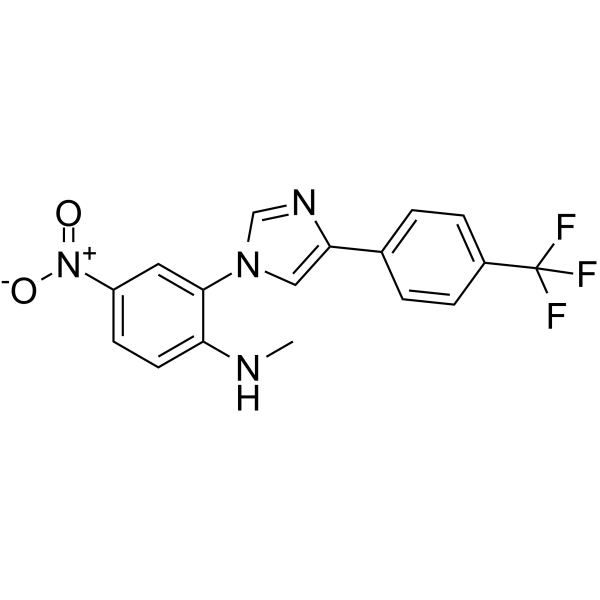
CU-T12-9 is a specific TLR1/2 agonist with EC50 of 52.9 nM in HEK-Blue hTLR2 SEAP assay. CU-T12-9 activates both the innate and the adaptive immune systems. CU-T12-9 selectively activates the TLR1/2 heterodimer, not TLR2/6. CU-T12-9 signals through NF-κB and invokes an elevation of the downstream effectors TNF-α, IL-10, and iNOS .
loading...
    loading...
Cat. No.: HY-148420
CAS No.: 2586047-09-6
Target:  

STING

Research Areas:  

Inflammation/Immunology

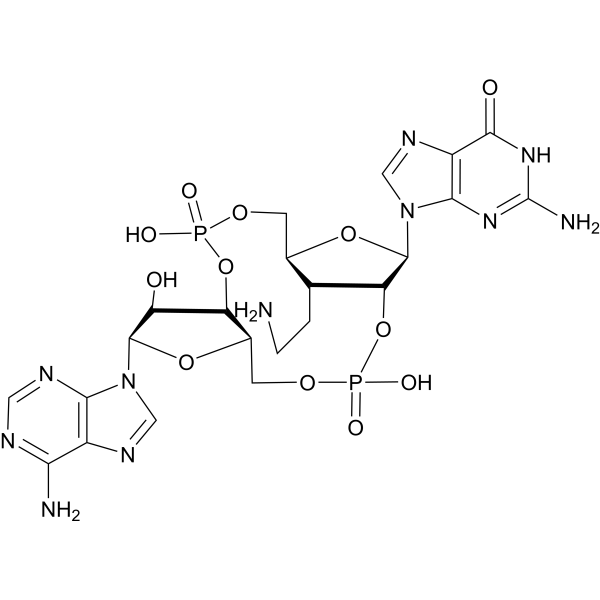
CDN-A is a cyclic di-nucleotide, it can be used to synthesis antibody-drug conjugate (ADC). Cyclic di-nucleotides are potent stimulators of innate and adaptive immune responses. In humans, cyclic di-nucleotide, which are either produced endogenously in response to foreign DNA or by invading bacterial pathogens, trigger the innate immune system by activating the expression of interferon genes .
loading...
    loading...
Cat. No.: HY-144002
CAS No.: 216014-46-9
Synonyms: RC-529
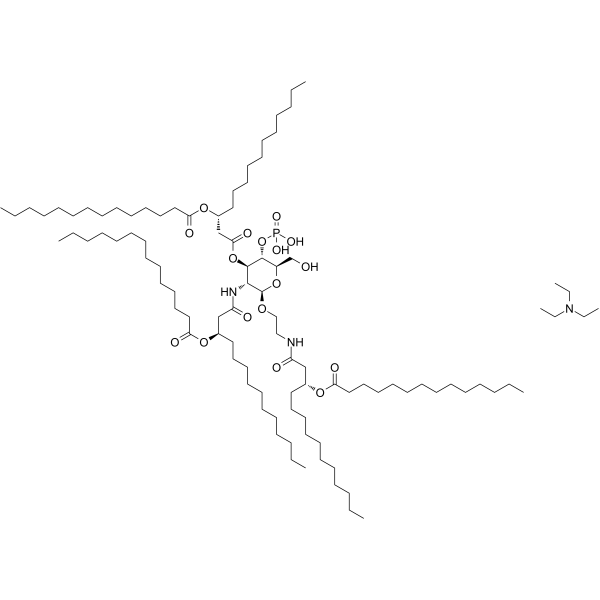
RIBI-529 (RC-529) is a fully synthetic, low-toxicity TLR4 agonist vaccine adjuvant. RIBI-529 upregulates cell surface co-stimulatory molecules, receptors, cytokines and chemokines, and activates the innate immune system. RIBI-529 enhances short-term CD4 + T cell clonal expansion, division, and ex vivo survival under growth factor withdrawal conditions. RIBI-529 enhances humoral and cell-mediated adaptive immune responses, induces non-specific resistance against viral and bacterial pathogens, and skews responses toward a Th1 type, accompanied by Th2 responses .
loading...
    loading...
Cat. No.: HY-174662
Target:  

mRNA

Research Areas:  

Inflammation/Immunology

Human IFNG mRNA encodes the human interferon gamma (IFNG) protein, a member of the type II interferon class. IFNG is secreted by cells of both the innate and adaptive immune systems. The active protein is a homodimer that binds to the interferon gamma receptor which triggers a cellular response to viral and microbial infections.
loading...
    loading...
Cat. No.: HY-159753
Research Areas:  

Inflammation/Immunology

HS105 is a vaccine adjuvant and a key component in vaccines. Adjuvants can be divided into immunostimulants and delivery systems. Adjuvants can not only enhance the intensity and durability of immune responses, but also affect the type of immune responses. On the one hand, immunostimulants promote the production of antigen signals and co-stimulatory signals by targeting Toll-like receptors (TLRs) and other pattern recognition receptors (PRRs), leading to the maturation and activation of antigen presenting cells (APCs), thereby enhancing adaptive immune responses; on the other hand, delivery systems are carrier materials that promote antigen delivery by prolonging the bioavailability of loaded antigens and targeting antigens to lymph nodes or APCs. Several common adjuvants include: saponins, TLRs agonists, polysaccharides, nanoparticles, cytokines, and mucosal adjuvants .
loading...
    loading...
Cat. No.: HY-L031
813 compounds

Immuno-Oncology is a type of immunotherapy that has the specific purpose of treating cancer. It works by stimulating our immune system to fight back. Normally, our immune system is able to destroy cancer cells in our body, however sometimes cancer cells can adapt and mutate, effectively hiding from our immune system. This is when tumors can develop and become a threat to our health. Immuno-oncology involves mobilizing lymphocytes to recognize and eliminate cancer cells using the body’s immune system. There are several immuno-oncology treatments available, including Immune cell therapy (CAR-T), monoclonal antibodies (mABs) and checkpoint inhibitors, cytokines and cancer vaccines.

MCE Small Molecule Immuno-Oncology Compound Library offers 813 bioactive tumor immunology compounds that target some important checkpoints such as PD1/PD-L1, CXCR, Sting, IDO, TLR, etc. This library is a useful tool for Immuno-oncology research.

Cat. No.: HY-159751
Research Areas:  

Inflammation/Immunology

HS101 is a vaccine adjuvant and a key component in vaccines. Adjuvants can be divided into immunostimulants and delivery systems. Adjuvants can not only enhance the intensity and durability of immune responses, but also affect the type of immune responses. On the one hand, immunostimulants promote the production of antigen signals and co-stimulatory signals by targeting Toll-like receptors (TLRs) and other pattern recognition receptors (PRRs), leading to the maturation and activation of antigen presenting cells (APCs), thereby enhancing adaptive immune responses; on the other hand, delivery systems are carrier materials that promote antigen delivery by prolonging the bioavailability of loaded antigens and targeting antigens to lymph nodes or APCs. Several common adjuvants include: saponins, TLRs agonists, polysaccharides, nanoparticles, cytokines, and mucosal adjuvants .
loading...
    loading...
Cat. No.: HY-159752
HS103 is a vaccine adjuvant and a key component in vaccines. Adjuvants can be divided into immunostimulants and delivery systems. Adjuvants can not only enhance the intensity and durability of immune responses, but also affect the type of immune responses. On the one hand, immunostimulants promote the production of antigen signals and co-stimulatory signals by targeting Toll-like receptors (TLRs) and other pattern recognition receptors (PRRs), leading to the maturation and activation of antigen presenting cells (APCs), thereby enhancing adaptive immune responses; on the other hand, delivery systems are carrier materials that promote antigen delivery by prolonging the bioavailability of loaded antigens and targeting antigens to lymph nodes or APCs. Several common adjuvants include: saponins, TLRs agonists, polysaccharides, nanoparticles, cytokines, and mucosal adjuvants .
loading...
    loading...
Cat. No.: HY-110353R
CAS No.: 1821387-73-8
CU-T12-9 (Standard) is the analytical standard of CU-T12-9 (HY-110353). This product is intended for research and analytical applications. CU-T12-9 is a specific TLR1/2 agonist with EC50 of 52.9 nM in HEK-Blue hTLR2 SEAP assay. CU-T12-9 activates both the innate and the adaptive immune systems. CU-T12-9 selectively activates the TLR1/2 heterodimer, not TLR2/6. CU-T12-9 signals through NF-κB and invokes an elevation of the downstream effectors TNF-α, IL-10, and iNOS .
loading...
    loading...
Cat. No.: HY-184379
CAS No.: 2358714-71-1
Target:  

HIV

Research Areas:  

Infection

SRI-37264 is a HIV-1 Nef inhibitor with a Kd value of 162 nM. SRI-37264 binds directly to HIV-1 Nef, disrupts the Nef·MHC-I·AP-1 μ1 complex, and inhibits the Nef-dependent enhancement of HIV-1 infectivity. SRI-37264 restores MHC-I expression on the surface of HIV-infected primary cells. SRI-37264 inhibits HIV-1 replication in primary macrophages. SRI-37264 is applicable to research related to HIV-1 infection .
loading...
    loading...

