8 Results for "

alpha helices

" in MedChemExpress (MCE) Product Catalog:
Products (8)

8 Results for "alpha helices" in MCE Product Catalog:

130
130 Cited Publications
Cat. No.: HY-12040
CAS No.: 488832-69-5
Purity:  99.80%
Synonyms: STA-4783
Research Areas:  

Cancer

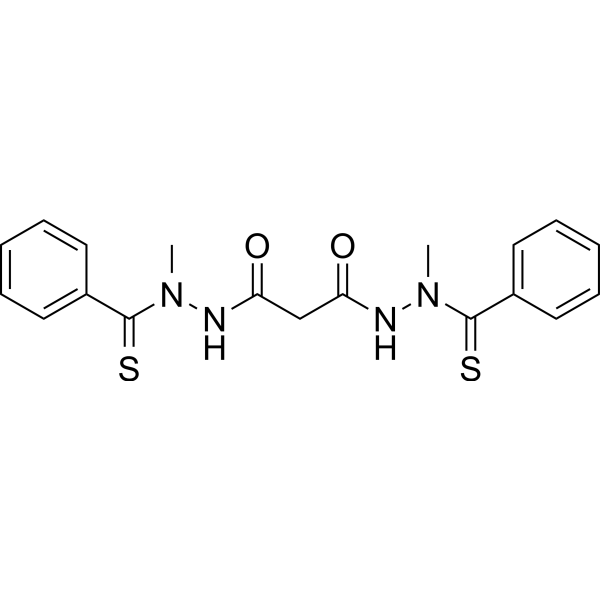
Elesclomol (STA-4783) is a potent copper ionophore and promotes copper-dependent cell death (cuproptosis). Elesclomol specifically binds ferredoxin 1 (FDX1) α2/α3 helices and β5 strand. Elesclomol inhibits FDX1-mediated Fe-S cluster biosynthesis. Elesclomol is an oxidative stress inducer that induces cancer cell apoptosis. Elesclomol is a reactive oxygen species (ROS) inducer. Elesclomol can be used for Menkes and associated disorders of hereditary copper deficiency research .
loading...
    loading...
Cat. No.: HY-P4371A
Target:  

Peptides

Research Areas:  

Others

Hel 13-5 TFA is a monomeric synthetic peptide based on the N-terminal fragment of human SP-B. Hel 13-5 TFA is mainly α-helical and consists of 13 hydrophobic amino acid residues and 5 hydrophilic amino acid residues. Hel 13-5 TFA can be combined with phospholipids for the development of a model system for pulmonary surfactant .
loading...
    loading...
Cat. No.: HY-12040S
Synonyms: STA-4783-d2
Elesclomol-d2 (STA-4783-d2) is a deuterium labeled Elesclomol (HY-12040). Elesclomol (STA-4783) is a potent copper ionophore and promotes copper-dependent cell death (cuproptosis). Elesclomol specifically binds ferredoxin 1 (FDX1) α2/α3 helices and β5 strand. Elesclomol inhibits FDX1-mediated Fe-S cluster biosynthesis. Elesclomol is an oxidative stress inducer that induces cancer cell apoptosis. Elesclomol is a reactive oxygen species (ROS) inducer. Elesclomol can be used for Menkes and associated disorders of hereditary copper deficiency research .
loading...
    loading...
Cat. No.: HY-158235
CAS No.: 2966803-96-1
Target:  

Tyrosinase

Research Areas:  

Others

Tyrosinase-IN-27 (compound 6f) is a tyrosinase (TYR) inhibitor (IC50: 0.88 μM) that statically quenches TYR. Tyrosinase-IN-27 increases the hydrophobicity of the enzyme microenvironment by binding to TYR, reducing the content of α-helices in the enzyme and changing its secondary structure. Tyrosinase-IN-27 can be used in the food industry to effectively inhibit the browning of lotus root slices. .
loading...
    loading...
Cat. No.: HY-184849
CAS No.: 7219-59-2
Research Areas:  

Others

Glu-Arg is a dipeptide linked by L-glutamic acid and L-arginine. Glu-Arg contributes to the construction of the hydrophobic network and maintenance of stability of mouse cAMP-dependent protein kinase; it acts as a core hub connecting the activation segment and the GHI subdomain in eukaryotic protein kinases, and promotes signal transmission between elements and within enzymes. As a salt bridge, Glu-Arg regulates the formation and unfolding rates of α-helices, and its optimized spatial conformation is conducive to the stability and folding rate of α-helices. Glu-Arg induces concentration-dependent intracellular calcium changes in cultured human fungiform taste bud cells .
loading...
    loading...
Cat. No.: HY-187388
HDAC6/ERα ligand-1 is a dual-target ligand with inhibitory activity against both estrogen receptor α (ERα) and histone deacetylase 6 (HDAC6). HDAC6/ERα ligand-1 can be used to synthesize PROTACs, such as PROTAC HDAC6/ERα degrader 1 (HY-187387). HDAC6/ERα ligand-1 binds to the ligand-binding pocket of ERα and forms hydrogen bonds with specific residues in helices 10, 11 and 12. HDAC6/ERα ligand-1 binds stably to HDAC6 and forms hydrogen bonds with specific residues of this protein. HDAC6/ERα ligand-1 can be used in breast cancer research .
loading...
    loading...
Cat. No.: HY-L0119V
3,253 compounds

Protein protein interactions (PPI) have pivotal roles in life processes. The studies showed that aberrant PPI are associated with various diseases. However, the design of modulators targeting PPI still faces tremendous challenges, such the difficult PPI interfaces for the drug design, lack of ligands reference, lack of guidance rules for the PPI modulators development and high-resolution PPI proteins structures.

The PPI Library comprises molecules of various sizes, frameworks, and shapes ranging from fragment-like entities to macrocyclic derivatives designed as secondary structure mimetics or as epitope mimetics. The designs cover β-turn / loop mimetics and α-helix mimetics. Since helices present at the interface in 62% of all protein-protein interactions. This library focused on designs including mimics with the substitution geometry of an a-helices, as well as designs that mimic the location of “hot-spot” side chains in helix-mediated PPIs.

Cat. No.: HY-187096
Research Areas:  

Cancer

ERα/RAD51 degrader 1 is a ERα and RAD51 HyT degrader as well as an apoptosis (Apoptosis) inducer. ERα/RAD51 degrader 1 induces conformational changes in helices 11-12 of ERα, promotes the recruitment of Hsp70, and drives the degradation of ERα and RAD51 via the ubiquitin-proteasome pathway. ERα/RAD51 degrader 1 downregulates the expression of BRCA1/2. ERα/RAD51 degrader 1 acts on tamoxifen (HY-13757A)-sensitive and tamoxifen-resistant breast cancer in both in vitro and in vivo models. ERα/RAD51 degrader 1 is applicable to breast cancer-related research (hydrophobic tag: (HY-B0402)) .
loading...
    loading...

