
10 Results for "

iNKT

" in MedChemExpress (MCE) Product Catalog:
Products (10)

10 Results for "iNKT" in MCE Product Catalog:

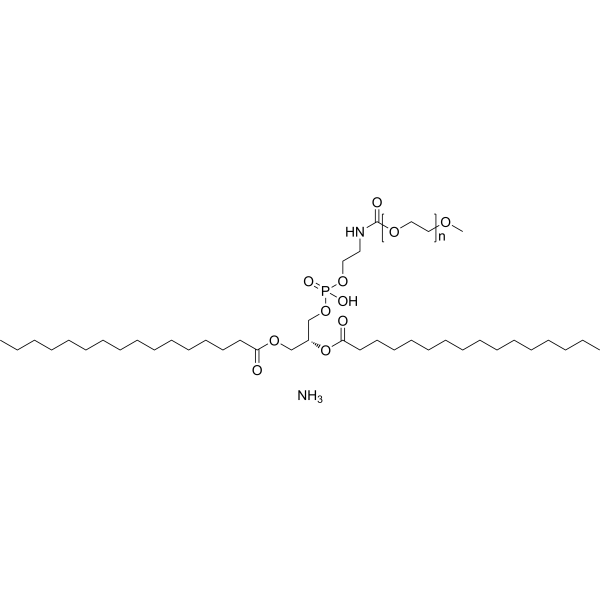
Cat. No.: HY-144012A
CAS No.: 474922-84-4
Synonyms: 16:0 PEG350 PE; 1,2-Dipalmitoyl-sn-glycero-3-phosphoethanolamine-N-[methoxy(polyethylene glycol)-350] ammonium
DPPE-PEG350 is a CD1d-dependent lipid antagonist thus blocking the ERK phosphorylation pathway in iNKT cells . DPPE-PEG350 is a PEG lipid functional end group used in the synthesis of liposomes (LPs) for the design of conjugated polymer nanoparticles.
loading...
    loading...
Cat. No.: HY-P990287

Target:  

CD1

Research Areas:  

Inflammation/Immunology

Anti-Mouse CD1d Antibody (19G11) is a rat-derived IgG1 type antibody inhibitor, targeting to mouse CD1d. Anti-Mouse CD1d Antibody (19G11) can neutralize CD1d and inhibit the activation of invariant natural killer T (iNKT) cells. Anti-Mouse CD1d Antibody (19G11) can be used for the researches of inflammation and immunology, such as colitis .
loading...
    loading...
Cat. No.: HY-P991667

Target:  

Inhibitory Antibodies

Research Areas:  

Cardiovascular Disease

NKTT 120 is a humanized monoclonal antibody against the iNKT cells. NKTT 120 is promising for research of sickle cell disease (SCD) .
loading...
    loading...
Cat. No.: HY-P990180
Anti-Mouse NKG2A/C/E Antibody (20D5) is an anti-mouse NKG2A/C/E IgG2a monoclonal antibody. Anti-Mouse NKG2A/C/E Antibody (20D5) can activate natural killer (NK) and CD8 + T cells. Anti-Mouse NKG2A/C/E Antibody (20D5) can exacerbate liver pathological damage by enhancing the activation of iNKT cells. Anti-Mouse NKG2A/C/E Antibody (20D5) can be used for researches on cancer and immunology such as lymphoma .
loading...
    loading...
Cat. No.: HY-P990807

Target:  

CD1

Anti-Mouse CD1d Antibody (20H2 (HB323)) is a rat-derived IgG1 κ type antibody inhibitor, targeting to mouse CD1d. Anti-Mouse CD1d Antibody (20H2 (HB323)) can block CD1d and neutralize invariant natural killer T (iNKT) cells. Anti-Mouse CD1d Antibody (20H2 (HB323)) can be used for the researches of cancer, infection, inflammation and immunology, such as melanoma, L. monocytogenes infection and arthritis .
loading...
    loading...
Cat. No.: HY-144120
Target:  

SARS-CoV

Research Areas:  

Infection

αGalCer-RBD is a self-adjuvanting lipoprotein conjugate. αGalCer-RBD induces potent immunity against SARS-CoV-2 and its variants of concern. αGalCer-RBD conjugate induces RBD-specific, cytokine-producing T cell development. αGalCer-RBD has great potential to be an effective COVID-19 vaccine candidate. α-Galactosylceramide (αGalCer) is a potent invariant natural killer T cell (iNKT) agonist . RBD: receptor-binding domain
loading...
    loading...
Cat. No.: HY-159902
CAS No.: 1384423-78-2
Target:  

Interleukin Related

Research Areas:  

Inflammation/Immunology Cancer

KRN7000 analog 3 (Compound 14),α-GalCer (HY-102022) analogue, is a iNKT agonist. KRN7000 analog 3 induces higher levels of IL-2 cytokine secretion (49.2-62.6 ng/mL) than a-GalCer (44.1 ng/mL) in mNK1.2 cells. KRN7000 analog 3 is promising for research of antitumor agents and vaccine adjuvants .
loading...
    loading...
Cat. No.: HY-P991854

Target:  

Interleukin Related

Research Areas:  

Inflammation/Immunology

Anti-iNKT Cell Antibody (6B11) recognizes an epitope on T cell receptor (TCR) V alpha 24-J alpha 18. Anti-iNKT Cell Antibody is specific for cloned and primary human but not rodent iNKT and the human invariant TCR-α. Recommend Isotype Controls: Mouse IgG1 kappa, Isotype Control (HY-P99977) .
loading...
    loading...
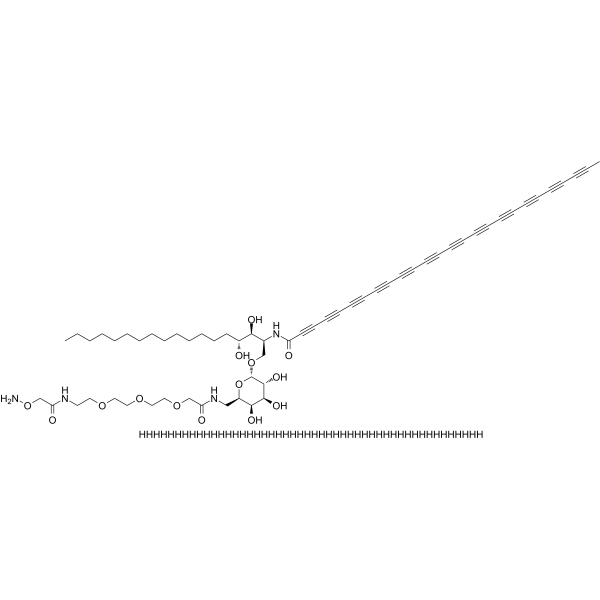
Cat. No.: HY-159874
Target:  

Interleukin Related

Research Areas:  

Cancer

KRN7000 analog 2 is a iNKT agonist, which is promising for research of antitumor agents and vaccine adjuvants.
loading...
    loading...
Cat. No.: HY-152940A
CAS No.: 1639008-30-2
Synonyms: C24:1 α-glucosylceramide
Target:  

Endogenous Metabolite

Research Areas:  

Inflammation/Immunology

αGlcCer is a glycosphingolipid, which was originally identified in marine sponges. αGlcCer is a lipid antigen for invariant natural killer T (iNKT) cells, and stimulates iNKT cells.
loading...
    loading...

