1. Search Result
Search Result
Results for "

incision

" in MedChemExpress (MCE) Product Catalog:

8

Inhibitors & Agonists

1

Peptides

1

Isotope-Labeled Compounds

Cat. No. Product Name Target Research Areas Chemical Structure
  • HY-111256

    mGluR Neurological Disease
    A-850002 is a metabotropic glutamate receptor (mGluR) antagonist (IC50=27 nM) that significantly attenuates spontaneous pain behavior after skin incision in rats. A-850002 can be used for analgesia research .
    A-850002
  • HY-135412

    Sodium Channel Neurological Disease
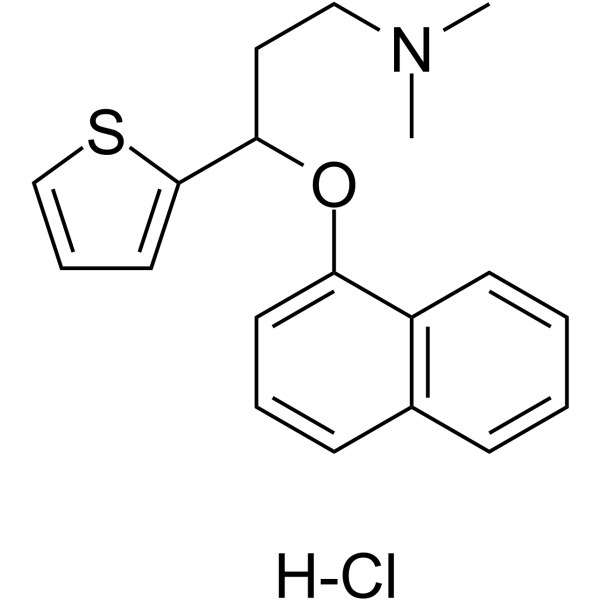
    N-Methyl Duloxetine hydrochloride is an analgesic. N-Methyl Duloxetine (hydrochloride) elicits both tonic and use-dependent block of neuronal Na + channels .
    N-Methyl Duloxetine hydrochloride
  • HY-14854A

    ATI-5923 sodium

    VKOR Cardiovascular Disease
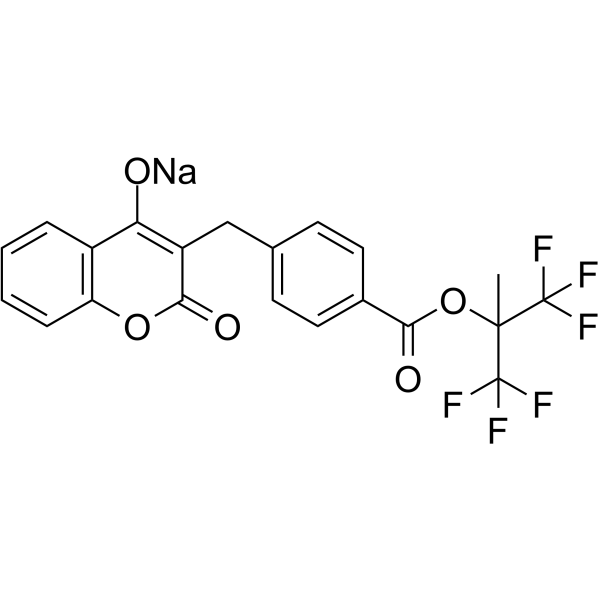
    Tecarfarin (ATI-5923) sodium is an orally active VKOR inhibitor with an IC50 of 0.67 μM against VKORC1. Tecarfarin sodium blocks the post-translational modification of vitamin K-dependent coagulation factors II, VII, IX and X, reducing their levels and activities. Tecarfarin sodium prolongs prothrombin time, attenuates venous and arterial thrombosis, increases ear incision bleeding volume, and exerts reversible anticoagulant effects. Tecarfarin sodium is applicable to research related to arterial and venous thrombosis as well as other diseases requiring anticoagulation .
    Tecarfarin sodium
  • HY-14854R

    ATI-5923 (Standard)

    Reference Standards VKOR Cardiovascular Disease
    Tecarfarin (ATI-5923) (Standard) is the analytical standard of Tecarfarin. This product is intended for research and analytical applications. Tecarfarin is an orally active VKOR inhibitor with an IC50 of 0.67 μM against VKORC1. Tecarfarin blocks the post-translational modification of vitamin K-dependent coagulation factors II, VII, IX and X, reducing their levels and activities. Tecarfarin prolongs prothrombin time, attenuates venous and arterial thrombosis, increases ear incision bleeding volume, and exerts reversible anticoagulant effects. Tecarfarin is applicable to research related to arterial and venous thrombosis as well as other diseases requiring anticoagulation .
    Tecarfarin (Standard)
  • HY-14854S

    ATI-5923-13C,d3

    Isotope-Labeled Compounds VKOR Cardiovascular Disease
    Tecarfarin- 13C,d3 (ATI-5923- 13C,d3) is 13C labeled Tecarfarin. Tecarfarin is an orally active VKOR inhibitor with an IC50 of 0.67 μM against VKORC1. Tecarfarin blocks the post-translational modification of vitamin K-dependent coagulation factors II, VII, IX and X, reducing their levels and activities. Tecarfarin prolongs prothrombin time, attenuates venous and arterial thrombosis, increases ear incision bleeding volume, and exerts reversible anticoagulant effects. Tecarfarin is applicable to research related to arterial and venous thrombosis as well as other diseases requiring anticoagulation .
    Tecarfarin-13C,d3
  • HY-P11480

    Trk Receptor Neurological Disease
    TrkA/NGF-IN-1 (Peptide 19) is an inhibitor of protein-protein interactions between TrkA and NGF (IC50: 21 nM for human TrkA in PathHunter assay). TrkA/NGF-IN-1 shows an analgesic effect in a rat incisional pain model .
    TrkA/NGF-IN-1
  • HY-W415753

    VUFB-15754

    Drug Derivative Neurological Disease Inflammation/Immunology
    Alaptide, a spirocyclic synthetic dipeptide and a derivative of melanocyte-stimulating hormone release-inhibiting factor (MIF), is a transdermal permeation modifier. Alaptide loaded on nanofibrous membranes accelerates the healing of skin incisions, particularly the healing of skin burns. Alaptide is a nootropic agent, that influences the dopaminergic system and increases homovanillic acid level in the striatum of rat models. Alaptide can be used for wound healing with large damaged areas and neurological diseases research .
    Alaptide
  • HY-114583

    TRP Channel Neurological Disease
    AMG-8562 is a TRPV1 modulator. AMG-8562 blocks Capsaicin (HY-10448) activation of TRPV1 without affecting heat activation of TRPV1. AMG-8562 potentiates pH 5 activation of TRPV1. AMG-8562 blocks capsaicin-induced flinching behavior in pain models. AMG-8562 produces significant efficacy in CFA- and skin incision-induced thermal hyperalgesia, and in the Acetic acid (HY-Y0319)-induced writhing models .
    AMG-8562

Inquiry Online

Your information is safe with us. * Required Fields.

Salutation


Country or Region *

Applicant Name *


Organization Name *

Department *


Email Address *


Product Name *

Cat. No.


Requested quantity *

Phone Number *


Remarks

Inquiry Online

Inquiry Information

Product Name:
Cat. No.:
Quantity:
MCE Japan Authorized Agent:

