



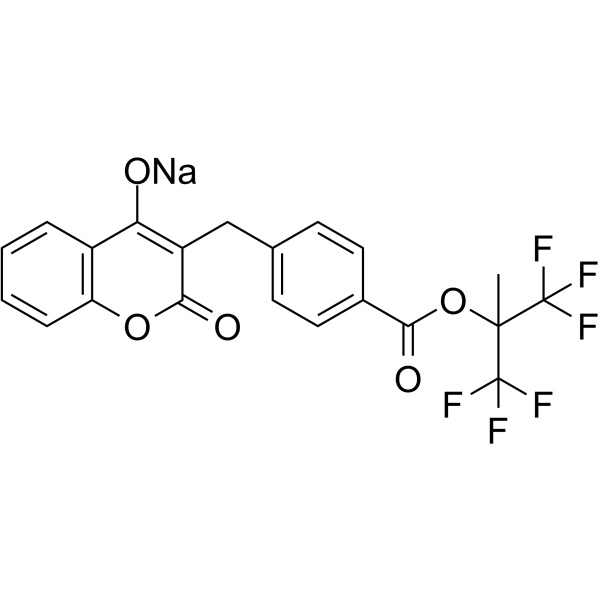
Tecarfarin sodium
Tecarfarin (ATI-5923) sodium is an orally active VKOR inhibitor with an IC50 of 0.67 μM against VKORC1. Tecarfarin sodium blocks the post-translational modification of vitamin K-dependent coagulation factors II, VII, IX and X, reducing their levels and activities. Tecarfarin sodium prolongs prothrombin time, attenuates venous and arterial thrombosis, increases ear incision bleeding volume, and exerts reversible anticoagulant effects. Tecarfarin sodium is applicable to research related to arterial and venous thrombosis as well as other diseases requiring anticoagulation.
Nur für Forschungszwecke. Wir verkaufen nicht an Patienten.
- CAS. Nr.: 1004551-83-0
- Formel: C21H13F6NaO5
- Molecular Weight:482.31
-
Speicherung:
Please store the product under the recommended conditions in the Certificate of Analysis.

To place orders, for customer services and technical support, please contact: MedChemExpress USA
Tel: 609-228-6898 E-mail: [email protected] [email protected]


-
 Biologische Aktivität
-
Chemical Information
- Reinheit & Dokumentation
- Verweise
-
 Help & FAQs




Biologische Aktivität
Beschreibung
IC50 & Target
VKOR[1]
In Vitro
Tecarfarin sodium inhibits CYP2C9-mediated metabolism in transfected cells[2].
Tecarfarin (0.01-100 μM; 20 min) sodium potently inhibits VKORC1 activity in pooled human liver microsomes, with an IC50 of 0.67 μM. As a non-competitive inhibitor, its corresponding Ki values are 0.49 μM and 0.63 μM, which are two calculated values derived from the slope and the vertical intercept, respectively[3].
MedChemExpress (MCE) has not independently confirmed the accuracy of these methods. They are for reference only.
In Vivo
Tecarfarin (0.05-0.5 mg/kg; p.o.; daily; 4-7 days) sodium increases the arterial occlusive thrombosis time and venous occlusive thrombosis time by 57% and 119%, respectively, in mongrel dogs with electrically injured and stenotic blood vessels[1].
Tecarfarin (1 mg/kg; p.o.; once daily; for 2 consecutive days) sodium increases the INR to 2.1 in New Zealand white rabbits, and reduces venous thrombosis rates by 89% (radioactive method) and 82% (weighing method), respectively, with no statistically significant increase in bleeding compared with the normal saline control group[1].
Tecarfarin (0.1-0.2 mg/kg; intravenous injection; continuous infusion; administered for 9 days per course) sodium produces a dose-dependent anticoagulant effect in beagle dogs[3].
Tecarfarin (0.05-0.3 mg/kg; p.o.; twice daily or once daily; 10-21 days) sodium administered once daily produces dose-dependent anticoagulant effects in beagle dogs[3].
Tecarfarin (0.5 mg/kg; p.o.; once daily; for 4 consecutive days) sodium induces stable anticoagulant effects in beagles, and these effects can be completely reversed by intravenous infusion of fresh frozen plasma or subcutaneous injection of vitamin K1[3].
Tecarfarin (0.3 mg/kg or dose-adjusted; oral administration; once daily; for 20 consecutive days) sodium induces stable anticoagulant effects in beagle dogs when dosed to maintain PT at 15-30 s, and its anticoagulant efficacy and plasma levels are not affected by co-administration with Amiodarone (HY-14187)[3].
MedChemExpress (MCE) has not independently confirmed the accuracy of these methods. They are for reference only.


Chemical Information
-
CAS. Nr. 1004551-83-0
-
Molecular Weight 482.31
-
Formel C21H13F6NaO5
-
SMILES
O=C1C(CC2=CC=C(C(OC(C(F)(F)F)(C)C(F)(F)F)=O)C=C2)=C(O[Na])C3=C(O1)C=CC=C3
-
Synonyms
ATI-5923 sodium
-
Versand
Room temperature in continental US; may vary elsewhere.
-
Speicherung
Please store the product under the recommended conditions in the Certificate of Analysis.


Reinheit & Dokumentation
Verweise
[1]. Bowersox SS, et al. Antithrombotic activity of the novel oral anticoagulant, Tecarfarin [Sodium 3-[4-((1,1,1,3,3,3-hexafluoro-2-methylpropan-2-yloxy) carbonyl) benzyl]-2-oxo-2H-chromen-4-olate] in animal models. Thromb Res. 2010 Nov;126(5):e383-8. [Content Brief]
[2]. Hobl EL, et al. Tecarfarin: A Novel Vitamin K Antagonist. Thromb Haemost. 2017 Nov;117(11):2009-2011. [Content Brief]
[3]. Choppin A, et al. Effect of tecarfarin, a novel vitamin K epoxide reductase inhibitor, on coagulation in beagle dogs. Br J Pharmacol. 2009;158(6):1536-1547. [Content Brief]

Calculators
Konzentration (Stammlösung) × Volumen (Stammlösung) = Konzentration (Ziellösung) × Volumen (Ziellösung)


Tecarfarin sodium Related Classifications
HY-14854A Related Classifications
 Powered by Bioz