1. Search Result
Search Result
Results for "

molybdenum

" in MedChemExpress (MCE) Product Catalog:

11

Inhibitors & Agonists

1

Biochemical Assay Reagents

2

Natural
Products

Cat. No. Product Name Target Research Areas Chemical Structure
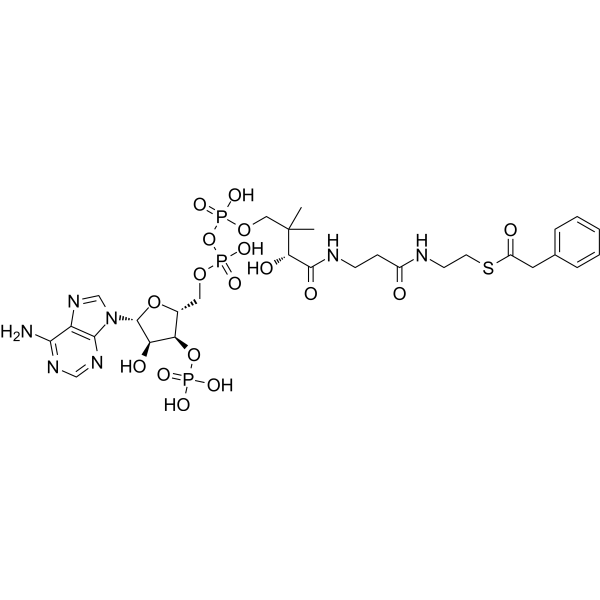
  • HY-135024

    Phenylacetyl Coenzyme A

    Endogenous Metabolite Metabolic Disease
    Phenylacetyl CoA is an acceptor oxidoreductase. Phenylacetyl CoA is a membrane-bound molybdenum–iron–sulfur enzyme involved in anaerobic metabolism of phenylalanine in the denitrifying bacterium Thauera aromatica .
    Phenylacetyl CoA
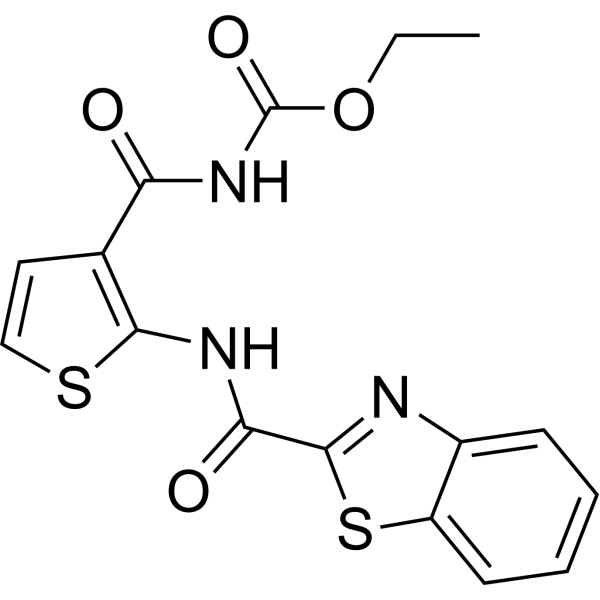
  • HY-12904
    TCA1
    1 Publications Verification

    Bacterial Infection
    TCA1 is a small molecule with activity against agent-susceptible and -resistant Mycobacterium tuberculosis (Mtb). TCA1 inhibits enzymes involved in cell wall and molybdenum cofactor biosynthesis, such as DprE1 and MoeW .
    TCA1
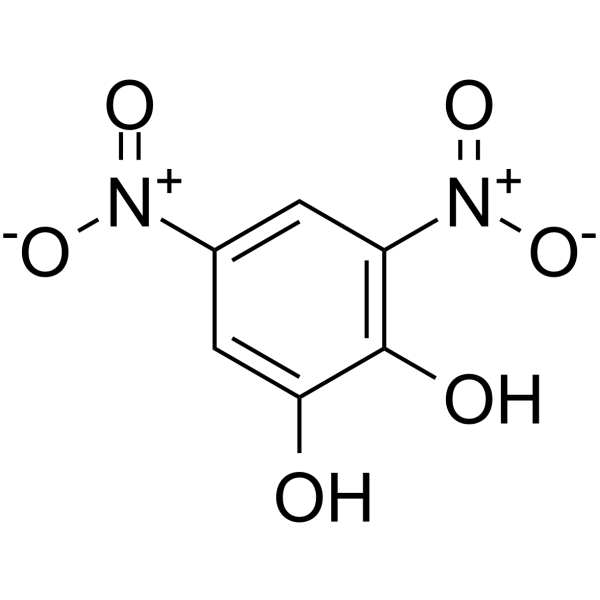
  • HY-100959

    OR-486; 3,5-Dinitropyrocatechol

    COMT Neurological Disease
    3,5-Dinitrocatechol (OR-486) is a potent catechol-O-methyltransferase inhibitor, with an IC50 of 12 nM. 3,5-Dinitrocatechol can be used in the preparation of the molybdenum (VI)- 3,5-Dinitrocatechol complex .
    3,5-Dinitrocatechol
  • HY-P2996B

    Others Others
    Nitrate Reductase (NAD[P]H), Pichia pastoris (recombinant) is a simplified version of nitrate reductase S-NaR1 expressed and purified by Pichia pastoris. Nitrate Reductase (NAD[P]H), Pichia Pastoris (recombinant) contains sites binding molybdenum-molybdenopyridine (Mo-MPT) and nitrate reduction active sites and only contains two domains instead of the five domains of the complete NaR. This simplified form of nitrate reductase was expressed in high density in P. pastoris and purified to homogeneity in one step by fixed metal affinity chromatography (IMAC). Nitrate Reductase (NAD[P]H), Pichia Pastoris (recombinant) can be used in the development of biosensors and environmental monitoring .
    Nitrate Reductase (NAD[P]H), Pichia Pastoris (recombinant)
  • HY-W009022

    Biochemical Assay Reagents Others
    Diantipyrylmethane is a chromogenic reagent commonly used for the determination of the contents of metals such as Au (III), Ti (IV), Ir, Fe (III), molybdenum, neodymium, U (IV), iridium, platinum and rhenium via spectrophotometry and extraction photometry. Diantipyrylmethane can also form a fluorescent complex with Er (III) ions, which is applied to the determination of erbium .
    Diantipyrylmethane
  • HY-100959R

    OR-486 (Standard); 3,5-Dinitropyrocatechol (Standard)

    COMT Reference Standards Neurological Disease
    3,5-Dinitrocatechol (Standard) is the analytical standard of 3,5-Dinitrocatechol. This product is intended for research and analytical applications. 3,5-Dinitrocatechol (OR-486) is a potent catechol-O-methyltransferase inhibitor, with an IC50 of 12 nM. 3,5-Dinitrocatechol can be used in the preparation of the molybdenum (VI)- 3,5-Dinitrocatechol complex .
    3,5-Dinitrocatechol (Standard)
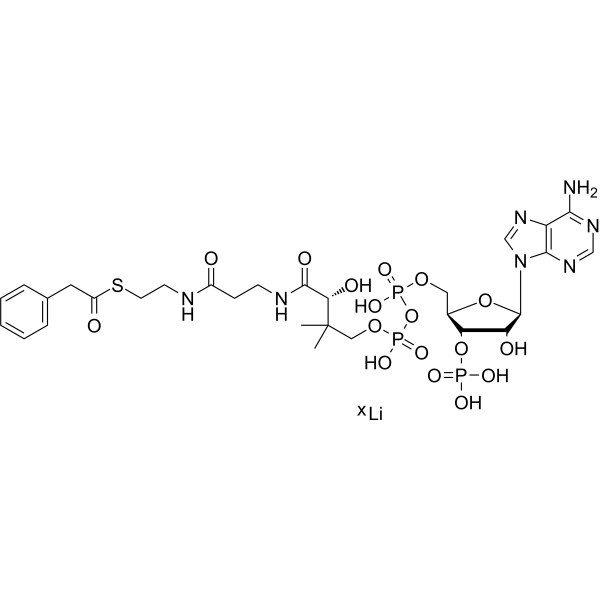
  • HY-135024A

    Phenylacetyl coenzyme A lithium; S-Benzeneacetate-CoA lithium; S-Benzeneacetate-coenzyme A lithium

    Endogenous Metabolite Metabolic Disease
    Phenylacetyl CoA lithium (Phenylacetyl Coenzyme A lithium) is an acceptor oxidoreductase. Phenylacetyl CoA is a membrane-bound molybdenum–iron–sulfur enzyme involved in anaerobic metabolism of phenylalanine in the denitrifying bacterium Thauera aromatica .
    Phenylacetyl CoA lithium
  • HY-P2996E

    Biochemical Assay Reagents Metabolic Disease
    Nitrate Reductase, Corn (EC 1.7.1.1) is an iron-sulfur-molybdenum flavonoid protein that catalyzes the conversion of nitrite to nitrate.
    Nitrate Reductase, Corn
  • HY-P2996D

    Biochemical Assay Reagents Metabolic Disease
    Nitrate Reductase, Aspergillus species (EC 1.7.1.2) is an iron-sulfur-molybdenum flavonoid protein that catalyzes the conversion of nitrite to nitrate.
    Nitrate Reductase, Aspergillus species
  • HY-E70923

    Biochemical Assay Reagents Metabolic Disease
    Xanthine dehydrogenase, Microorganism (EC 1.17.1.4) belongs to the molybdenum-containing hydroxylase family and participates in the oxidative metabolism of purines. Xanthine dehydrogenase, Microorganism (EC 1.17.1.4) is a homodimer and can be converted into xanthine oxidase through reversible thiol oxidation or irreversible proteolytic modification.
    Xanthine dehydrogenase, Microorganism
  • HY-182000

    Xanthine Oxidase BCRP GLUT Metabolic Disease
    Xanthine oxidase-IN-23 (Compound BPF) is an orally active, reversible, mixed-type Xanthine oxidase inhibitor with an IC50 of 3.33 μM. Xanthine oxidase-IN-23 directly binds to XOD in a reversible mixed-type manner to inhibit its catalytic activity. Xanthine oxidase-IN-23 upregulates ABCG2 and downregulates GLUT9 to promote renal urate excretion. Xanthine oxidase-IN-23 reduces serum urate levels and improves renal function in hyperuricemic mice. Xanthine oxidase-IN-23 can be used in the research of hyperuricemia .
    Xanthine oxidase-IN-23

Inquiry Online

Your information is safe with us. * Required Fields.

Salutation


Country or Region *

Applicant Name *


Organization Name *

Department *


Email Address *


Product Name *

Cat. No.


Requested quantity *

Phone Number *


Remarks

Inquiry Online

Inquiry Information

Product Name:
Cat. No.:
Quantity:
MCE Japan Authorized Agent: