10 Results for "

psychoactive properties

" in MedChemExpress (MCE) Product Catalog:
Products (10)

10 Results for "psychoactive properties" in MCE Product Catalog:

2
2 Cited Publications
Cat. No.: HY-W014971
CAS No.: 343-94-2
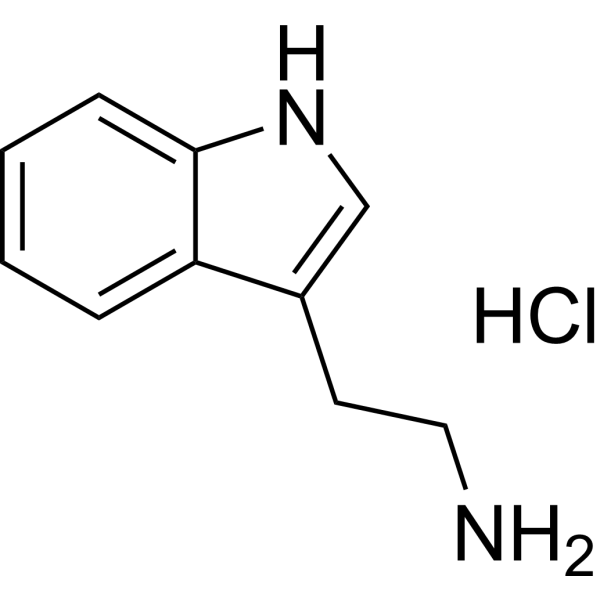
Tryptamine hydrochloride belongs to the class of indole alkaloids and is a derivative of the amino acid tryptophan. Tryptamine hydrochloride is psychoactive and acts as a neurotransmitter in the body, affecting mood, perception and cognition. In its hydrochloride form, Tryptamine hydrochloride hydrochloride, it is commonly used as a research chemical and as a starting material for the synthesis of other organic compounds. It can also occur naturally in certain plants and animals, including fungi and mammals. Due to the psychoactive properties of Tryptamine hydrochloride and its derivatives, its use and possession are controlled substances in many countries.
loading...
    loading...
Cat. No.: HY-W775306
CAS No.: 31932-13-5
Synonyms: CBDVA
Cannabidivarinic acid (CBDVA), the carboxylic acid precursor of Cannabidivarin(CBDV), is a non-psychoactive cannabinoid found in Cannabis with anti-inflammatory properties .
loading...
    loading...
Cat. No.: HY-W753724
CAS No.: 155638-84-9
Target:  

Drug Derivative

Research Areas:  

Neurological Disease

N-Ethyl 2C-B hydrochloride is a phenethylamine with psychoactive properties .
loading...
    loading...
Cat. No.: HY-117087
CAS No.: 1071544-43-8
Target:  

Phosphatase PANoptosis

Research Areas:  

Cancer

K103 is an inhibitor discovered from the screen that is an analog of the serotonin antagonist benzazocine. K103 exhibited inhibition of SHIP homologues, labelling it a pan-SHIP1/2 inhibitor, but the molecule had no effect on another 5' inositol phosphatase, OCRL. In line with the "two PIPs hypothesis", the molecule exhibited significant anti-tumour effects against a variety of cell lines, particularly breast cancer cells. Additional studies with K103 revealed that inhibition of SHIP1/2 in multiple myeloma cells resulted in G2/M cell cycle arrest followed by extensive apoptosis via activation of the caspase cascade. K103 fits the commonly used small molecule agent property profile, but while this work was being conducted, it was discovered that K103 caused psychoactive effects in mice, which limited the utility of the molecule in vivo. Therefore, certain synthetic studies were conducted on this tryptamine to identify the features that needed to be present in the molecule to maintain pan-SHIP1/2 inhibition in order to design an inhibitor with favourable pharmacodynamic properties and an improved side effect profile.
loading...
    loading...
Cat. No.: HY-168750
CAS No.: 1971007-91-6
Target:  

Cannabinoid Receptor

Research Areas:  

Neurological Disease

MDMB-FUBICA is a potent agonist of the cannabinoid receptors with psychoactive properties. MDMB-FUBICA can be used in the study of electronic cigarette .
loading...
    loading...
Cat. No.: HY-59059
CAS No.: 3784-30-3
Target:  

Monoamine Oxidase

Research Areas:  

Neurological Disease

5-(2-Aminopropyl)indole is an orally active psychoactive substance, that shows inhibitory activity against monoamine oxidase (MAO) and long-lasting stimulatory properties .
loading...
    loading...
Cat. No.: HY-169447
CAS No.: 6010-77-1
Target:  

Drug Derivative

Research Areas:  

Neurological Disease

2,3,4-Trimethoxyamphetamine hydrochloride is an amphetamine with psychoactive properties .
loading...
    loading...
Cat. No.: HY-A0171
CAS No.: 17243-39-9
Synonyms: Ba-30803 free base
Target:  

5-HT Receptor

Research Areas:  

Neurological Disease

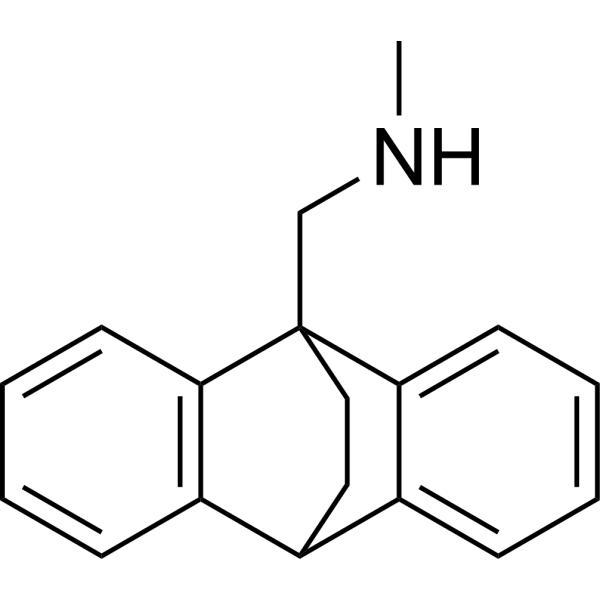
Benzoctamine is an orally active and potent psychoactive agent which possesses tranquillizing properties. Benzoctamine increases the turnover rate of catecholamines. Benzoctamine enhances the [3H]noradrenaline uptake in the rat heart. Benzoctamine also accelerated the disappearance of intracisternally injected [3H]noradrenaline .
loading...
    loading...
Cat. No.: HY-N17247
CAS No.: 23544-42-5
Synonyms: (-)-Mesembranol
Mesembranol ((-)-Mesembranol) is a mesembrine-type alkaloid and serotonin reuptake inhibitor. Mesembranol can be found in Sceletium tortuosum and exhibits phosphodiesterase 4 (PDE4) inhibition. Mesembranol contributes to the psychoactive properties of Sceletium tortuosum. Mesembranol can be used for the research of central nervous system-related conditions .
loading...
    loading...
Cat. No.: HY-W014971S
CAS No.: 362049-49-8
Tryptamine-d2-1 hydrochloride is the deuterium labeled Tryptamine hydrochloride (HY-W014971). Tryptamine hydrochloride belongs to the class of indole alkaloids and is a derivative of the amino acid tryptophan. Tryptamine hydrochloride is psychoactive and acts as a neurotransmitter in the body, affecting mood, perception and cognition. In its hydrochloride form, Tryptamine hydrochloride hydrochloride, it is commonly used as a research chemical and as a starting material for the synthesis of other organic compounds. It can also occur naturally in certain plants and animals, including fungi and mammals. Due to the psychoactive properties of Tryptamine hydrochloride and its derivatives, its use and possession are controlled substances in many countries.
loading...
    loading...

