9 Results for "

spectrophotometer

" in MedChemExpress (MCE) Product Catalog:
Products (9)

9 Results for "spectrophotometer" in MCE Product Catalog:

Cat. No.: HY-N1442
CAS No.: 633-96-5
Synonyms: Orange II; D&C Orange NO. 4
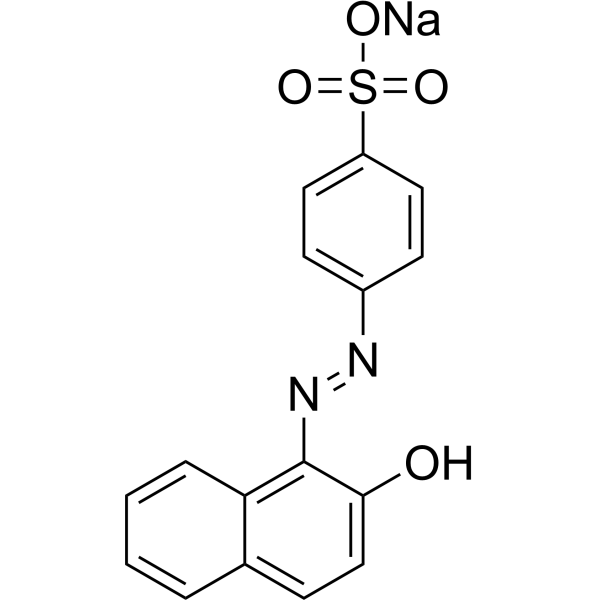
Acid Orange 7 (Orange II; D&C Orange NO. 4) is an azo dye widely used in the textile, food and cosmetic industries. Acid Orange 7 is mainly used as a colorant by combining with fibers and other substances through azo bonds. Acid Orange 7 has a maximum absorption wavelength at 484-485 nm, and the concentration is measured using a UV-visible spectrophotometer. Acid Orange 7 is difficult to degrade and has a certain degree of toxicity. It is often used to study various sewage treatment technologies and photocatalytic degradation reactions, and to evaluate the removal effects of different treatment methods on organic pollutants .
loading...
    loading...
Cat. No.: HY-NP002
CAS No.: 9048-46-8
BSA Standard Solution (5 mg/mL) is a bovine serum albumin solution commonly used as a standard for total serum protein detection. BSA Standard Solution (5 mg/mL) can be used for drawing standard curves and calibrating experiments in total protein assays. BSA Standard Solution (5 mg/mL) is also suitable for various biological experiments, including PCR detection inhibition, antibody desalting, chromatography control, SDS-PAGE electrophoresis, and calibration of UV spectrophotometers .
loading...
    loading...
Cat. No.: HY-W479534
CAS No.: 72298-61-4
Synonyms: DemNA
Decanoyl m-Nitroaniline (DemNA) is a nitroaniline fatty acid amides which can be used to measure fatty acid amide hydrolase (FAAH) activity (Ab = 410 nm).
loading...
    loading...
Cat. No.: HY-120971
CAS No.: 72298-63-6
Synonyms: DepNA
N-Decanoyl p-nitroaniline (DepNA) is one of several nitroaniline fatty acid amides which can be used to measure fatty acid amide hydrolase (FAAH) activity.1 FAAH is a relatively unselective enzyme in that it accepts a variety of amide head groups other than the ethanolamine of its endogenous substrate anandamide (AEA). It also will hydrolyze fatty acid amides with fewer carbons and fewer double bonds than arachidonate. Exposure of DepNA to FAAH activity results in the release of the yellow colorimetric dye p-nitroaniline (ε=13,500 at 410 nm). This allows the fast and convenient measurement of FAAH activity using a 96 well plate spectrophotometer.
loading...
    loading...
Cat. No.: HY-N1442R
CAS No.: 633-96-5
Synonyms: Orange II (Standard); D&C Orange NO. 4 (Standard)
Acid orange 7 (Standard) is the analytical standard of Acid orange 7 (HY-1442). This product is intended for research and analytical applications. Acid Orange 7 (Orange II; D&C Orange NO. 4) is an azo dye widely used in the textile, food and cosmetic industries. Acid Orange 7 is mainly used as a colorant by combining with fibers and other substances through azo bonds. Acid Orange 7 has a maximum absorption wavelength at 484-485 nm, and the concentration is measured using a UV-visible spectrophotometer. Acid Orange 7 is difficult to degrade and has a certain degree of toxicity. Acid Orange 7 is often used to study various sewage treatment technologies and photocatalytic degradation reactions, and to evaluate the removal effects of different treatment methods on organic pollutants .
loading...
    loading...
Cat. No.: HY-W750212
CAS No.: 2734676-29-8
Synonyms: Orange II-13C6; D&C Orange NO. 4-13C6
Acid Orange 7- 13C6 (Orange II- 13C6) is the 13C-labeled Acid orange 7 (HY-N1442). Acid Orange 7 (Orange II; D&C Orange NO. 4) is an azo dye widely used in the textile, food and cosmetic industries. Acid Orange 7 is mainly used as a colorant by combining with fibers and other substances through azo bonds. Acid Orange 7 has a maximum absorption wavelength at 484-485 nm, and the concentration is measured using a UV-visible spectrophotometer. Acid Orange 7 is difficult to degrade and has a certain degree of toxicity. It is often used to study various sewage treatment technologies and photocatalytic degradation reactions, and to evaluate the removal effects of different treatment methods on organic pollutants .
loading...
    loading...
Cat. No.: HY-D3127
CAS No.: 455251-97-5
Target:  

Fluorescent Dye

Research Areas:  

Others

DCA-Mln is a Fluorescent probe for ferric iron (Fe³⁺) detection. The probe works via an internal charge transfer (ICT) process from its diethylamino group to its dicyano group, which produces bright pink fluorescence in its unbound state; when Fe³⁺ is present, two molecules of DCA-Mln chelate with one Fe³⁺ ion, with one cyano group of each DCA-Mln participating in the complexation, and this binding triggers a photoinduced electron transfer (PET) process that provides a nonradiative deactivation pathway, resulting in fluorescence quenching; additionally, the probe exhibits a visible color change from purple to peach pink upon Fe³⁺ binding, enabling dual-channel detection. The probe has an excitation wavelength of 570 nm and an emission wavelength of 670 nm, and it shows a rapid response, with fluorescence stabilizing within 15 seconds of Fe³⁺ addition. DCA-Mln is cell-membrane-permeable, nontoxic at the imaging concentration of 10 μM, and can be used for Fe³⁺ detection in actual water samples, Fe³⁺ imaging in living cells, and as an anti-counterfeiting ink[1].
loading...
    loading...
Cat. No.: HY-D3033
Target:  

Fluorescent Dye

Research Areas:  

Others

FITC-Alginate is a FITC (HY-66019)-labeled sodium alginate. FITC-Alginate acts as a fluorescent dye and probe, which enables the visualization of sodium alginate microspheres, microreservoirs, and sodium alginate-iron complexes via confocal microscopy, providing support for structural characterization, distribution analysis, and cell localization studies. The excitation/emission wavelengths of FITC-Alginate are 488 nm/~550 nm .
loading...
    loading...
Cat. No.: HY-D3421
CAS No.: 3083251-08-2
Target:  

Fluorescent Dye

Research Areas:  

Others

DiOC14 (3) (hydroxyethanesulfonate) is a water-soluble lipophilic carbocyanine green fluorescent membrane dye used as a fluorescent probe for living cell membranes and lipid bilayers. DiOC14 (3) (hydroxyethanesulfonate) acts as a lipophilic tracer that integrates into cell membranes, with its fluorescence generated upon membrane integration independent of enzymatic hydrolysis, pH, or membrane potential. The Ex/Em of DiOC14 (3) (hydroxyethanesulfonate) is 477/525 nm.
loading...
    loading...

