



FFAR2
FFAR2 (free fatty acid receptor 2, also known as GPR43) is a short-chain fatty acid (SCFA)-sensing G protein-coupled receptor that links microbiota-derived metabolites to host immune and metabolic responses[1][2]. Mechanistically, FFAR2 is activated by acetate, propionate, and butyrate and regulates intracellular signaling pathways involved in leukocyte activation, chemotaxis, cytokine production, and epithelial barrier function[1][3]. Through these processes, FFAR2 contributes to the coordination of innate immune responses and maintenance of intestinal homeostasis, establishing a functional connection between dietary fiber fermentation and host physiology[2][3]. In disease-relevant settings, FFAR2 has been extensively studied in inflammatory bowel disease, metabolic disorders, infection models, and other conditions characterized by dysregulated immune responses, where modulation of SCFA-FFAR2 signaling influences inflammatory outcomes and tissue protection[2][3][4]. Compared with the closely related receptor FFAR3 (GPR41), which also recognizes SCFAs, FFAR2 displays distinct ligand preferences, signaling properties, and immune-cell expression patterns, particularly its prominent expression in neutrophils and other leukocyte populations[1][4]. This distinction has made FFAR2 a key target for dissecting receptor-specific effects of microbial metabolites in experimental systems[4]. For research applications, multiple synthetic agonists and antagonists have been developed to investigate FFAR2 biology, including selective pharmacological probes and the clinical-stage antagonist GLPG0974, enabling mechanistic studies of receptor signaling and therapeutic target validation[5].
参考文献:
- [1]. Le Poul E, et al. Functional characterization of human receptors for short chain fatty acids and their role in polymorphonuclear cell activation. J Biol Chem. 2003 Jul 11;278(28):25481-9. [Content Brief]
- [2]. Alvarez-Curto E, et al. Metabolism meets immunity: The role of free fatty acid receptors in the immune system. Biochem Pharmacol. 2016 Aug 15;114:3-13. [Content Brief]
- [3]. Schlatterer K, et al. Short-Chain Fatty Acid and FFAR2 Activation - A New Option for Treating Infections? Front Cell Infect Microbiol. 2021 Dec 2;11:785833. [Content Brief]
- [4]. Pedersen SF, et al. The SLC9A-C Mammalian Na+/H+ Exchanger Family: Molecules, Mechanisms, and Physiology. Physiol Rev. 2019 Oct 1;99(4):2015-2113. [Content Brief]
- [5]. Grundmann M, et al. Pharmacology of Free Fatty Acid Receptors and Their Allosteric Modulators. Int J Mol Sci. 2021 Feb 10;22(4):1763. [Content Brief]
All Product Categories
-
FFAR2 関連製品 (4)
関連製品 (4)

-
AZ1729
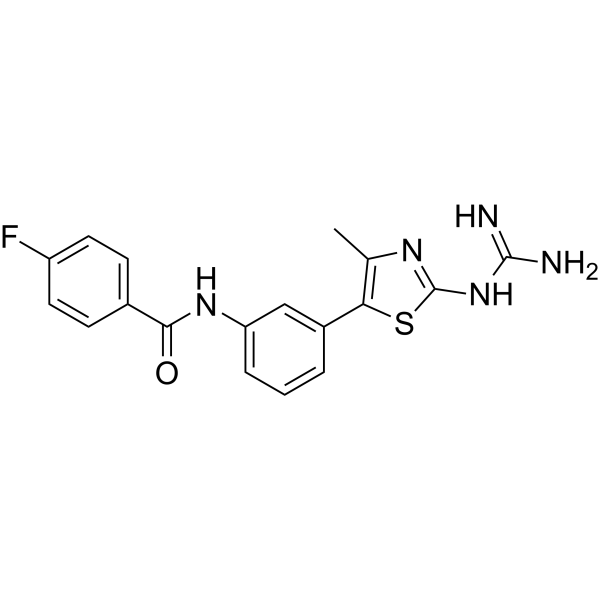 0 Images製品番号: HY-121140CAS 番号: 2016864-46-1AZ1729 is an FFA2/FFAR2 allosteric modulator and Gi-biased signaling enhancer. AZ1729 binds to the FFA2 allosteric site without interacting with the orthosteric site, enhances Gi coupling, and inhibits Gq/G11 coupling. AZ1729 inhibits Isoprenaline (HY-B0468)-induced lipolysis in mouse adipocytes. AZ1729 also induces human neutrophil migration. AZ1729 can be used to study the signaling pathways underlying the physiological roles of FFA2.
-
TUG-2304
 0 ImagesTUG-2304 is a highly selective free fatty acid receptor 2 (FFA2, GPR43) antagonist that completely suppresses propionate-induced neutrophil migration and respiratory burst. TUG-2304 is applicable to research related to metabolic and inflammatory diseases.

-
FFA2 agonist-2
 0 Images製品番号: HY-182729CAS 番号: 1229363-11-4FFA2 agonist-2 is a potent agonist of the FFA2 (GPR43) receptor, with a pEC50 of 7.9 for human FFA2, and a pEC50 of 7.3 for murine FFA2. FFA2 agonist-2 acts as an orthosteric agonist and shows no obvious cross‑activity against FFA1, FFA3 and FFA4. FFA2 agonist-2 can be used for FFA2 receptor research in type 2 diabetes and metabolic disorders.



