



IFNAR2
IFNAR2 (interferon alpha and beta receptor subunit 2) is a core component of the type I interferon receptor complex and associates with IFNAR1 to mediate cellular responses to interferon-α and interferon-β ligands[1][2]. Upon ligand engagement, IFNAR2 functions as the principal signaling subunit linked to JAK1, enabling receptor complex assembly and activation of the JAK-STAT pathway, which drives phosphorylation of STAT1 and STAT2 and subsequent transcription of interferon-stimulated genes involved in antiviral and immune regulation[1][2][3]. Mechanistically, formation of the IFN-IFNAR1-IFNAR2 signaling complex promotes cross-activation of receptor-associated kinases and efficient propagation of type I interferon signaling across diverse cell types[2][3]. In disease contexts, impaired IFNAR2-mediated signaling has been associated with altered antiviral immunity, while genetic variation and expression differences in IFNAR2 have been linked to severe viral infections, including COVID-19, highlighting its importance in host defense pathways[4]. Compared with the related receptor subunit IFNAR1, IFNAR2 exhibits distinctive isoform diversity generated by alternative splicing, producing signaling-competent membrane isoforms as well as soluble or truncated isoforms with limited or inhibitory signaling capacity[5]. This isoform-specific biology provides an important experimental framework for dissecting receptor activation, signal strength, and interferon responsiveness in cellular models[5]. For research applications, recombinant soluble IFNAR2 and endogenous soluble IFNAR2 have been used to investigate modulation of type I interferon activity and receptor-dependent antiviral responses, supporting their utility as mechanistic tools in interferon signaling studies[6].
References:
- [1]. IFNAR2 gene information from NCBI.
- [2]. Lee MJ, et al. Time to HIV rebound after infusion of long-acting broadly neutralising antibodies 3BNC117-LS and 10-1074-LS and analytical treatment interruption (the RIO trial): a double-blind, randomised, placebo-controlled trial. Lancet HIV. 2026 May 27:S2352-3018(26)00059-7. [Content Brief]
- [3]. Piehler J, et al. Structural and dynamic determinants of type I interferon receptor assembly and their functional interpretation. Immunol Rev. 2012 Nov;250(1):317-34. [Content Brief]
- [4]. Fricke-Galindo I, et al. IFNAR2 relevance in the clinical outcome of individuals with severe COVID-19. Front Immunol. 2022;13:949413. [Content Brief]
- [5]. Zanin N, et al. Interferon Receptor Trafficking and Signaling: Journey to the Cross Roads. Front Immunol. 2021 Jan 20;11:615603. [Content Brief]
- [6]. Aliaga-Gaspar P, et al. Recombinant soluble type I interferon receptor exerts antiviral activity by inducing proteins related to autophagy. Biomed Pharmacother. 2024 Dec;181:117678. [Content Brief]
All Product Categories
-
IFNAR2 Related Products (2)
Related Products (2)

-
IFN-α Receptor Recognition Peptide 1
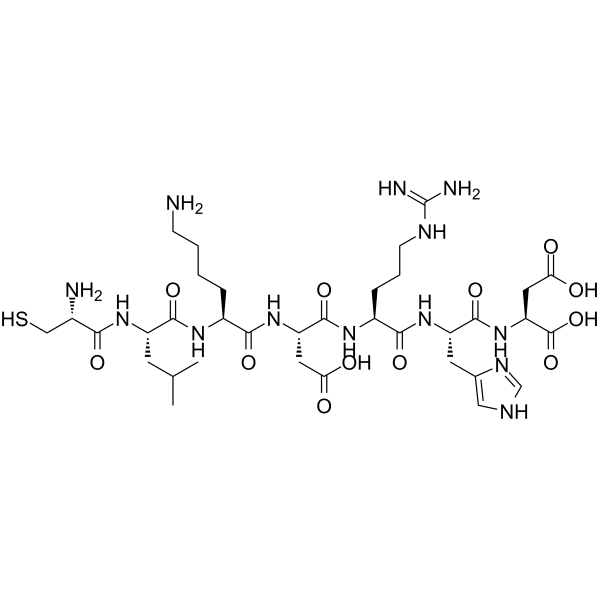 0 ImagesCat. No.: HY-P1758CAS No.: 153840-64-3Synonyms: IRRP1IFN-α Receptor Recognition Peptide 1 (IRRP1) is an amino acid synthetic peptide and also a regulator of IFN-α Receptor. IFN-α Receptor Recognition Peptide 1 binds to IFNAR2, enhances the binding capacity of IFN-α receptor, and slightly increases the IFN-α-induced growth inhibitory activity. IFN-α Receptor Recognition Peptide 1 inhibits IFN-α-induced STAT1 phosphorylation and STAT-DNA binding by blocking the activation of IFNAR by IFN-α. IFN-α Receptor Recognition Peptide 1 increases the occupancy of IFN-α on cell surface receptors, enhances the phosphorylation activation of ISGF3, and elevates IFN-α-induced antiviral activity. IFN-α Receptor Recognition Peptide 1 can be used in studies related to encephalomyocarditis virus infection.
-
IFN-α Receptor Recognition Peptide 1 acetate
 0 ImagesCat. No.: HY-P1758APurity: 99.29%Synonyms: IRRP1 acetateIFN-α Receptor Recognition Peptide 1 acetate (IRRP1 acetate) is an amino acid synthetic peptide and also a regulator of IFN-α Receptor. IFN-α Receptor Recognition Peptide 1 acetate binds to IFNAR2, enhances the binding capacity of IFN-α receptor, and slightly increases the IFN-α-induced growth inhibitory activity. IFN-α Receptor Recognition Peptide 1 acetate inhibits IFN-α-induced STAT1 phosphorylation and STAT-DNA binding by blocking the activation of IFNAR by IFN-α. IFN-α Receptor Recognition Peptide 1 acetate increases the occupancy of IFN-α on cell surface receptors, enhances the phosphorylation activation of ISGF3, and elevates IFN-α-induced antiviral activity. IFN-α Receptor Recognition Peptide 1 acetate can be used in studies related to encephalomyocarditis virus infection.



