



VDAC2
VDAC2 encodes a mitochondrial outer-membrane voltage-dependent anion channel and supports isoform-specific regulation of mitochondrial structure, metabolite exchange, and cell-death signaling[1]. Mechanistically, VDAC2 binds BAK and restrains BAK activation, thereby limiting mitochondrial apoptosis in viable cells[2]. In tBID-triggered apoptosis, however, VDAC2 recruits BAK to mitochondria, and defined VDAC2 motifs are required for BAK import and tBID-induced mitochondrial apoptosis[3][4]. VDAC2 also enables efficient BAX-mediated apoptosis and limits tumor development, distinguishing BAX regulation from BAK regulation at the mitochondrial outer membrane[5]. In ferroptosis models, Nedd4 ubiquitylates VDAC2/3 to suppress erastin-induced ferroptosis in melanoma, while VDAC2 and VDAC3 together facilitate erastin-induced ferroptotic cell death[6]. In tumor-immunity models, VDAC2 loss sensitizes tumor cells to IFNγ-induced mitochondrial DNA release, cGAS-STING activation, tumor destruction, and inflammatory remodeling[7]. Compared with related isoforms, VDAC2 shows a distinct apoptosis role: it is required for efficient BAX-mediated apoptosis but inhibits BAK-mediated apoptosis[5]. For experimental applications, WEHI-9625 binds VDAC2 and stabilizes the BAK-VDAC2 interaction to block mouse BAK-driven apoptosis[8].
References:
- [1]. Naghdi S, et al. VDAC2-specific cellular functions and the underlying structure. Biochim Biophys Acta. 2016 Oct;1863(10):2503-14. [Content Brief]
- [2]. Cheng EH, et al. VDAC2 inhibits BAK activation and mitochondrial apoptosis. Science. 2003 Jul 25;301(5632):513-7. [Content Brief]
- [3]. Roy SS, et al. VDAC2 is required for truncated BID-induced mitochondrial apoptosis by recruiting BAK to the mitochondria. EMBO Rep. 2009 Dec;10(12):1341-7. [Content Brief]
- [4]. Naghdi S, et al. Motifs of VDAC2 required for mitochondrial Bak import and tBid-induced apoptosis. Proc Natl Acad Sci U S A. 2015 Oct 13;112(41):E5590-9. [Content Brief]
- [5]. Chin HS, et al. VDAC2 enables BAX to mediate apoptosis and limit tumor development. Nat Commun. 2018 Nov 26;9(1):4976. [Content Brief]
- [6]. Yang Y, et al. Nedd4 ubiquitylates VDAC2/3 to suppress erastin-induced ferroptosis in melanoma. Nat Commun. 2020 Jan 23;11(1):433. [Content Brief]
- [7]. Yuan S, et al. VDAC2 loss elicits tumour destruction and inflammation for cancer therapy. Nature. 2025 Apr;640(8060):1062-1071. [Content Brief]
- [8]. van Delft MF, et al. A small molecule interacts with VDAC2 to block mouse BAK-driven apoptosis. Nat Chem Biol. 2019 Nov;15(11):1057-1066. [Content Brief]
All Product Categories
-
VDAC2 Related Products (4)
Related Products (4)

-
Erastin
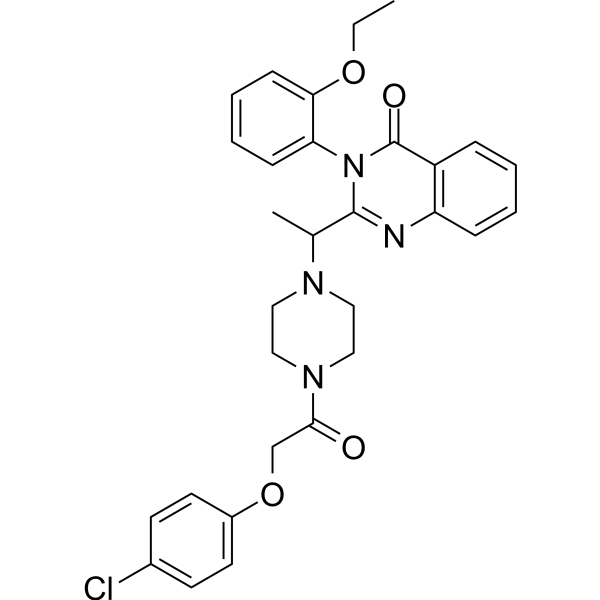 0 ImagesErastin is a ferroptosis inducer. Erastin exhibits the mechanism of ferroptosis induction related to ROS and iron-dependent signaling. Erastin inhibits voltage-dependent anion channels (VDAC2/VDAC3) and accelerates oxidation, leading to the accumulation of endogenous reactive oxygen species. Erastin also disrupts mitochondrial permeability transition pore (mPTP) with anti-tumor activity. Furthermore, Erastin can block the uptake of cystine mediated by SLC7A11 and also spares UMRC6-EV and -C91A cells from disulfidptosis under glucose starvation.
-
WEHI-3773
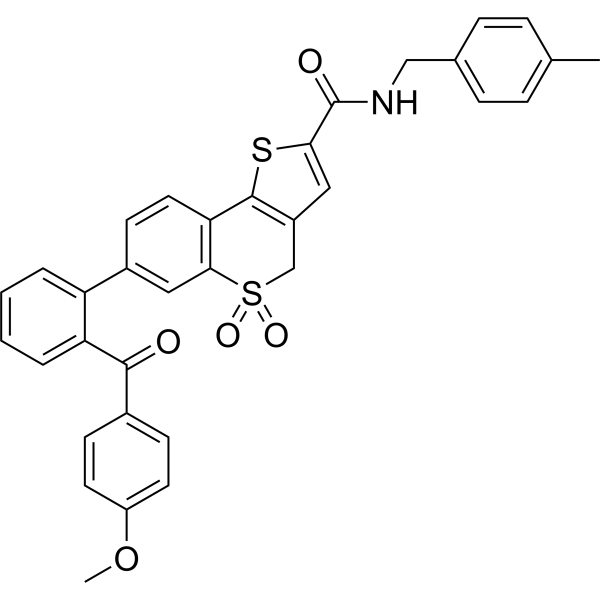
 0 ImagesCat. No.: HY-172262WEHI-3773 is a VDAC2 ligand and apoptosis modulator. WEHI-3773 directly binds to the β7-β10 region of VDAC2 and disrupts its interaction with BAX and BAK. WEHI-3773 regulates BAX-mediated apoptosis in BAK-deficient cells by modulating conformational activation of BAX, mitochondrial redistribution, and cytochrome c release. WEHI-3773 overcomes Venetoclax (HY-15531) resistance, resensitizes leukemia cells carrying BAX mutations to BH3 mimetics, and enables long-term clonogenic survival of BAK-deficient cells treated with BH3 mimetics. WEHI-3773 is applicable to research related to acute myeloid leukemia.
-
NCATS-SM0225
 0 ImagesCat. No.: HY-181529CAS No.: 1212623-02-3NCATS-SM0225 is an endoplasmic reticulum-associated degradation (ERAD) inhibitor and a direct binder of VDAC1, VDAC2 and VDAC3. NCATS-SM0225 exhibits an IC50of 1.02 μM for ERAD and a Kd of 3.13 μM for human VDAC1 binding. NCATS-SM0225 disrupts cellular calcium homeostasis, enhances VDAC1-IP3R coupling and activating PERK. NCATS-SM0225 selectively kills cancer cells, exhibits tumor growth inhibitory effects in melanoma xenograft models. NCATS-SM0225 can be used for research on multiple cancers including melanoma, as well as the molecular mechanisms of ERAD and calcium homeostasis regulation.



