



CRY1
CRY1 (cryptochrome 1) is a core circadian clock repressor, and CRY1/2 repress CLOCK:BMAL1 transcription while interacting with nuclear receptors that regulate metabolism[1][2]. Mechanistically, the CRY1 tail, especially the exon 11 region, controls circadian timing by regulating CRY1 association with CLOCK:BMAL1[3]. In disease models, a human CRY1 variant causes familial delayed sleep phase disorder, linking altered CRY1 repression to delayed circadian timing[4]. In cancer models, DNA damage stabilizes CRY1, and stabilized CRY1 promotes homologous recombination gene expression, DNA repair, and cell survival[5]. Compared with CRY2, CRY1 shows redundant and distinct functions; isoform-selective studies found KL101 stabilizes CRY1, whereas TH301 stabilizes CRY2[7]. For experimental applications, KL001 prevents ubiquitin-dependent CRY degradation and lengthens circadian period, while KL201 selectively stabilizes CRY1 and supports isoform-specific circadian clock research[6][8].
References:
- [1]. Kriebs A, et al. Circadian repressors CRY1 and CRY2 broadly interact with nuclear receptors and modulate transcriptional activity. Proc Natl Acad Sci U S A. 2017 Aug 15;114(33):8776-8781. [Content Brief]
- [2]. van der Horst GT, et al. Mammalian Cry1 and Cry2 are essential for maintenance of circadian rhythms. Nature. 1999 Apr 15;398(6728):627-30. [Content Brief]
- [3]. Parico GCG, et al. The human CRY1 tail controls circadian timing by regulating its association with CLOCK:BMAL1. Proc Natl Acad Sci U S A. 2020 Nov 10;117(45):27971-27979. [Content Brief]
- [4]. Patke A, et al. Mutation of the Human Circadian Clock Gene CRY1 in Familial Delayed Sleep Phase Disorder. Cell. 2017 Apr 6;169(2):203-215.e13. [Content Brief]
- [5]. Shafi AA, et al. The circadian cryptochrome, CRY1, is a pro-tumorigenic factor that rhythmically modulates DNA repair. Nat Commun. 2021 Jan 15;12(1):401. [Content Brief]
- [6]. Hirota T, et al. Identification of small molecule activators of cryptochrome. Science. 2012 Aug 31;337(6098):1094-7. [Content Brief]
- [7]. Miller S, et al. Isoform-selective regulation of mammalian cryptochromes. Nat Chem Biol. 2020 Jun;16(6):676-685. [Content Brief]
- [8]. Dong C, et al. Structural Basis for the Binding Selectivity of Human CDY Chromodomains. Cell Chem Biol. 2020 Jul 16;27(7):827-838.e7. [Content Brief]
All Product Categories
-
CRY1 Related Products (3)
Related Products (3)

-
KS15
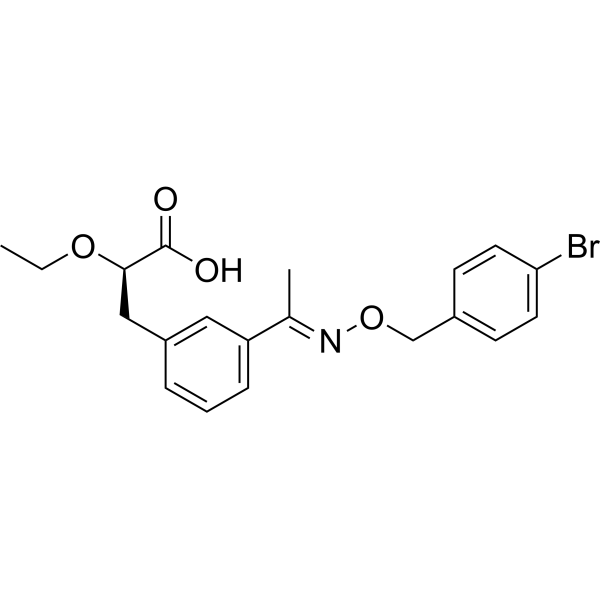 0 ImagesKS15 is an inhibitor of the interactions between cryptochromes (CRYs: CRY1 and CRY2) and the CLOCK:BMAL1 heterodimer. KS15 impairs the feedback actions of CRYs on E-box-dependent transcription (EC50=4.9 μM) by CLOCK:BMAL1 heterodimer, an indispensable transcriptional regulator of the mammalian circadian clock. Anti-proliferative activity.
-
M47
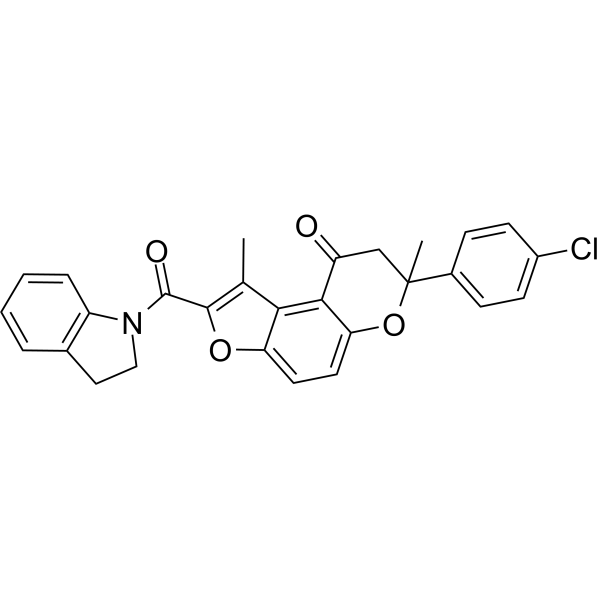 0 ImagesM47 is a molecular glue that selectively destabilizes Cryptochrome 1 (CRY1) and increases degradation of the CRY1 in the nucleus. M47 enhances apoptosis in Ras-transformed P53-deficient mouse skin fibroblast lines and enhances life span in p53 knockout mice. M47 can be used in research of cancer.
-
KL101
 0 ImagesCat. No.: HY-134193CAS No.: 396721-89-4KL101, a selective cryptochrome 1 (CRY1) stabilizer, is a circadian clock modulator. KL101 can stabilize the CRY1 protein and regulate its interaction with the core feedback loop of the biological clock, thereby modulating the circadian rhythm cycle of mammals.



