



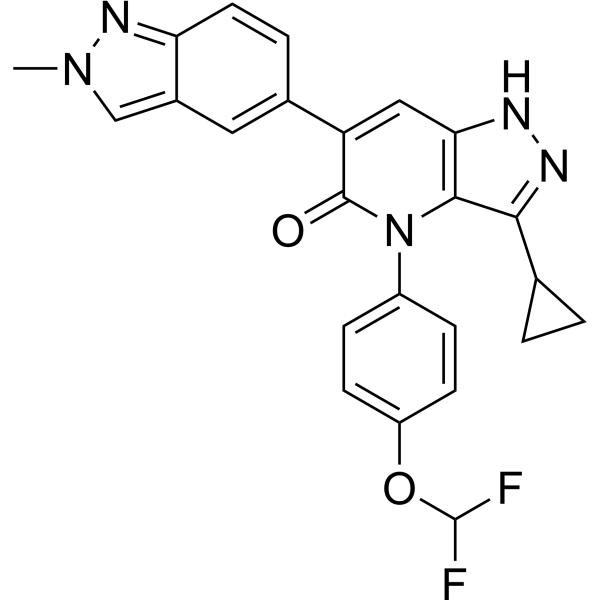
AZ'9567

Based on 1 Customer Validation
AZ'9567 is an orally active MAT2a inhibitor with a pIC50 of 9.1. AZ'9567 binds to MAT2a allosterically, reduces the synthesis of SAM, decreases SDMA levels, and exerts antiproliferative effects on MTAP-knockout cells. AZ'9567 depletes SAM, causes methionine accumulation in plasma and tissues, triggers adaptive disorders in one-carbon metabolism, transsulfuration metabolism and lipid metabolism, and induces oxidative stress, hepatic steatosis and lipid homeostasis imbalance. AZ'9567 can be used in studies related to MTAP-deficient/deleted cancers.
Nos produits utilisent uniquement pour la recherche. Nous ne vendons pas aux patients.
- Pureté : 99.19%
- CAS No.: 3056570-19-2
- Formule: C24H19F2N5O2
- Masse moléculaire:447.44
-
Stockage:Powder -20°C, 3 years ; In solvent -80°C, 6 months , -20°C, 1 month

To place orders, for customer services and technical support, please contact: MedChemExpress USA
Tel: 609-228-6898 E-mail: [email protected] [email protected]


-
 Activité biologique
-
Chemical Information
-
Solvant et solubilité
- Protocole
- Pureté et documentation
- Références
-
 Help & FAQs




Activité biologique
Description
In Vitro
AZ'9567 (2 h) potently reduces intracellular SAM levels in HCT116 MTAP knockout cells, with a pIC50 of 8.9[1][2].
AZ'9567 (48 h) potently inhibits SDMA levels in MTAP-knockout HCT116 cells with a pIC50 of 8.6, whereas it only exhibits weak activity in parental HCT116 wild-type cells with a pIC50 of 5.5[1].
AZ'9567 (5 days) inhibits the proliferation of HCT116 MTAP knockout cells with a pGI50 of 7.1; it shows weak activity in parental HCT116 wild-type cells, with a pGI50 of 5.8[1].
AZ'9567 inhibits the activity of MAT1A in primary human hepatocytes, leading to SAM depletion[2].
AZ'9567 (2.5 h) potently inhibits purified MAT2A protein with an IC50 of 1 nM[3].
MedChemExpress (MCE) has not independently confirmed the accuracy of these methods. They are for reference only.
Parmacokinetics
In Vivo
AZ'9567 (3-30 mg/kg; p.o.; twice daily; 7 days) causes dose-dependent SAM depletion and dramatic methionine accumulation in plasma, liver, heart, and brain, alongside broad perturbations in hepatic one-carbon, trans-sulfuration, and lipid metabolism pathways in male Han Wistar rats[2].
AZ'9567 exhibits robust in vivo pharmacodynamic modulation in HCT-116 MTAP-null xenografts, achieving over 90% reduction in tumor SAM and SDMA levels[3].
MedChemExpress (MCE) has not independently confirmed the accuracy of these methods. They are for reference only.
-
Animal Model:CrTac:NCr-Foxn1nu (female, 6−7 weeks old)[1]
-
Dosage:20 mg/kg
-
Administration:p.o.; twice daily (8 h apart); 24 days
-
Result:Achieved robust tumor growth inhibition, with tumor volumes remaining low near baseline over 24 days, while vehicle-treated tumors grew to over 1000 mm3.
Reduced tumor SAM levels by >90% relative to vehicle controls at 2, 6, and 24 h post-final dose.
Inhibited downstream SDMA levels by >90% relative to vehicle controls at 2, 6, and 24 h post-final dose.
Maintained free plasma concentrations at or above the HCT116 MTAP KO IC50 for the full 24 h post-final dose.
-
Animal Model:Crl:WI Han Wistar (8-10 week old male, 210-230 g)[2]
-
Dosage:3 mg/kg; 10 mg/kg; 30 mg/kg
-
Administration:p.o.; twice daily; 7 days
-
Result:Increased plasma methionine concentrations 15-fold (to 775 µmol/L), 19-fold (to 1180 µmol/L), and 17-fold (to 940 µmol/L) for the 3, 10, and 30 mg/kg dose groups, respectively, on Day 7.
Recorded maximal plasma methionine increase of +1557% with the 30 mg/kg dose.
Decreased SAM levels relative to controls: plasma by 30% (3 mg/kg), 60% (10 mg/kg), and 70% (30 mg/kg); liver by ~45% across all doses; heart by 87% (3 mg/kg), 87% (10 mg/kg), and 90% (30 mg/kg); brain by 68% (30 mg/kg only, no significant change at 3 and 10 mg/kg).
Increased tissue methionine levels relative to controls: liver by +1552% (3 mg/kg), +1862% (10 mg/kg), +2314% (30 mg/kg); heart by +931% (3 mg/kg), +1323% (10 mg/kg), +1316% (30 mg/kg); brain by +1342% (3 mg/kg), +1389% (10 mg/kg), +1835% (30 mg/kg).
Identified 357, 467, and 519 differentially expressed proteins for 3, 10, and 30 mg/kg doses, respectively; upregulated 1-C metabolism enzymes (BHMT, BHMT2, GNMT, MTR, DMGDH), cholesterol biosynthesis enzymes (Hmgcs1, Cyp4a2, Idi1, etc.), MAT2A, and MAT1A; downregulated trans-sulfuration pathway enzymes (CBS, Cdo1, CSAD), fatty acid metabolism enzymes (Scd1, Acaca, Fads1, etc.), and MAT2B.
Decreased liver levels of SAM, choline, phosphocholine, CDP-choline, glycerophosphocholine, cystathionine, hypotaurine, taurine, glutathione, and cytidine; increased liver levels of methionine, betaine, 5-methyltetrahydrofolate, pyroglutamic acid, ophthalmic acid, phosphoethanolamine, CDP-ethanolamine, and spermidine.
Accumulated triglycerides, cholesteryl esters, and phosphoglycerolipids in liver; significantly decreased phosphatidylcholines, phosphatidylethanolamines, phosphatidylinositols, and cardiolipins across all doses.
-
Animal Model:Mice[2]
-
Dosage:20 mg/kg
-
Administration:twice daily
-
Result:Demonstrated robust anti-tumor response, with >90% depletion of both SAM and SDMA on Day 24.


Chemical Information
-
CAS No. 3056570-19-2
-
Appearance Solid
-
Masse moléculaire 447.44
-
Formule C24H19F2N5O2
-
Color White to off-white
-
SMILES
O=C1C(C2=CC3=CN(C)N=C3C=C2)=CC(NN=C4C5CC5)=C4N1C6=CC=C(OC(F)F)C=C6
-
Livraison
Room temperature in continental US; may vary elsewhere.
-
Stockage
Powder -20°C 3 years In solvent -80°C 6 months -20°C 1 month


Solvant et solubilité
In Vitro:
DMSO : 62.5 mg/mL (139.68 mM; Need ultrasonic; Hygroscopic DMSO has a significant impact on the solubility of product, please use newly opened DMSO)
Please refer to the solubility information to select the appropriate solvent. Once prepared, please aliquot and store the solution to prevent product inactivation from repeated freeze-thaw cycles.
Storage method and period of stock solution: -80°C, 6 months; -20°C, 1 month. When stored at -80°C, please use it within 6 months. When stored at -20°C, please use it within 1 month.
Please refer to the solubility information to select the appropriate solvent. Once prepared, please aliquot and store the solution to prevent product inactivation from repeated freeze-thaw cycles.
Storage method and period of stock solution: -80°C, 6 months; -20°C, 1 month. When stored at -80°C, please use it within 6 months. When stored at -20°C, please use it within 1 month.
Concentration (start) × Volume (start) = Concentration (final) × Volume (final)


Pureté et documentation
-
Fiche technique (283 KB)
-
SDS (252 KB)
- English - EN (252 KB)
- Français - FR (252 KB)
- Deutsch - DE (252 KB)
- Norwegian - NO (252 KB)
- Español - ES (252 KB)
- Swedish - SV (252 KB)
- Italian - IT (252 KB)
- Korean - KR (252 KB)
- Portuguese - PT (252 KB)
-
Instruction de manipulation (2659 KB)
Références
[1]. Atkinson SJ, et al. Development of a Series of Pyrrolopyridone MAT2A Inhibitors. J Med Chem. 2024;67(6):4541-4559. [Content Brief]
[2]. Fogal V, et al. Mechanistic safety assessment via multi-omic characterisation of systemic pathway perturbations following in vivo MAT2A inhibition. Arch Toxicol. 2024;98(8):2589-2603. [Content Brief]
[3]. Yang S, et al. Discovery of Novel Spirocyclic MAT2A Inhibitors Demonstrating High In Vivo Efficacy in MTAP-Null Xenograft Models. J Med Chem. 2025;68(3):3480-3494. [Content Brief]


Complete Stock Solution Preparation Table
Please refer to the solubility information to select the appropriate solvent. Once prepared, please aliquot and store the solution to prevent product inactivation from repeated freeze-thaw cycles.
Storage method and period of stock solution: -80°C, 6 months; -20°C, 1 month. When stored at -80°C, please use it within 6 months. When stored at -20°C, please use it within 1 month.
| Optional Solvent | Concentration Solvent Mass | 1 mg | 5 mg | 10 mg | 25 mg |
|---|---|---|---|---|---|
| DMSO | 1 mM | 2.2349 mL | 11.1747 mL | 22.3494 mL | 55.8734 mL |
| 5 mM | 0.4470 mL | 2.2349 mL | 4.4699 mL | 11.1747 mL | |
| 10 mM | 0.2235 mL | 1.1175 mL | 2.2349 mL | 5.5873 mL | |
| 15 mM | 0.1490 mL | 0.7450 mL | 1.4900 mL | 3.7249 mL | |
| 20 mM | 0.1117 mL | 0.5587 mL | 1.1175 mL | 2.7937 mL | |
| 25 mM | 0.0894 mL | 0.4470 mL | 0.8940 mL | 2.2349 mL | |
| 30 mM | 0.0745 mL | 0.3725 mL | 0.7450 mL | 1.8624 mL | |
| 40 mM | 0.0559 mL | 0.2794 mL | 0.5587 mL | 1.3968 mL | |
| 50 mM | 0.0447 mL | 0.2235 mL | 0.4470 mL | 1.1175 mL | |
| 60 mM | 0.0372 mL | 0.1862 mL | 0.3725 mL | 0.9312 mL | |
| 80 mM | 0.0279 mL | 0.1397 mL | 0.2794 mL | 0.6984 mL | |
| 100 mM | 0.0223 mL | 0.1117 mL | 0.2235 mL | 0.5587 mL |


AZ'9567 Related Classifications
HY-162353 Related Classifications
 Powered by Bioz