



LL-37 amide TFA
Based on 2 publication(s) in Google Scholar
LL-37 amide TFA is a selective agonist of formyl peptide receptor-like FPRL1, effectively inhibiting periodontal pathogens (ED99=8.5-8.7 μg/mL). LL-37 amide TFA exerts its bactericidal effect by activating FPRL1-mediated immune cell chemotaxis and disrupting bacterial cell membrane integrity. It can also regulate inflammatory responses (inhibiting the release of factors such as TNF-α) and promote angiogenesis. Amidation modification reduces its sensitivity to serum inhibition and improves its stability. LL-37 amide TFA possesses key activities in bactericidal action, immunomodulation, and wound healing, and is mainly used in research on infection-related diseases such as periodontal disease and deep tissue injuries (pressure ulcers), and wound healing.
Nos produits utilisent uniquement pour la recherche. Nous ne vendons pas aux patients.
- Pureté: 99.97%
- Formule: C205H341N61O52.xC2HF3O2
- Masse moléculaire:4492.28 (free base)
-
Stockage:
Sealed storage, away from moisture and light.
Powder -80°C, 2 years , -20°C, 1 year* In solvent : -80°C, 6 months; -20°C, 1 month (sealed storage, away from moisture and light)

To place orders, for customer services and technical support, please contact: MedChemExpress USA
Tel: 609-228-6898 E-mail: [email protected] [email protected]


-
 Activité biologique
-
Chemical Information
-
Solvant et solubilité
- Pureté et documentation
- Références
-
 Help & FAQs


Publications Citing Use of MedChemExpress (MCE) LL-37 amide TFA
More

Activité biologique
LL-37 amide TFA is the carboxyl-terminal amidated form of LL-37. Compared to natural LL-37, it exhibits significantly improved stability and enhanced resistance to enzymatic degradation[1].
Antibacterial activity: It shows good antibacterial effects against both Gram-positive bacteria (such as *Bacillus megaterium*) and Gram-negative bacteria (such as *Escherichia coli* D21). The MIC against D21 is approximately 5 μM, comparable to that of natural LL-37[1].
Cytotoxicity: The toxicity to eukaryotic cells is concentration-dependent, with a safe concentration range of 0.1-10 μM. Toxicity increases significantly at concentrations above 10 μM[1].
LL-37 amide TFA (8.5-8.7 μg/mL; 1 h) exhibits bactericidal activity against *Actinobacillus actinomycetemcomitans* FDC-Y4 and *Porphyromonas gingivalis* ATCC 33123, with ED99 values ??of 8.7 μg/mL and 8.5 μg/mL, respectively[3].
MedChemExpress (MCE) has not independently confirmed the accuracy of these methods. They are for reference only.
MedChemExpress (MCE) has not independently confirmed the accuracy of these methods. They are for reference only.


Chemical Information
-
Appearance Solid
-
Masse moléculaire 4492.28 (free base)
-
Formule C205H341N61O52.xC2HF3O2
-
Color White to off-white
-
Sequence
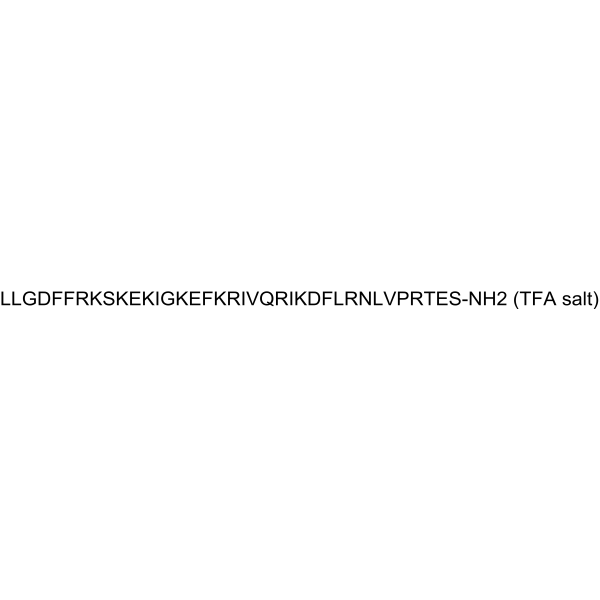
Leu-Leu-Gly-Asp-Phe-Phe-Arg-Lys-Ser-Lys-Glu-Lys-Ile-Gly-Lys-Glu-Phe-Lys-Arg-Ile-Val-Gln-Arg-Ile-Lys-Asp-Phe-Leu-Arg-Asn-Leu-Val-Pro-Arg-Thr-Glu-Ser-NH2
-
Sequence Shortening
LLGDFFRKSKEKIGKEFKRIVQRIKDFLRNLVPRTES-NH2
-
Livraison
Room temperature in continental US; may vary elsewhere.
-
Stockage
Sealed storage, away from moisture and light
Powder -80°C 2 years -20°C 1 year * In solvent : -80°C, 6 months; -20°C, 1 month (sealed storage, away from moisture and light)


Publications (2)
-
Journal Impact Factor
-
Most Recent
-
Eur J Pharmacol
Systemic administration of Neochamaejasmin B inhibits mast cell activation to reduce inflammation in a rosacea mouse model by targeting MRGPRX2. [Abstract]2025 Sep 15:1003:177988. PMID: 40706973 -


Solvant et solubilité
DMSO : 50 mg/mL (Need ultrasonic; Hygroscopic DMSO has a significant impact on the solubility of product, please use newly opened DMSO)


Pureté et documentation
-
Fiche technique (270 KB)
-
SDS (252 KB)
- English - EN (252 KB)
- Français - FR (252 KB)
- Deutsch - DE (252 KB)
- Norwegian - NO (252 KB)
- Español - ES (252 KB)
- Swedish - SV (252 KB)
- Italian - IT (252 KB)
- Korean - KR (252 KB)
- Portuguese - PT (252 KB)
-
Instruction de manipulation (2659 KB)
Références

Calculators
Concentration (start) × Volume (start) = Concentration (final) × Volume (final)


LL-37 amide TFA Related Classifications
HY-P4744A Related Classifications
 Powered by Bioz