



75747-14-7
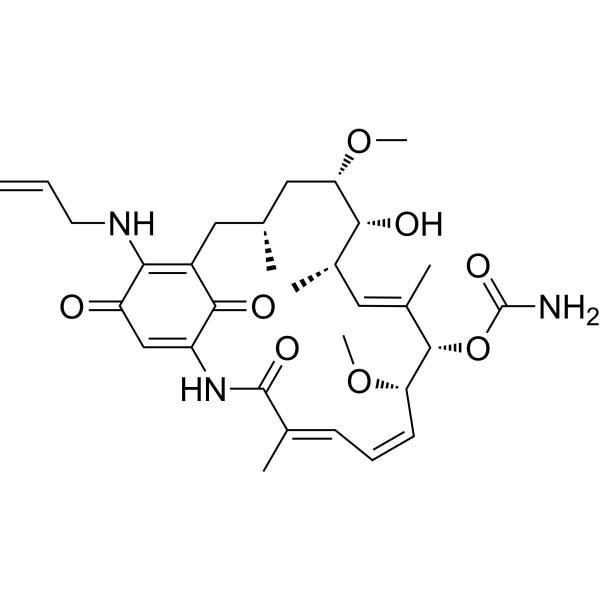
Chemical Structure
Tanespimycin
Synonym(s): 17-AAG; NSC 330507; CP 127374
- CAS No.: 75747-14-7
- Formula:C31H43N3O8
- Molecular Weight:585.69
IUPAC Name: (4E,6Z,8S,9S,10E,12S,13R,14S,16R)-19-(allylamino)-13-hydroxy-8,14-dimethoxy-4,10,12,16-tetramethyl-3,20,22-trioxo-2-azabicyclo[16.3.1]docosa-1(21),4,6,10,18-pentaen-9-yl carbamate
InChIKey: AYUNIORJHRXIBJ-TXHRRWQRSA-N
SMILES: O=C(C(NC(/C(C)=C/C=C\[C@H](OC)[C@H](/C(C)=C/[C@@H]([C@H]([C@H](C[C@@H](C1)C)OC)O)C)OC(N)=O)=O)=CC2=O)C1=C2NCC=C
Biological Activity: Tanespimycin (17-AAG) is a potent HSP90 inhibitor with an IC50 of 5 nM, having a 100-fold higher binding affinity for tumour cell derived HSP90 than normal cell derived HSP90[1][5]. Tanespimycin depletes cellular STK38/NDR1 and reduces STK38 kinase activity. Tanespimycin also downregulates the stk38 gene expression[3].
| Cat. No. | 상품명 | Purity | 제품 설명 | Pricing | |||||||||||||||||||
|---|---|---|---|---|---|---|---|---|---|---|---|---|---|---|---|---|---|---|---|---|---|---|---|
|
|
Tanespimycin | 98.58% | Tanespimycin (17-AAG) is a potent HSP90 inhibitor with an IC50 of 5 nM, having a 100-fold higher binding affinity for tumour cell derived HSP90 than normal cell derived HSP90. Tanespimycin depletes cellular STK38/NDR1 and reduces STK38 kinase activity. Tanespimycin also downregulates the stk38 gene expression. | ||||||||||||||||||||
|
loading...
/
|
|||||||||||||||||||||||
|
|
Tanespimycin (Standard) | 98.72% | Tanespimycin (Standard) is the analytical standard of Tanespimycin. This product is intended for research and analytical applications. Tanespimycin (17-AAG) is a potent HSP90 inhibitor with an IC50 of 5 nM, having a 100-fold higher binding affinity for tumour cell derived HSP90 than normal cell derived HSP90. Tanespimycin depletes cellular STK38/NDR1 and reduces STK38 kinase activity. Tanespimycin also downregulates the stk38 gene expression. | ||||||||||||||||||||
|
loading...
/
|
|||||||||||||||||||||||
|
|
Tanespimycin-d5 | Tanespimycin-d5 (17-AAG-d5; NSC 330507-d5; CP 127374-d5) is the deuterium labeled Tanespimycin (HY-10211). Tanespimycin (17-AAG) is a potent HSP90 inhibitor with an IC50 of 5 nM, having a 100-fold higher binding affinity for tumour cell derived HSP90 than normal cell derived HSP90. Tanespimycin depletes cellular STK38/NDR1 and reduces STK38 kinase activity. Tanespimycin also downregulates the stk38 gene expression. | |||||||||||||||||||||
|
loading...
/
|
|||||||||||||||||||||||
-
Similarity Score 0.89
 HY-10389RAlvespimycin (Standard)
-
Similarity Score 0.89
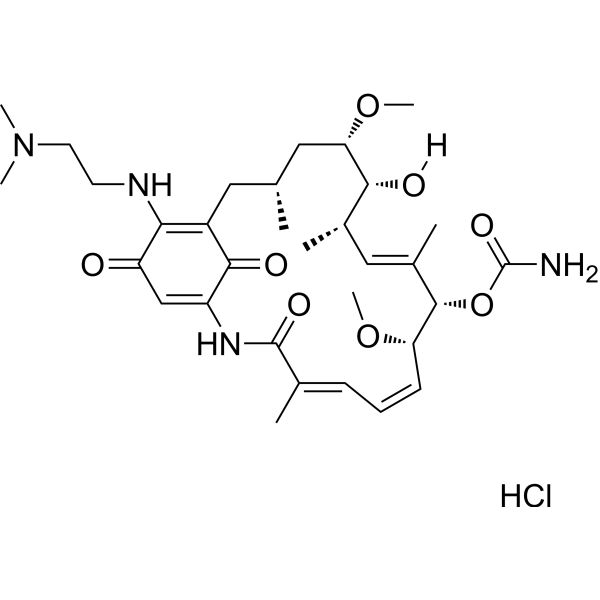 HY-12024Alvespimycin hydrochloride
-
Similarity Score 0.88
 HY-1518917-Aminogeldanamycin
-
Similarity Score 0.88
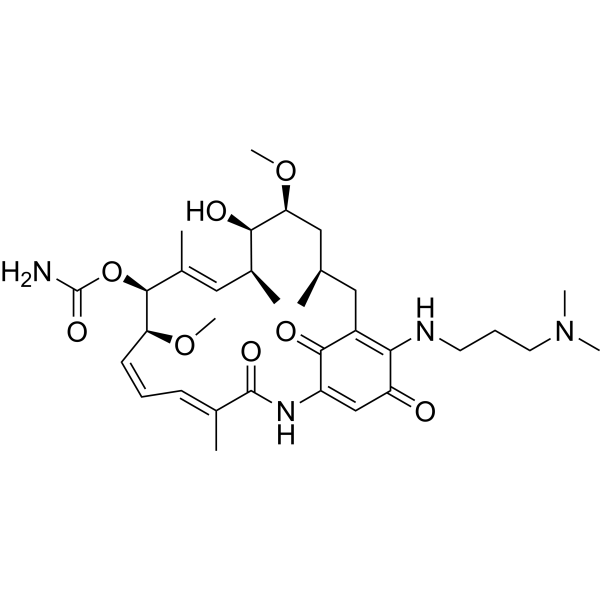 HY-13631217-DMAP-GA
-
Similarity Score 0.87
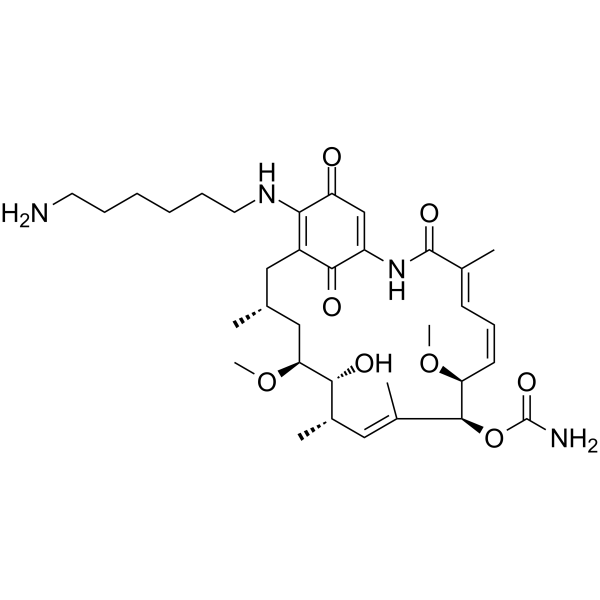 HY-133571Aminohexylgeldanamycin
-
Similarity Score 0.87
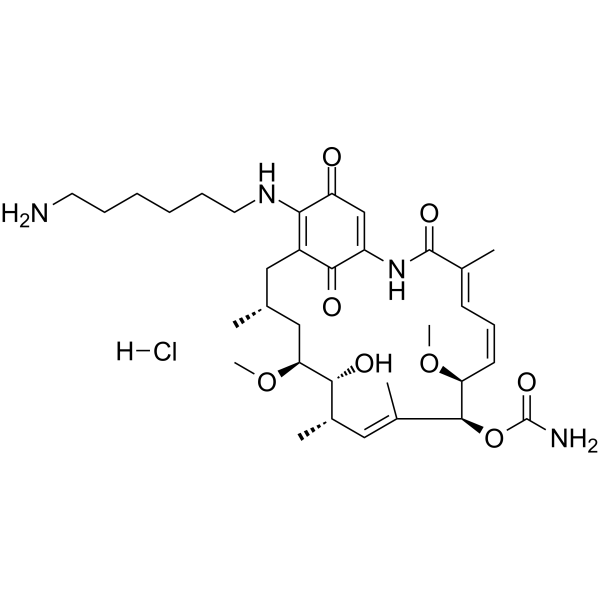 HY-133571AAminohexylgeldanamycin hydrochloride
-
Similarity Score 0.84
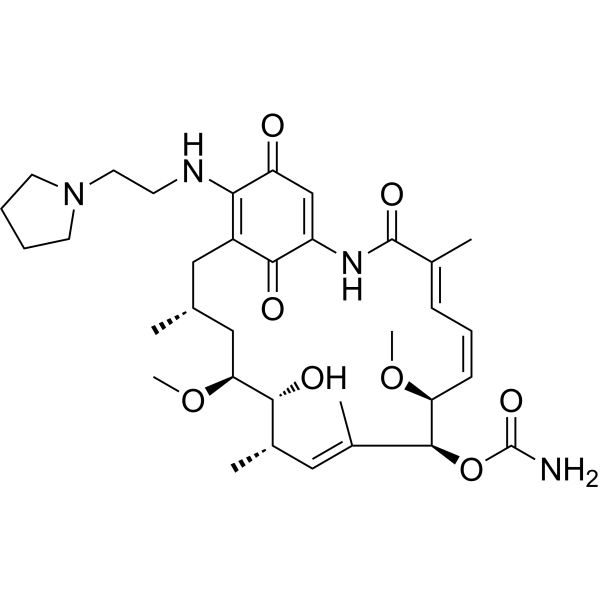 HY-13357017-AEP-GA
-
Similarity Score 0.83
 HY-N1505417-O-Demethylgeldanamycin
-
Similarity Score 0.82
 HY-15230RGeldanamycin (Standard)
-

Explore the MedChemAI to find more analogs


References
- [1]. Solit DB, et al. 17-Allylamino-17-demethoxygeldanamycin induces the degradation of androgen receptor and HER-2/neu and inhibits the growth of prostate cancer xenografts.Clin Cancer Res, 2002, 8(5), 986-993. [Content Brief]
- [3]. Zhang J, et al. The heat shock protein 90 inhibitor 17-AAG suppresses growth and induces apoptosis in human cholangiocarcinoma cells.Clin Exp Med. 2012 Sep 7. [Content Brief]
- [5]. Kamal A, et al. A high-affinity conformation of Hsp90 confers tumour selectivity on Hsp90 inhibitors. Nature. 2003 Sep 25;425(6956):407-10. [Content Brief]



