



Carglumic Acid
Based on 2 publication(s) in Google Scholar
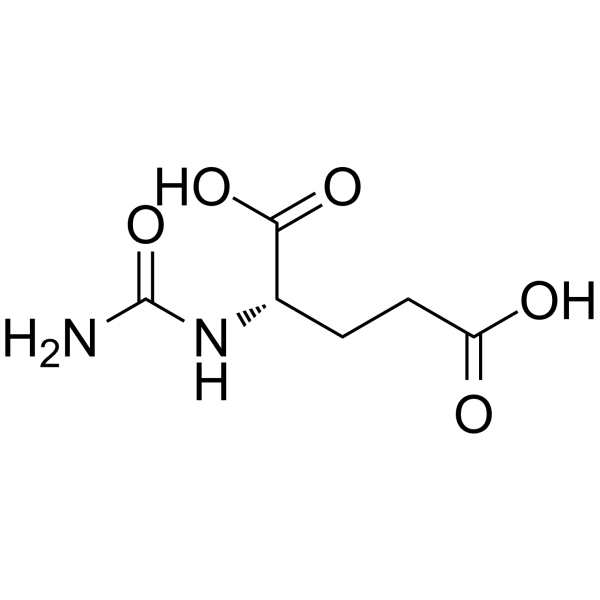
Carglumic acid (N-Carbamyl-L-glutamic acid), a functional analogue of N-acetylglutamate (NAG) and a carbamoyl phosphate synthetase 1 (CPS1) activator, is used to treat acute and chronic hyperammonemia associated with NAG synthase (NAGS) deficiency.
Nos produits utilisent uniquement pour la recherche. Nous ne vendons pas aux patients.
- Pureté: 99.90%
- CAS No.: 1188-38-1
- Formule: C6H10N2O5
- Masse moléculaire:190.15
-
Stockage:Powder -20°C, 3 years , 4°C, 2 years ; In solvent -80°C, 2 years , -20°C, 1 year

To place orders, for customer services and technical support, please contact: MedChemExpress USA
Tel: 609-228-6898 E-mail: [email protected] [email protected]


-
 Activité biologique
-
Chemical Information
-
Solvant et solubilité
- Protocole
- Pureté et documentation
- Références
-
 Help & FAQs
-

Metabolism/Protease Compound Library
HY-L012
-
FDA-Approved Drug Library
HY-L022
-
Anti-Cancer Compound Library
HY-L025
-
Peptidomimetic Library
HY-L033
-
Drug Repurposing Compound Library
HY-L035
-
Anti-COVID-19 Compound Library
HY-L052
-
Orally Active Compound Library
HY-L061
-
FDA Approved & Pharmacopeial Drug Library
HY-L066
-
Anti-Breast Cancer Compound Library
HY-L074
-
Anti-Pancreatic Cancer Compound Library
HY-L077
-
Rare Diseases Drug Library
HY-L102
-
EMA-Approved Drug Library
HY-L116
-
FDA-Approved Anticancer Drug Library
HY-L122
-
Human Metabolite Library
HY-L123
-
Off-patent Drug Library
HY-L141
-
Bioactive Compound Library Max
HY-L181
-
MCE Bioactive Compound Library
HY-L001V
-
Drug Repurposing Compound Library Plus
HY-L035P
-
FDA-Approved Drug Library Plus
HY-L022P
-
FDA-Approved Drug Library Mini
HY-L022M
-
Bioactive Compound Library
HY-L001
-
Non-natural Amino Acid Compound Library
HY-L198
-
High-Throughput Bioactive Compound Library
HY-L205
-
Mass Spectrometry Human Metabolite Library
HY-L215
-
Amino Acid Metabolite Compound Library
HY-L227


Publications Citing Use of MedChemExpress (MCE) Carglumic Acid
More

Activité biologique
|
CPS I |
Carglumic acid suppresses cell viability in the pancreatic ductal adenocarcinoma cell lines, triple-negative breast cancer cell lines, hepatoma cell lines, and human non-small cell lung carcinoma cell lines in a dose-dependent manner. The 50% inhibitory concentration (IC50) of Carglumic acid against those cell lines is between 5 and 7.5 mM. The results show that Carglumic acid does not induce complete cell cycle arrest. Instead, there are more sub-G1 cells among Carglumic acid-treated AsPC1 and MDA-MB-231 cells than among untreated cells. In AsPC1 and HPDE-E6E7 cells, the IC50s of Carglumic acid are 5 mM and over 10 mM, respectively . In MDA-MB-231 and MCF-12A cells, the IC50s of Carglumic acid are 5 mM and 6 mM, respectively[1].
MedChemExpress (MCE) has not independently confirmed the accuracy of these methods. They are for reference only.
MedChemExpress (MCE) has not independently confirmed the accuracy of these methods. They are for reference only.
| NCT Number | Sponsor | Condition | Start Date |
Phase

|
|---|---|---|---|---|
| NCT01329991 | Plexxikon| | 2011-05 | PHASE1 |


Chemical Information
-
CAS No. 1188-38-1
-
Appearance Solid
-
Masse moléculaire 190.15
-
Formule C6H10N2O5
-
Color White to off-white
-
SMILES
O=C(O)CC[C@@H](C(O)=O)NC(N)=O
-
Synonyms
N-Carbamyl-L-glutamic acid
-
Livraison
Room temperature in continental US; may vary elsewhere.
-
Stockage
Powder -20°C 3 years 4°C 2 years In solvent -80°C 2 years -20°C 1 year


Publications (2)
-
Journal Impact Factor
-
Most Recent
-
Mol Ther
RAC1 directly phosphorylates both PKM2 and FBP1 to promote radioresistance in hepatocellular carcinoma. [Abstract]2025 Nov 7:S1525-0016(25)00870-6. PMID: 41204670 -
ACS Omega
Identification of New Modulators and Inhibitors of Palmitoyl-Protein Thioesterase 1 for CLN1 Batten Disease and Cancer. [Abstract]2024 Feb 28;9(10):11870-11882. PMID: 38496939


Solvant et solubilité
DMSO : 100 mg/mL (525.90 mM; Need ultrasonic; Hygroscopic DMSO has a significant impact on the solubility of product, please use newly opened DMSO)
H2O : 10 mg/mL (52.59 mM; Need ultrasonic)
Please refer to the solubility information to select the appropriate solvent. Once prepared, please aliquot and store the solution to prevent product inactivation from repeated freeze-thaw cycles.
Storage method and period of stock solution: -80°C, 2 years; -20°C, 1 year. When stored at -80°C, please use it within 2 years. When stored at -20°C, please use it within 1 year.
* Note: If you choose water as the stock solution, please dilute it to the working solution, then filter and sterilize it with a 0.22 μm filter before use.
Please refer to the solubility information to select the appropriate solvent. Once prepared, please aliquot and store the solution to prevent product inactivation from repeated freeze-thaw cycles.
Storage method and period of stock solution: -80°C, 2 years; -20°C, 1 year. When stored at -80°C, please use it within 2 years. When stored at -20°C, please use it within 1 year.
* Note: If you choose water as the stock solution, please dilute it to the working solution, then filter and sterilize it with a 0.22 μm filter before use.
Concentration (start) × Volume (start) = Concentration (final) × Volume (final)
Select the appropriate dissolution method based on your experimental animal and administration route.
- For the following dissolution methods, please ensure to first prepare a clear stock solution using an In Vitro approach and then sequentially add co-solvents:
- To ensure reliable experimental results, the clarified stock solution can be appropriately stored based on storage conditions. As for the working solution for In Vivo experiments, it is recommended to prepare freshly and use it on the same day.
- The percentages shown for the solvents indicate their volumetric ratio in the final prepared solution. If precipitation or phase separation occurs during preparation, heat and/or sonication can be used to aid dissolution.
Add each solvent one by one: 10% DMSO 40% PEG300 5% Tween-80 45% Saline
Solubility: ≥ 2.5 mg/mL (13.15 mM); Clear solution
This protocol yields a clear solution of ≥ 2.5 mg/mL (saturation unknown).
Taking 1 mL working solution as an example, add 100 μL DMSO stock solution (25.0 mg/mL) to 400 μL PEG300, and mix evenly; then add 50 μL Tween-80 and mix evenly; then add 450 μL Saline to adjust the volume to 1 mL.
Preparation of Saline: Dissolve 0.9 g sodium chloride in ddH₂O and dilute to 100 mL to obtain a clear Saline solution.
Add each solvent one by one: 10% DMSO 90% (20% SBE-β-CD in Saline)
Solubility: ≥ 2.5 mg/mL (13.15 mM); Clear solution
This protocol yields a clear solution of ≥ 2.5 mg/mL (saturation unknown).
Taking 1 mL working solution as an example, add 100 μL DMSO stock solution (25.0 mg/mL) to 900 μL 20% SBE-β-CD in Saline, and mix evenly.
Preparation of 20% SBE-β-CD in Saline (4°C, storage for one week): 2 g SBE-β-CD powder is dissolved in 10 mL Saline, completely dissolve until clear.
Please enter the basic information of animal experiments:
-
-
-
-
Recommended: Prepare an additional quantity of animals to account for potential losses during experiments.
Please enter your animal formula composition:
-
%DMSO +
Recommended: Keep the proportion of DMSO in working solution below 2% if your animal is weak.
-
%+
-
+%Tween-80 + +
-
%Saline +
The co-solvents required include: DMSO, . All of co-solvents are available by MedChemExpress (MCE). , Tween 80. All of co-solvents are available by MedChemExpress (MCE).
Working solution concentration: 0.22 mg/mL
Method for preparing stock solution: mg drug dissolved in μL DMSO. Stock solution concentration: mg/mL.
1. Take μL DMSO stock solution;
2. Add μL .
μL , mix evenly;
3. Then add μL Tween 80, mix evenly;
4. Then add μL
Please ensure that the stock solution in the first step is dissolved to a clear state, and add co-solvents in sequence. You can use ultrasonic heating (ultrasonic cleaner, recommended frequency 20-40 kHz), vortexing, etc. to assist dissolution.

Protocole
Caspase activity is measured by using a fluorimetric caspase-3 assay kit. In brief, cells that are treated with Carglumic Acid or that are left untreated are lysed in a lysis buffer, and 50 μg of protein lysate is incubated with Ac-DEVD-AMC substrate in the assay buffer for 1 h. The resultant fluorescence signals are read by using a fluorometer (excitation 360 nm, emission 460 nm), and the results are tabulated as fold changes relative to the untreated control cells[1].
MedChemExpress (MCE) has not independently confirmed the accuracy of these methods. They are for reference only.
Cell viability is evaluated by MTT (3-(4,5-dimethylthiazol-2-yl)-2,5-diphenyltetrazolium bromide) assay. In brief, various cancer cell lines are seeded (1×10⁴ cells/well) in a 96-well plate and treated with different doses of Carglumic Acid. After 48 h, 50 μL of MTT solution per well (stock solution concentration 5 mg/mL) is added to each well, and the cells are incubated for 2 h more, followed by addition of 100 μL of dimethyl sulfoxide to each well. Absorbance at 570 nm is measured immediately using a multiwell scanner[1].
MedChemExpress (MCE) has not independently confirmed the accuracy of these methods. They are for reference only.
For orthotopic cancer models, AsPC1/luc human pancreatic cancer cells (1×10⁶) are injected into the pancreas of nude mice or MDA-MB-231 human triple-negative breast cancer cells (3×10⁶) are injected into the mammary fat pad of nude mice. Carglumic acid is administered to mice 5 days after tumor inoculation in the pancreatic cancer model and 7 days after tumor inoculation in the triple-negative breast cancer model. Tumor-bearing mice receive a Carglumic acid dose of 120 mg/kg orally every day for 10 days, 60 mg/kg orally three times per week for 2 weeks, or 60 mg/kg intravenously three times per week for 2 weeks. Tumor volume is determined by measuring luciferase signals using the in vivo imaging system in the pancreatic cancer model[1].
MedChemExpress (MCE) has not independently confirmed the accuracy of these methods. They are for reference only.


Pureté et documentation
-
Fiche technique (288 KB)
-
SDS (396 KB)
- English - EN (396 KB)
- Français - FR (396 KB)
- Deutsch - DE (396 KB)
- Norwegian - NO (396 KB)
- Español - ES (396 KB)
- Swedish - SV (396 KB)
- Italian - IT (396 KB)
- Korean - KR (396 KB)
- Portuguese - PT (396 KB)
-
Instruction de manipulation (2659 KB)
Références


Complete Stock Solution Preparation Table
Please refer to the solubility information to select the appropriate solvent. Once prepared, please aliquot and store the solution to prevent product inactivation from repeated freeze-thaw cycles.
Storage method and period of stock solution: -80°C, 2 years; -20°C, 1 year. When stored at -80°C, please use it within 2 years. When stored at -20°C, please use it within 1 year.
| Optional Solvent | Concentration Solvent Mass | 1 mg | 5 mg | 10 mg | 25 mg |
|---|---|---|---|---|---|
| H2O / DMSO | 1 mM | 5.2590 mL | 26.2950 mL | 52.5901 mL | 131.4752 mL |
| 5 mM | 1.0518 mL | 5.2590 mL | 10.5180 mL | 26.2950 mL | |
| 10 mM | 0.5259 mL | 2.6295 mL | 5.2590 mL | 13.1475 mL | |
| 15 mM | 0.3506 mL | 1.7530 mL | 3.5060 mL | 8.7650 mL | |
| 20 mM | 0.2630 mL | 1.3148 mL | 2.6295 mL | 6.5738 mL | |
| 25 mM | 0.2104 mL | 1.0518 mL | 2.1036 mL | 5.2590 mL | |
| 30 mM | 0.1753 mL | 0.8765 mL | 1.7530 mL | 4.3825 mL | |
| 40 mM | 0.1315 mL | 0.6574 mL | 1.3148 mL | 3.2869 mL | |
| 50 mM | 0.1052 mL | 0.5259 mL | 1.0518 mL | 2.6295 mL | |
| DMSO | 60 mM | 0.0877 mL | 0.4383 mL | 0.8765 mL | 2.1913 mL |
| 80 mM | 0.0657 mL | 0.3287 mL | 0.6574 mL | 1.6434 mL | |
| 100 mM | 0.0526 mL | 0.2630 mL | 0.5259 mL | 1.3148 mL |
* Note: If you choose water as the stock solution, please dilute it to the working solution, then filter and sterilize it with a 0.22 μm filter before use.


Carglumic Acid Related Classifications
HY-B0711 Related Classifications
 Powered by Bioz