



Reactive Blue 4
Based on 3 publication(s) in Google Scholar
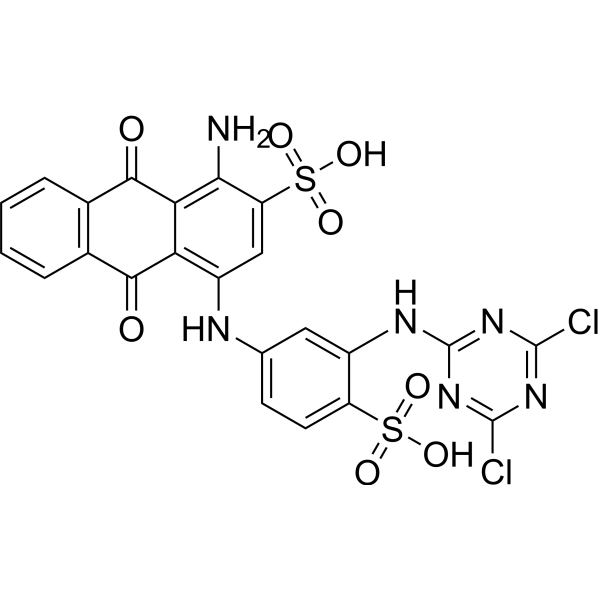
Reactive Blue 4 is an anthraquinone dye used extensively in the textile industry. Reactive Blue 4 is a single colorimetric chemosensor for sequential determination of multiple analytes with different optical responses in aqueous media.
Nos produits utilisent uniquement pour la recherche. Nous ne vendons pas aux patients.
- CAS No.: 13324-20-4
- Formule: C23H14Cl2N6O8S2
- Masse moléculaire:637.43
-
Stockage:
4°C, protect from light
* In solvent : -80°C, 6 months; -20°C, 1 month (protect from light)

To place orders, for customer services and technical support, please contact: MedChemExpress USA
Tel: 609-228-6898 E-mail: [email protected] [email protected]


-
 Activité biologique
-
Chemical Information
-
Solvant et solubilité
- Pureté et documentation
- Références
-
 Help & FAQs


Publications Citing Use of MedChemExpress (MCE) Reactive Blue 4
More

Activité biologique
Reactive Blue 4 (50 μM) can continuously detect copper ions (Cu2+), L-arginine (Arg), and L-cysteine ??(Cys) in water (10.0 mM HEPES buffer, pH 7.0). First, the presence of Cu2+ causes a color change that is visible to the naked eye, and the spectrum changes according to the binding site-signaling subunit method. Subsequently, the Reactive Blue 4-Cu2+ complex was successfully applied to the detection of Cys and Arg through different recognition pathways[1].
The aqueous solution of Reactive Blue 4 is dark blue, and its UV-Vis spectrum demonstrates an absorption peak at 607 nm. Upon the gradual addition of Cu2+ ion to the Reactive Blue 4 solution, a slight red shift from 607 to 619 nm and the gradual decrease in the intensity of absorbance band at 607 nm accompanying with a color change to deep sky blue was observed. Moreover, the existence of an isosbestic point at 645 nm during the titration indicated the formation of a single component[1].
Reactive Blue 4 is common textile dyes that can be adsorbed onto single-walled carbon nanotubes (SWCNTs) through electrostatic interactions, allowing the separation of residual dyes[3].
MedChemExpress (MCE) has not independently confirmed the accuracy of these methods. They are for reference only.


Chemical Information
-
CAS No. 13324-20-4
-
Appearance Solid
-
Masse moléculaire 637.43
-
Formule C23H14Cl2N6O8S2
-
Color Blue to dark blue
-
SMILES
O=S(C(C(N)=C1C2=O)=CC(NC3=CC=C(S(=O)(O)=O)C(NC4=NC(Cl)=NC(Cl)=N4)=C3)=C1C(C5=C2C=CC=C5)=O)(O)=O
-
Livraison
Room temperature in continental US; may vary elsewhere.
-
Stockage
4°C, protect from light
* In solvent : -80°C, 6 months; -20°C, 1 month (protect from light)


Publications (3)
-
Journal Impact Factor
-
Most Recent
-
Int Immunopharmacol
The immunoregulator β-glucan produces antidepressant effects through microglia-mobilized astrocytic P2Y1R-BDNF signaling in the dentate gyrus. [Abstract]2025 Sep 6:165:115494. PMID: 40915186 -
Biochem Biophys Res Commun
2023 Jul 12:665:64-70. PMID: 37149984 -
Pharmacol Biochem Behav
Intranasal LAG3 antibody infusion induces microglia-dependent antidepressant effect by mobilizing astrocytic P2Y1R-mediated BDNF synthesis in the hippocampus. [Abstract]2025 Dec:257:174114. PMID: 41106438


Solvant et solubilité
DMSO : 83.33 mg/mL (130.73 mM; Need ultrasonic; Hygroscopic DMSO has a significant impact on the solubility of product, please use newly opened DMSO)
Please refer to the solubility information to select the appropriate solvent. Once prepared, please aliquot and store the solution to prevent product inactivation from repeated freeze-thaw cycles.
Storage method and period of stock solution: -80°C, 6 months; -20°C, 1 month (protect from light). When stored at -80°C, please use it within 6 months. When stored at -20°C, please use it within 1 month.
Please refer to the solubility information to select the appropriate solvent. Once prepared, please aliquot and store the solution to prevent product inactivation from repeated freeze-thaw cycles.
Storage method and period of stock solution: -80°C, 6 months; -20°C, 1 month (protect from light). When stored at -80°C, please use it within 6 months. When stored at -20°C, please use it within 1 month.
Concentration (start) × Volume (start) = Concentration (final) × Volume (final)


Pureté et documentation
-
Fiche technique (280 KB)
-
SDS (394 KB)
- English - EN (394 KB)
- Français - FR (394 KB)
- Deutsch - DE (394 KB)
- Norwegian - NO (394 KB)
- Español - ES (394 KB)
- Swedish - SV (394 KB)
- Italian - IT (394 KB)
- Korean - KR (394 KB)
- Portuguese - PT (394 KB)
-
Instruction de manipulation (2659 KB)
Références
[1]. Reactive Blue 4 as a Single Colorimetric Chemosensor for Sequential Determination of Multiple Analytes with Different Optical Responses in Aqueous Media: Cu2+-Cysteine Using a Metal Ion Displacement and Cu2+-Arginine Through the Host-Guest Interaction. [Content Brief]
[2]. Chaudhari AU, et al. Effective biotransformation and detoxification of anthraquinone dye reactive blue 4 by using aerobic bacterial granules. Water Res. 2017 Oct 1;122:603-613. [Content Brief]
[3]. Machado FM, et al. Adsorption of Reactive Blue 4 dye from water solutions by carbon nanotubes: experiment and theory. Phys Chem Chem Phys. 2012 Aug 21;14(31):11139-53. [Content Brief]


Complete Stock Solution Preparation Table
Please refer to the solubility information to select the appropriate solvent. Once prepared, please aliquot and store the solution to prevent product inactivation from repeated freeze-thaw cycles.
Storage method and period of stock solution: -80°C, 6 months; -20°C, 1 month (protect from light). When stored at -80°C, please use it within 6 months. When stored at -20°C, please use it within 1 month.
| Optional Solvent | Concentration Solvent Mass | 1 mg | 5 mg | 10 mg | 25 mg |
|---|---|---|---|---|---|
| DMSO | 1 mM | 1.5688 mL | 7.8440 mL | 15.6880 mL | 39.2200 mL |
| 5 mM | 0.3138 mL | 1.5688 mL | 3.1376 mL | 7.8440 mL | |
| 10 mM | 0.1569 mL | 0.7844 mL | 1.5688 mL | 3.9220 mL | |
| 15 mM | 0.1046 mL | 0.5229 mL | 1.0459 mL | 2.6147 mL | |
| 20 mM | 0.0784 mL | 0.3922 mL | 0.7844 mL | 1.9610 mL | |
| 25 mM | 0.0628 mL | 0.3138 mL | 0.6275 mL | 1.5688 mL | |
| 30 mM | 0.0523 mL | 0.2615 mL | 0.5229 mL | 1.3073 mL | |
| 40 mM | 0.0392 mL | 0.1961 mL | 0.3922 mL | 0.9805 mL | |
| 50 mM | 0.0314 mL | 0.1569 mL | 0.3138 mL | 0.7844 mL | |
| 60 mM | 0.0261 mL | 0.1307 mL | 0.2615 mL | 0.6537 mL | |
| 80 mM | 0.0196 mL | 0.0980 mL | 0.1961 mL | 0.4902 mL | |
| 100 mM | 0.0157 mL | 0.0784 mL | 0.1569 mL | 0.3922 mL |


Reactive Blue 4 Related Classifications
HY-125815 Related Classifications
 Powered by Bioz