



CD105 Antibody (YA547)
(Synonyms: ENG; END; Endoglin; CD antigen CD105)Based on 1 Customer Validation
CD105 Antibody (YA547) is a Rabbit-derived and non-conjugated IgG monoclonal antibody, targeting to CD105.
-
Host:
Rabbit
-
Isotype:
IgG
-
Application:
WB, IHC-P, IP
-
Reactivity :
Human
-
Formulation:
Supplied in 50 mM Tris-Glycine (pH 7.4), 0.15 M NaCl, 40% Glycerol and 0.05% BSA. Preservative: 0.01% Sodium azide
-
Conjugation:
Non-conjugated


To place orders, for customer services and technical support, please contact: MedChemExpress USA
Tel: 609-228-6898 E-mail: [email protected] [email protected]





Applications
| Application |
WB

WB: Western Blot
|
IHC-P
IHC-P: Immunohistochemistry-Paraffin
|
IP
IP: Immunoprecipitation
|
|---|---|---|---|
| Dilution Ratio | 1:500-1:1000 | 1:50-1:100 | 1:20 |


Product Details
CD105 Antibody (YA547) is a Rabbit-derived and non-conjugated IgG monoclonal antibody, targeting to CD105.
-
Host Rabbit

-
Clonality Recombinant,Monoclonal

-
Species ReactivityHuman
-
Observed Molecular WeightObserved band size: 95 kDa
Note: Due to possible protein modifications or aggregation, the molecular weight should be confirmed by actual measurement, and the predicted value is for reference only.

-
Calculated Molecular Weight Predicted band size: 71 kDa

Synthetic peptide corresponding to Human CD105.The exact sequence is proprietary to MCE.
Endogenous
affinity purified
Non-conjugated
Unmodified
IgG


Product Properties
-
Appearance
Solution
-
Formulation
Supplied in 50 mM Tris-Glycine (pH 7.4), 0.15 M NaCl, 40% Glycerol and 0.05% BSA. Preservative: 0.01% Sodium azide
-
Concentration
Batch-dependent, Please check the COA for the concentration of each lot. Check Lot Concentration
-
Storage & Stability
Stored at -20°C for 1 year. Avoid repeated freeze / thaw cycles.
-
Shipping
Shipping with blue ice.


Verification Images
-
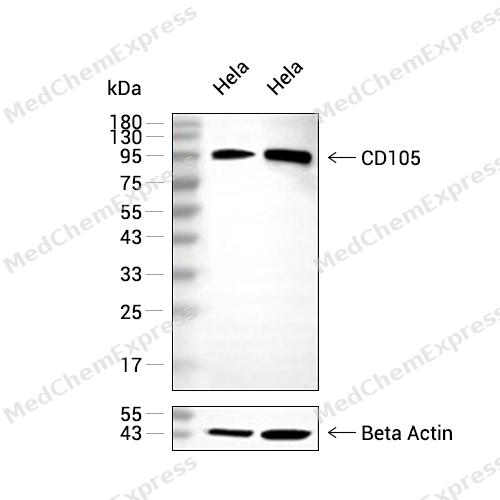 Western blot analysis of extracts from Hela (lane 2(20μg) and Hela (lane 3(40μg) using CD105 (HY-P80591) Rabbit mAb. Proteins were transferred to a PVDF membrane and blocked with 5% non-fat milk in TBST for 2 hour at room temperature. The primary antibody (1/1000) and Loading control antibody (Beta Actin, HY-P80438, 1/10000) was used in 5% non-fat milk in TBST at 4°C overnight. Goat Anti-Mouse IgG-HRP Secondary Antibody (1/10000) was used for 1 hour at room temperature.


Background
-
Function
CD105 (Endoglin, ENG) is a TGF-β receptor accessory protein primarily expressed on mesenchymal stem cells and activated endothelial cells; it serves as a classic positive marker for the identification of mesenchymal stem cells (MSCs) and is a key target in research concerning angiogenesis, tumor neovascularization, and fibrosis.
-
Subcellular Localization
Cell membrane; Single-pass type I membrane protein
-
Expression
Tissue_specificity:Detected in umbilical cord membrane endothelial cells (PubMed: 10625079) . Detected in the placenta (protein level) (PubMed: 1692830) . Detected in endothelial cells (PubMed: 1692830) . -
Isoforms & Post-Translational Modification
CD105 has 2 isomers: P17813-1: 70578 Da (predicted); P17813-2: 67542 Da (predicted).
-
Subunit
Homodimer; disulfide-linked. Forms a heteromeric complex with the signaling receptors for transforming growth factor-beta: TGFBR1 and/or TGFBR2. It is able to bind TGFB1 and TGFB2 with high affinity, but not TGFB3. Interacts with GDF2, forming a heterotetramer with a 2:2 stoichiometry. Interacts with ACVRL1. Can form a heteromeric complex with GDF2 and ACVRL1. Interacts with BMP10. Interacts with DYNLT4. Interacts with ARRB2
-
SwissProt ID
-
Synonyms
ENG; END; Endoglin; CD antigen CD105
-
Research Field
Epigenetics and Nuclear Signaling


Documentation
-
Data Sheet (262 KB)
-
SDS (251 KB)
- English - EN (251 KB)
- Français - FR (251 KB)
- Deutsch - DE (251 KB)
- Norwegian - NO (251 KB)
- Español - ES (251 KB)
- Swedish - SV (251 KB)
- Italian - IT (251 KB)
- Korean - KR (251 KB)
- Portuguese - PT (251 KB)
-
User Guide for Antibodies (1077 KB)
References
[1]. Castonguay R, et al. Soluble endoglin specifically binds bone morphogenetic proteins 9 and 10 via its orphan domain, inhibits blood vessel formation, and suppresses tumor growth. J Biol Chem. 2011 Aug 26;286(34):30034-46. [Content Brief]
[2]. Nolan-Stevaux O, et al. Endoglin requirement for BMP9 signaling in endothelial cells reveals new mechanism of action for selective anti-endoglin antibodies. PLoS One. 2012;7(12):e50920. [Content Brief]
[3]. McAllister KA, et al. Endoglin, a TGF-beta binding protein of endothelial cells, is the gene for hereditary haemorrhagic telangiectasia type 1. Nat Genet. 1994 Dec;8(4):345-51. [Content Brief]
[4]. Lee NY, et al. The interaction of endoglin with beta-arrestin2 regulates transforming growth factor-beta-mediated ERK activation and migration in endothelial cells. J Biol Chem. 2007 Jul 20;282(29):21507-17. [Content Brief]
[5]. Gougos A, et al. Primary structure of endoglin, an RGD-containing glycoprotein of human endothelial cells. J Biol Chem. 1990 May 25;265(15):8361-4. [Content Brief]
[6]. Alt A, et al. Structural and functional insights into endoglin ligand recognition and binding. PLoS One. 2012;7(2):e29948. [Content Brief]
[7]. Bellón T, et al. Identification and expression of two forms of the human transforming growth factor-beta-binding protein endoglin with distinct cytoplasmic regions. Eur J Immunol. 1993 Sep;23(9):2340-5. [Content Brief]

 Powered by Bioz
