



Hyponatremia
-
Hyponatremia (6)


- Formula: C32H26N4O2
- Molecular Weight: 498.57
Conivaptan (YM 087 free base) is an orally active dual vasopressin V1a/V2 receptor antagonist with Ki values of 0.48 nM and 3.04 nM for vasopressin V1a receptor and V2 receptor, respectively. Conivaptan competitively and reversibly blocks vasopressin-mediated antidiuresis, vasoconstriction, and cellular hypertrophy, while inhibiting CYP3A4. Conivaptan inhibits vasopressin-induced intracellular calcium, cAMP, and mitogen-activated kinase activation in vascular smooth muscle cells and cardiomyocytes. Conivaptan induces water diuresis while improving hemodynamics in heart failure models, reducing left ventricular end-diastolic pressure, vascular resistance, and organ weight. Conivaptan is used for research on hyponatremia and congestive heart failure.
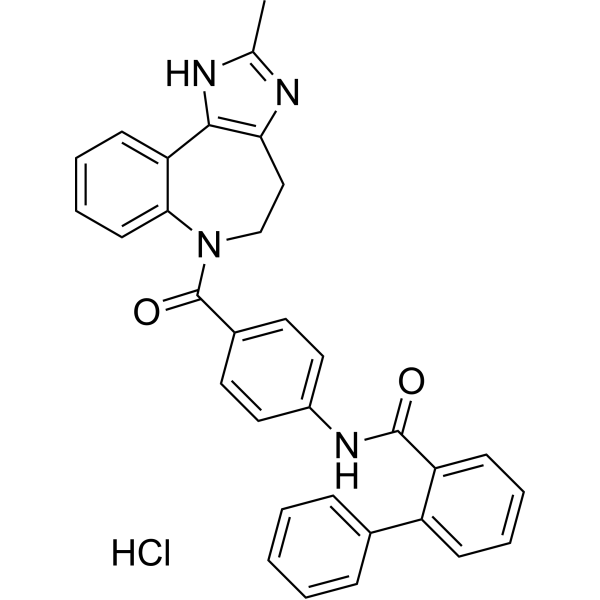
- Formula: C32H27ClN4O2
- Molecular Weight: 535.04
Conivaptan hydrochloride (YM 087) is an orally active dual vasopressin V1a/V2 receptor antagonist with Ki values of 0.48 nM and 3.04 nM for vasopressin V1a receptor and V2 receptor, respectively. Conivaptan hydrochloride competitively and reversibly blocks vasopressin-mediated antidiuresis, vasoconstriction, and cellular hypertrophy, while inhibiting CYP3A4. Conivaptan hydrochloride inhibits vasopressin-induced intracellular calcium, cAMP, and mitogen-activated kinase activation in vascular smooth muscle cells and cardiomyocytes. Conivaptan hydrochloride induces water diuresis while improving hemodynamics in heart failure models, reducing left ventricular end-diastolic pressure, vascular resistance, and organ weight. Conivaptan hydrochloride is used for research on hyponatremia and congestive heart failure.
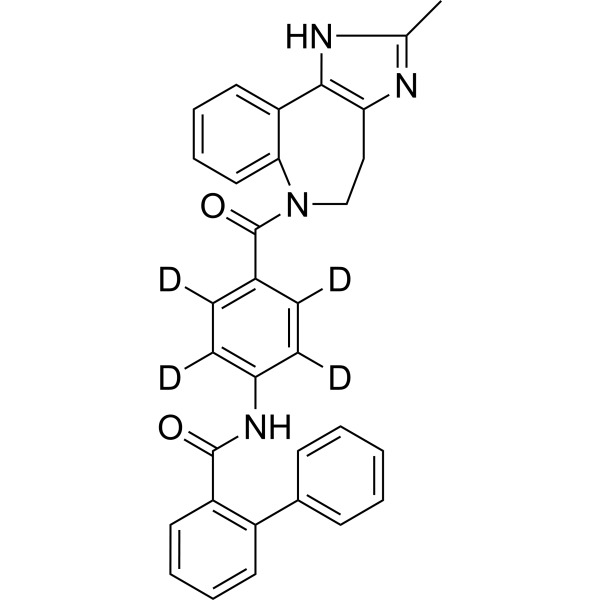
- Formula: C32H22D4N4O2
- Molecular Weight: 502.60
Conivaptan-d4 (YM 087-d4) is the deuterated-labeled Conivaptan (HY-18347). Conivaptan (YM 087 free base) is an orally active dual vasopressin V1a/V2 receptor antagonist with Ki values of 0.48 nM and 3.04 nM for vasopressin V1a receptor and V2 receptor, respectively. Conivaptan competitively and reversibly blocks vasopressin-mediated antidiuresis, vasoconstriction, and cellular hypertrophy, while inhibiting CYP3A4. Conivaptan inhibits vasopressin-induced intracellular calcium, cAMP, and mitogen-activated kinase activation in vascular smooth muscle cells and cardiomyocytes. Conivaptan induces water diuresis while improving hemodynamics in heart failure models, reducing left ventricular end-diastolic pressure, vascular resistance, and organ weight. Conivaptan is used for research on hyponatremia and congestive heart failure.

- Formula: C16H15N3O3S2
- Molecular Weight: 361.44
M353-0039 is a selective UT-A2 inhibitor with a human IC50 of 0.35 μM. M353-0039 blocks urea transport mediated by UT-A2. M353-0039 can be used for the study of hyponatremia and edema associated with congestive heart failure, nephrotic syndrome, and cirrhosis.

- Formula: C19H19N3O3
- Molecular Weight: 337.37
E822-1968 is an UT-A2 inhibitor with a human IC50 of 0.44 μM. E822-1968 blocks urea transport mediated by UT-A2. E822-1968 can be used for the study of hyponatremia and edema associated with congestive heart failure, nephrotic syndrome, and cirrhosis.

- Formula: C32H27ClN4O2
- Molecular Weight: 535.04
Conivaptan hydrochloride (Standard) (YM 087 (Standard)) is the analytical standard of Conivaptan hydrochloride (HY-18347A). This product is intended for research and analytical applications. Conivaptan hydrochloride is an orally active dual vasopressin V1a/V2 receptor antagonist with Ki values of 0.48 nM and 3.04 nM for vasopressin V1a receptor and V2 receptor, respectively. Conivaptan hydrochloride competitively and reversibly blocks vasopressin-mediated antidiuresis, vasoconstriction, and cellular hypertrophy, while inhibiting CYP3A4. Conivaptan hydrochloride inhibits vasopressin-induced intracellular calcium, cAMP, and mitogen-activated kinase activation in vascular smooth muscle cells and cardiomyocytes. Conivaptan hydrochloride induces water diuresis while improving hemodynamics in heart failure models, reducing left ventricular end-diastolic pressure, vascular resistance, and organ weight. Conivaptan hydrochloride is used for research on hyponatremia and congestive heart failure.



