



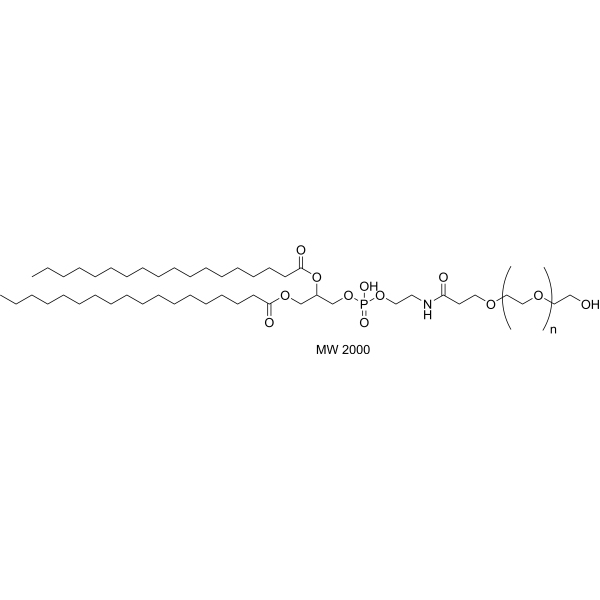
DSPE-PEG2000-OH
Based on 1 publication(s) in Google Scholar
DSPE-PEG2000-OH is an absorption enhancer. DSPE-PEG2000-OH reduces the expression levels of ZO-1 and Occludin. DSPE-PEG2000-OH enhances the pulmonary absorption of poorly absorbable macromolecules via the paracellular pathway without altering pulmonary membrane fluidity.
For research use only. We do not sell to patients.
- Purity : 99.89%
- Molecular Weight:2000 (Average)
-
Storage:Powder -20°C, 3 years ; In solvent -80°C, 6 months , -20°C, 1 month

To place orders, for customer services and technical support, please contact: MedChemExpress USA
Tel: 609-228-6898 E-mail: [email protected] [email protected]


-
 Biological Activity
-
Chemical Information
-
Solvent & Solubility
- Protocols
- Purity & Documentation
- References
-
 Help & FAQs


Publications Citing Use of MedChemExpress (MCE) DSPE-PEG2000-OH
More

Biological Activity
Description
In Vitro
DSPE-PEG2000-OH (1% (w/v); 20 min) does not alter the fluidity of isolated rat lung membrane vesicles, as measured by fluorescence polarization using DPH and TMA-DPH probes[1].
MedChemExpress (MCE) has not independently confirmed the accuracy of these methods. They are for reference only. Further protocols information, click here.
In Vivo
DSPE-PEG-OH (0.1-1.0% (w/v); intratracheal administration; single dose; 1.0% (w/v); intratracheal administration; once weekly; for 2 consecutive weeks) does not induce significant local pulmonary membrane damage in brown rats (rats) at doses up to 1.0% (w/v), whether administered as a single intratracheal dose or once weekly for 2 consecutive weeks[1].
MedChemExpress (MCE) has not independently confirmed the accuracy of these methods. They are for reference only.
-
Animal Model:Sprague Dawley (SD) (Male, ~250 g, ~8 weeks old)[1]
-
Dosage:0.1% (w/v), 0.5% (w/v), 1.0% (w/v), 2.0% (w/v)
-
Administration:intrapulmonary; single dose
-
Result:Increased FD4 Cmax to 1.48 μg/mL, AUC0-240min to 273.34 μg·min/mL, and enhancement ratio to 1.2 at 0.1% dose; increased FD4 Cmax to 3.15 μg/mL, AUC0-240min to 511.90 μg·min/mL, and enhancement ratio to 2.2 at 0.5% dose (p < .01); increased FD4 Cmax to 9.21 μg/mL, AUC0-240min to 1013.99 μg·min/mL, and enhancement ratio to 4.3 at 1.0% dose (p < .01); increased FD4 Cmax to 7.53 μg/mL, AUC0-240min to 937.40 μg·min/mL, and enhancement ratio to 3.9 at 2.0% dose (p < .01).
Increased FD10 Cmax to 1.34 μg/mL, AUC0-240min to 228.92 μg·min/mL, and enhancement ratio to 1.8 at 0.1% dose (p < .01); increased FD10 Cmax to 2.32 μg/mL, AUC0-240min to 374.12 μg·min/mL, and enhancement ratio to 2.9 at 0.5% dose (p < .01); increased FD10 Cmax to 3.78 μg/mL, AUC0-240min to 585.89 μg·min/mL, and enhancement ratio to 4.5 at 1.0% dose (p < .01).
Increased FD70 Cmax to 0.25 μg/mL, AUC0-240min to 37.64 μg·min/mL, and enhancement ratio to 3.7 at 0.5% dose (p < .01); increased FD70 Cmax to 0.25 μg/mL, AUC0-240min to 38.43 μg·min/mL, and enhancement ratio to 3.7 at 1.0% dose (p < .01); showed no significant enhancement for FD70 at 0.1% dose.
Increased calcitonin D% to 30.21, AAC0-240min to 117.42, and enhancement ratio to 3.0 at 1.0% dose (p < .01).
Increased insulin D% to 60.19, AAC0-240min to 12.76, and enhancement ratio to 1.4 at 1.0% dose, with no statistically significant difference compared to control.
-
Animal Model:Sprague Dawley (SD) (Male, ~250 g, ~8 weeks old)[1]
-
Dosage:0.1% (w/v), 0.5% (w/v), 1.0% (w/v) (single dose); 1.0% (w/v) (2 consecutive weekly doses)
-
Administration:intrapulmonary; single dose; intrapulmonary; weekly; 2 weeks
-
Result:Showed no obvious lung tissue damage compared to PBS control at all tested single doses, unlike positive control NaDC which caused significant tissue changes.
Exhibited no statistically significant difference in BALF protein and lactate dehydrogenase (LDH) levels compared to PBS control at 4 h post single dose administration.
Showed no statistically significant difference in BALF protein and LDH levels compared to PBS control after 2 consecutive weekly doses of 1.0% (w/v), unlike positive control NaDC which caused a dramatic increase in both markers.


Chemical Information
-
Appearance Solid
-
Molecular Weight 2000 (Average)
-
Color White to off-white
-
SMILES
CCCCCCCCCCCCCCCCCC(OC[C@](OC(CCCCCCCCCCCCCCCCC)=O)([H])COP(O)(OCCNC(OCCOCCO)=O)=O)=O.[n]
-
Shipping
Room temperature in continental US; may vary elsewhere.
-
Storage
Powder -20°C 3 years In solvent -80°C 6 months -20°C 1 month


Publications (1)
-
Journal Impact Factor
-
Most Recent
-
J Nanobiotechnology
Targeted delivery and ROS-responsive release of Resolvin D1 by platelet chimeric liposome ameliorates myocardial ischemia-reperfusion injury. [Abstract]2022 Oct 20;20(1):454. PMID: 36266658


Solvent & Solubility
In Vitro:
Ethanol : 100 mg/mL (Need ultrasonic)

Protocols
-
RNA extraction experimental
By lysing cells, releasing RNA, and removing impurities such as proteins and DNA, high-purity RNA products are finally obtained. The commonly used traditional method is the guanidine isothiocyanate/phenol/chloroform method (Trizol), which is suitable for a variety of animal materials including animal tissues, microorganisms, cultured cells, etc., and most plant materials.


Purity & Documentation
-
Data Sheet (274 KB)
-
SDS (251 KB)
- English - EN (251 KB)
- Français - FR (251 KB)
- Deutsch - DE (251 KB)
- Norwegian - NO (251 KB)
- Español - ES (251 KB)
- Swedish - SV (251 KB)
- Italian - IT (251 KB)
- Korean - KR (251 KB)
- Portuguese - PT (251 KB)
-
Handling Instructions (2659 KB)
References

Calculators
Concentration (start) × Volume (start) = Concentration (final) × Volume (final)


DSPE-PEG2000-OH Related Classifications
HY-140741 Related Classifications
 Powered by Bioz