



Epiboxidine
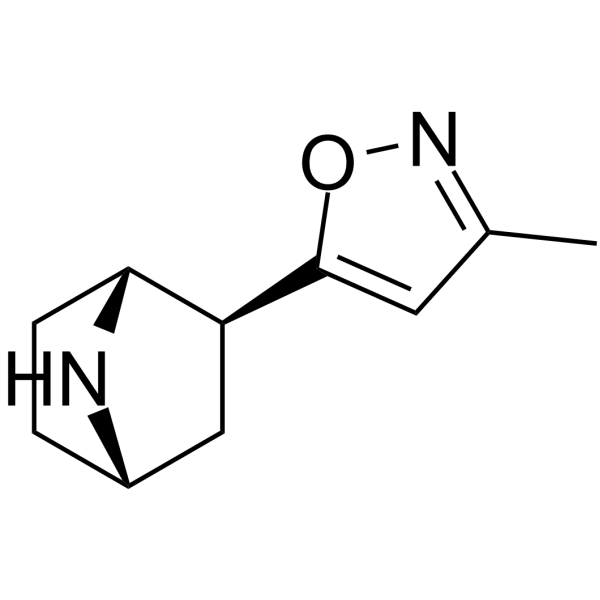
Epiboxidine is a potent and selective neural nAChR agonist with Kis of 0.46 nM and 1.2 nM for rat and human α4β2 nAChRs, respectively. Epiboxidine is a methylisoxazole analog of the alkaloid Epibatidine, and is also an analog of another nAChR agonist, ABT 418.
For research use only. We do not sell to patients.
- CAS No.: 188895-96-7
- Formula: C10H14N2O
- Molecular Weight:178.23
-
Storage:
Please store the product under the recommended conditions in the Certificate of Analysis.

To place orders, for customer services and technical support, please contact: MedChemExpress USA
Tel: 609-228-6898 E-mail: [email protected] [email protected]


-
 Biological Activity
-
Chemical Information
- Purity & Documentation
- References
-
 Help & FAQs




Biological Activity
Description
IC50 & Target
Ki: 0.46 nM (rat α4β2 nAChR) and 1.2 nM (human α4β2 nAChR)[1]
In Vitro
Epiboxidine has affinity and functional at central neuronal α4β2 receptors, with Kis of 0.46 and 1.2 in rat and humen[1].
Epiboxidine has activity at ganglionic-type α3β4*-nicotinic receptors of PC12 cells, with a Ki of 19[1].
Epiboxidine is much less toxic than Epibatidine[1].
Epiboxidine stimulates sodium-22 influx in PC12 and TE671 cells, with EC50s of 0.18 and 2.6 µM[2].
MedChemExpress (MCE) has not independently confirmed the accuracy of these methods. They are for reference only.
In Vivo
Epiboxidine (50 and 100 mg/kg; intraperitoneal injected; once) causes marked antinociception as measured in the hot-plate assay[2].
Epiboxidine inhibits [3H]nicotine binding in rat cerebral cortical membranes, with a Ki of 0.6 nM[2].
MedChemExpress (MCE) has not independently confirmed the accuracy of these methods. They are for reference only.
-
Animal Model:Adult male NIH Swiss strain mice (25-30 g)[2]
-
Dosage:50 and 100 mg/kg
-
Administration:I.p.; once
-
Result:Caused a dose-related Straub tail, hypomotility, hypoventilation and piloerection.


Chemical Information
-
CAS No. 188895-96-7
-
Molecular Weight 178.23
-
Formula C10H14N2O
-
SMILES
CC1=NOC([C@@H]2[C@@H]3N[C@@H](CC3)C2)=C1
-
Shipping
Room temperature in continental US; may vary elsewhere.
-
Storage
Please store the product under the recommended conditions in the Certificate of Analysis.


Purity & Documentation
References
[1]. Fitch RW, et al. Homoepiboxidines: further potent agonists for nicotinic receptors. Bioorg Med Chem. 2004;12(1):179-190. [Content Brief]
[2]. Badio B, et al. Synthesis and nicotinic activity of epiboxidine: an isoxazole analogue of epibatidine. Eur J Pharmacol. 1997;321(2):189-194. [Content Brief]

Calculators
Concentration (start) × Volume (start) = Concentration (final) × Volume (final)


Epiboxidine Related Classifications
HY-138953 Related Classifications
 Powered by Bioz