



Darodipine
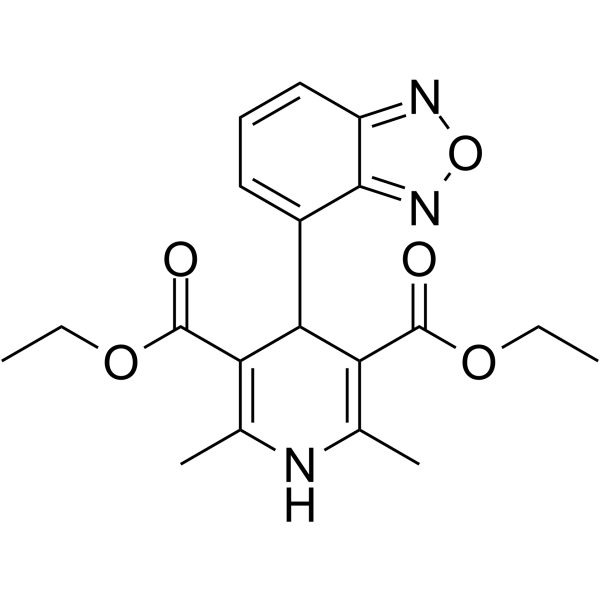
Darodipine (PY 108-068, PY-108068) is a potent calcium channel antagonist.
Para uso exclusivo en investigación. No vendemos a pacientes.
- No. CAS: 72803-02-2
- Fòrmula: C19H21N3O5
- Peso molecular:371.39
-
Almacenamiento:
Please store the product under the recommended conditions in the Certificate of Analysis.

To place orders, for customer services and technical support, please contact: MedChemExpress USA
Tel: 609-228-6898 E-mail: [email protected] [email protected]


-
 Actividad biológica
-
Chemical Information
- Protocolo
- Pureza y Documentación
- Referencias
-
 Help & FAQs


Ver todos los productos específicos de isoformas Calcium Channel
More

Actividad biológica
MedChemExpress (MCE) has not independently confirmed the accuracy of these methods. They are for reference only.


Chemical Information
-
No. CAS 72803-02-2
-
Peso molecular 371.39
-
Fòrmula C19H21N3O5
-
SMILES
O=C(C1=C(C)NC(C)=C(C(OCC)=O)C1C2=CC=CC3=NON=C32)OCC
-
Synonyms
PY 108-068; PY-108068
-
Envío
Room temperature in continental US; may vary elsewhere.
-
Almacenamiento
Please store the product under the recommended conditions in the Certificate of Analysis.

Protocolo
Rats: Male Wistar rats are used. Twelve-month-old rats are left untreated and used as adult reference animals. Twenty-one-month-old rats are allotted randomly to two groups of 8 animals each. Rats of the first group receive an oral daily dose of 5 mg/kg of darodipine in drinking water. The animals of the second group are left untreated and served as a control group. Rats of these two groups are allowed to survive for 6 months, until 27 months of age (old rats). Darodipine-treated rats have water consumption determined every second day and body weight determined weekly[1].
MedChemExpress (MCE) has not independently confirmed the accuracy of these methods. They are for reference only.


Pureza y Documentación
Referencias
[1]. Amenta F, et al. Effect of long-term treatment with the dihydropyridine-type calcium channel blocker darodipine(PY 108-068) on the cerebral capillary network in aged rats. Mech Ageing Dev. 1995 Jan 31;78(1):27-37. [Content Brief]
[2]. Vega JA, et al. Effect of treatment with the dihydropyridine-type calcium antagonist darodipine (PY 108-068) on the expression of neurofilament protein immunoreactivity in the cerebellar cortex of aged rats. Mech Ageing Dev. 1994 Aug;75(2):169-77. [Content Brief]

Calculators
Concentration (start) × Volume (start) = Concentration (final) × Volume (final)


Darodipine Related Classifications
HY-U00086 Related Classifications
 Powered by Bioz