14 Results for "

Bioconjugates

" in MedChemExpress (MCE) Product Catalog:
Products (14)

14 Results for "Bioconjugates" in MCE Product Catalog:

1
1 Cited Publications
Cat. No.: HY-135140
CAS No.: 1345955-28-3
Purity:  98.02%
Research Areas:  

Others

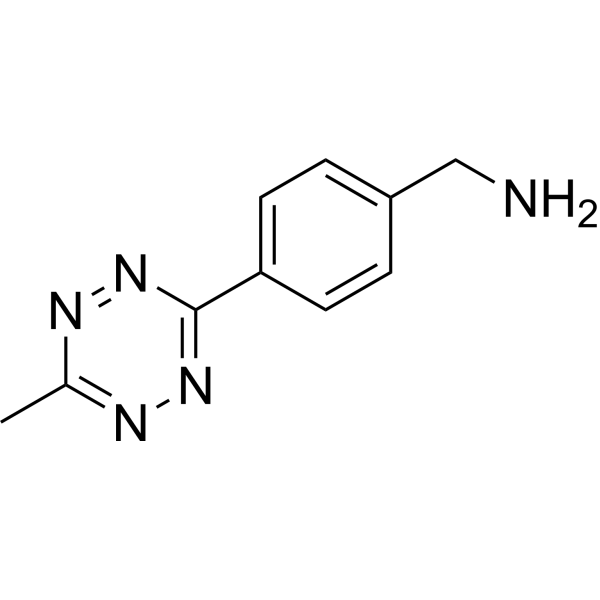
Methyltetrazine-amine, a tetrazine compound, is used for the site-specific dual functionalization of the resulting bioconjugates .
loading...
    loading...
1
1 Cited Publications
Cat. No.: HY-135140A
CAS No.: 1596117-29-1
Purity:  99.74%
Research Areas:  

Others

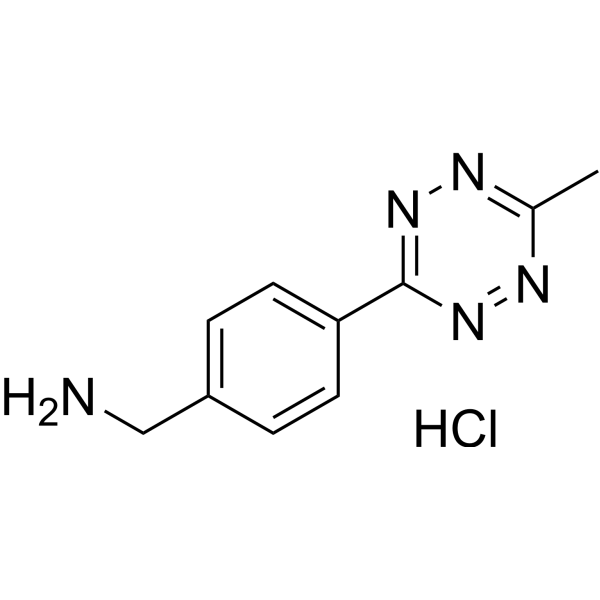
Methyltetrazine-Amine hydrochloride is a tetrazine compound. Methyltetrazine-Amine hydrochloride can be used for the site-specific dual functionalization of the resulting bioconjugates. Methyltetrazine-Amine hydrochloride can be added during protein precipitation in experiments using trans-cyclooctene .
loading...
    loading...
Cat. No.: HY-W105411
CAS No.: 6342-17-2
N,N'-Diacryloylpiperazine can be used to synthesize bioconjugates and other compounds, and can also be used in the fields of medicine and biotechnology. N,N'-Diacryloylpiperazine is a biomaterial or organic compound that can be used for life science research .
loading...
    loading...
Cat. No.: HY-134566
CAS No.: 145195-58-0
Purity:  ≥91.0%
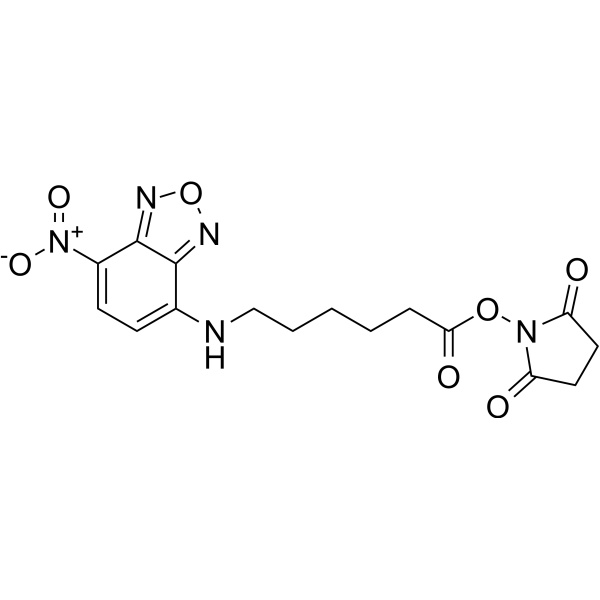
NBD-X, SE, the acceptor fluorophore, can be used to create environment sensitive bioconjugates .
loading...
    loading...
Cat. No.: HY-W040291
CAS No.: 96735-88-5
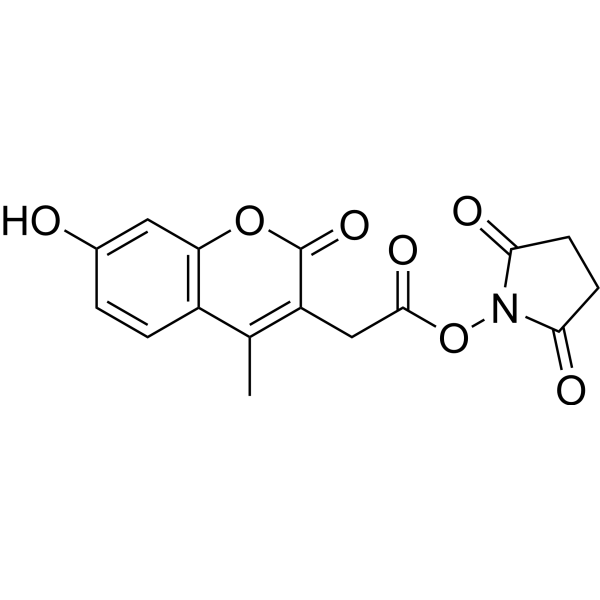
7-Hydroxy-4-methylcoumarin-3-acetic acid, SE is a blue fluorophore that has pH-dependent and environment-sensitive fluorescence. It is widely used for preparing bioconjugates of blue fluorescence.
loading...
    loading...
Cat. No.: HY-160045
Research Areas:  

Cancer

AP1153 aptamer sodium is a DNA aptamer that specifically binds to the cholecystokinin receptor CCKBR (Kd: ~15 pM), but does not activate CCKBR-related signaling pathways. AP1153 aptamer sodium is internalized by pancreatic ductal adenocarcinoma (PDAC) cells in a receptor-mediated manner. AP1153 aptamer sodium can bioconjugate to the surface of fluorescent nanoparticles to facilitate nanoparticle delivery to PDAC tumors in vivo .
loading...
    loading...
Cat. No.: HY-149744
CAS No.: 2408732-52-3
Research Areas:  

Inflammation/Immunology

FXb is an immunizing and functionalized hapten and can be used for protein bioconjugates preparation .
loading...
    loading...
Cat. No.: HY-175423
Research Areas:  

Metabolic Disease

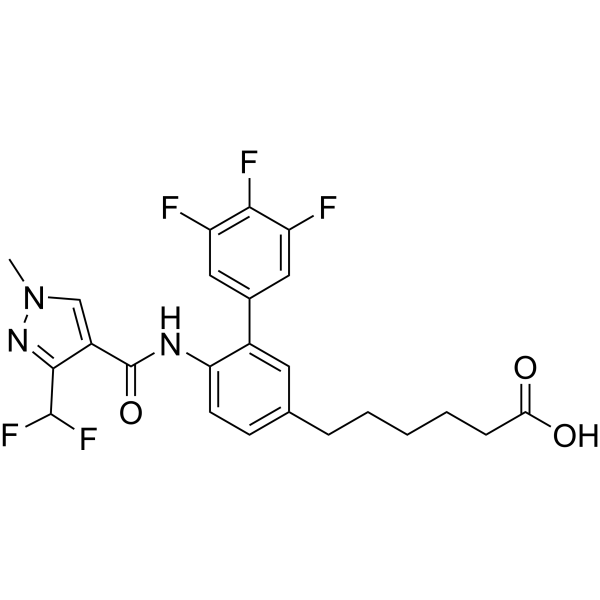
DHODH-IN-30 (compound 4g) is a potent human dihydroorotate dehydrogenase (hDHODH) inhibitor with an IC50 of 32 nM. DHODH-IN-30 exhibits protective effects against oxidative stress .
loading...
    loading...
Cat. No.: HY-164084
CAS No.: 2849417-34-9
Research Areas:  

Others

DBCO-NHCO-C5-O-phenylethenesulfonyl fluoride is a DBCO containing linker, which can be used in bioconjugate, drug delivery and other biochemical research .
loading...
    loading...
Cat. No.: HY-D2757
CAS No.: 135926-06-6
5(6)-Carboxyrhodamine 110 NHS Ester is the nonsulfonated analog of the BP Fluor 488 dye. The amine-reactive 5(6)-Carboxyrhodamine 110 NHS ester can be used to create bright and photostable green-fluorescent bioconjugates with excitation/emission maxima ~502/527 nm. The conjugates of this dye often used for Fluorescence Correlation Spectroscopy (FCS).
loading...
    loading...
Cat. No.: HY-155466
CAS No.: 3056144-84-1
Target:  

Dopamine Receptor

Research Areas:  

Neurological Disease

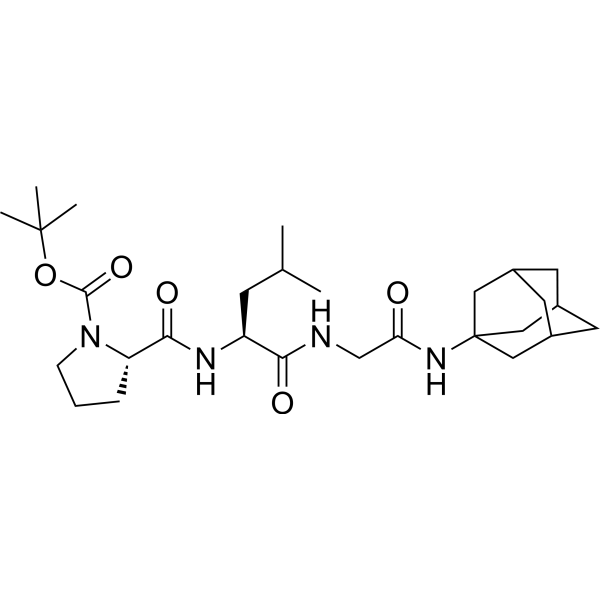
Boc-MIF-1-Am (compound 2) is a human dopamine D2 receptor enhancer (EC50=17.82 nM) and is a bioconjugate of melanostatin (MIF-1) and amantadine. Boc-MIF-1-Am (200 μM) exhibited mild neurotoxicity in SH-SY5Y cells .
loading...
    loading...
Cat. No.: HY-D2165
AF 594 streptavidin is a bioconjugating agent. It consists of AF 594 and streptomycin, a streptomycin derivative of the red fluorescent dye AF 594. AF 594 has high fluorescence quantum yield and high photostability (Ex=594 nm, Em=615 nm). AF 594 streptavidin can be selectively conjugated to streptavidin-modified molecules via a streptomycin-modifying group for fluorescent labeling and spectroscopic analysis .
loading...
    loading...
Cat. No.: HY-D2773
CAS No.: 219729-26-7
5-Carboxyrhodamine 110 NHS Ester is the nonsulfonated analog of the BP Fluor 488 dye. The amine-reactive 5(6)-Carboxyrhodamine 110 NHS Ester can be used to create bright and photostable green-fluorescent bioconjugates with excitation/emission maxima ~502/527 nm. For many applications, the dye is preferred over 5-(6)-carboxyfluorescein NHS ester or FITC because of its exceptional photostability and fluorescence insensitivity to pH (4-9). Although the mixed isomers of Carboxyrhodamine 110 NHS Ester preferred, routinely used fluorescent dye for labeling proteins, peptides and nucleotides, purification of peptide and nucleotides labeled with 5(6) isomers might be troublesome due to significant signal broadening in HPLC purification. Peptides and nucleotides labeled with a single isomer usually give better resolution in HPLC purification that is often required in the conjugation processes.
loading...
    loading...
Cat. No.: HY-L167
164 compounds

Boric acid is a stable and usually non-toxic group widely used in modern synthesis to form C-C and C-heteroatom bonds. Boric acid exhibits exquisite reversible coordination characteristics and can be explored as a molecular construction tool, with specific mechanisms for controlling the structure and biological characteristics of bioconjugates. Boric acid has various activities, such as anticancer, antibacterial, and antiviral activities. In drugs, boric acid mainly exists in the form of arylboronic acid. In addition to this form, heterocycles containing boric acid, such as pyridine, pyrrole, and indole derivatives, are also very useful in pharmaceutical chemistry. Molecular modification by introducing boric acid groups into bioactive molecules has been shown to alter selectivity, physicochemical, and pharmacokinetic characteristics, and improve existing activity.

MCE designs a unique collection of 164 boronic acid compounds. It is a good tool to be used for research on cancer and other diseases.

  • 1

