



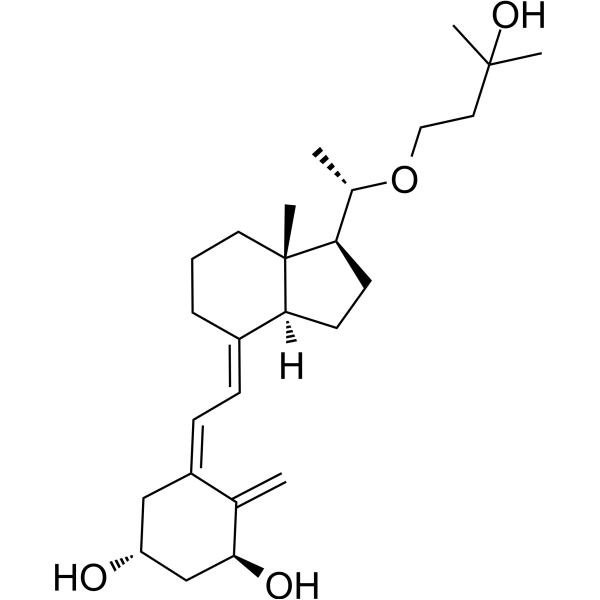
Maxacalcitol
Based on 4 publication(s) in Google Scholar
Maxacalcitol (22-Oxacalcitriol), a vitamin D3 (HY-15398) analog, is an orally active VDR agonist. Maxacalcitol has a limited calcemic effect. Maxacalcitol has the potential for psoriasis and hyperparathyroidism research.
For research use only. We do not sell to patients.
- Purity: 99.08%
- CAS No.: 103909-75-7
- Formula: C26H42O4
- Molecular Weight:418.61
-
Storage:
4°C, protect from light, stored under nitrogen
* The compound is unstable in solutions, freshly prepared is recommended.

To place orders, for customer services and technical support, please contact: MedChemExpress USA
Tel: 609-228-6898 E-mail: [email protected] [email protected]


-
 Biological Activity
-
Chemical Information
-
Solvent & Solubility
- Purity & Documentation
- References
-
 Help & FAQs



Publications Citing Use of MedChemExpress (MCE) Maxacalcitol
More

Biological Activity
|
Cell Line

|
Type | Value | Description | References |
|---|---|---|---|---|
| Caco-2 | EC50 |
144.5 nM
Compound: 22-oxa-1,25(OH)2D3
|
Activation of VDR in human Caco2 cells expressing lentiviral VDRE-luciferase vector assessed as VDRE-mediated transcriptional activity measured after 24 hrs by luciferase transcriptional reporter assay
Activation of VDR in human Caco2 cells expressing lentiviral VDRE-luciferase vector assessed as VDRE-mediated transcriptional activity measured after 24 hrs by luciferase transcriptional reporter assay
|
[PMID: 27070779] |
| Caco-2 | EC50 |
40.8 nM
Compound: 22-oxa-1,25(OH)2D3
|
Transactivation of VDR in human Caco2 cells after 24 hrs by luciferase reporter gene assay
Transactivation of VDR in human Caco2 cells after 24 hrs by luciferase reporter gene assay
|
[PMID: 26367019] |
| HaCaT | EC50 |
159.7 nM
Compound: 22-oxa-1,25(OH)2D3
|
Activation of VDR in human HaCaT cells expressing lentiviral VDRE-luciferase vector assessed as VDRE-mediated transcriptional activity measured after 24 hrs by luciferase transcriptional reporter assay
Activation of VDR in human HaCaT cells expressing lentiviral VDRE-luciferase vector assessed as VDRE-mediated transcriptional activity measured after 24 hrs by luciferase transcriptional reporter assay
|
[PMID: 27070779] |
| HaCaT | EC50 |
37.9 nM
Compound: 22-oxa-1,25(OH)2D3
|
Transactivation of VDR in human HaCaT cells after 24 hrs by luciferase reporter gene assay
Transactivation of VDR in human HaCaT cells after 24 hrs by luciferase reporter gene assay
|
[PMID: 26367019] |
| Jurkat | EC50 |
0.855 nM
Compound: 22-oxa-1,25(OH)2D3
|
Activation of VDR in human Jurkat cells expressing lentiviral VDRE-luciferase vector assessed as VDRE-mediated transcriptional activity measured after 24 hrs by luciferase transcriptional reporter assay
Activation of VDR in human Jurkat cells expressing lentiviral VDRE-luciferase vector assessed as VDRE-mediated transcriptional activity measured after 24 hrs by luciferase transcriptional reporter assay
|
[PMID: 27070779] |
| Keratinocyte | IC50 |
22.6 nM
Compound: 2, maxacalcitol
|
Antiproliferative activity against human keratinocyte assessed as inhibition of [3H]TdR uptake
Antiproliferative activity against human keratinocyte assessed as inhibition of [3H]TdR uptake
|
[PMID: 16630723] |
Maxacalcitol (22-Oxacalcitriol; 100 nM; for 24 h) markedly increases the expression of LL-37 mRNA in Ca9-22 cells and modestly but significantly increases in HSC-2, HSC-3, and HSC-4 cells[1].
MedChemExpress (MCE) has not independently confirmed the accuracy of these methods. They are for reference only.
-
Cell Line:Human gingival/oral epithelial cells
-
Concentration:100 nM
-
Incubation Time:24 h
-
Result:Markedly increased the expression of LL-37 mRNA 77-fold in human gingival epithelial Ca9-22 cells and modestly but significantly increased in human oral epithelial HSC-2, HSC-3, and HSC-4 cells.
Maxacalcitol in a dose of 30 but not 15 µg/kg/day induced reduction in detrusor overactivity (DO) index, non-voiding contractions frequency (FNVC), and amplitude (ANVC), while increasing volume threshold to elicit non-voiding contractions (VTNVC)[2].
MedChemExpress (MCE) has not independently confirmed the accuracy of these methods. They are for reference only.
-
Animal Model:Female Wistar rats (weighting 200-225 g)[2]
-
Dosage:15 µg/kg
-
Administration:Oral gavage; daily; 14 days
-
Result:Followed by GSK 269962 at a single dose of 10 mg/kg, led to a statistically significant reduction of intercontraction interval and bladder compliance, and an increase in DO index, without any effect on ANVC, FNVC, and VTNVC.
| NCT Number | Sponsor | Condition | Start Date |
Phase
|
|---|---|---|---|---|
| NCT01329991 | Plexxikon| | 2011-05 | PHASE1 |


Chemical Information
-
CAS No. 103909-75-7
-
Appearance Solid
-
Molecular Weight 418.61
-
Formula C26H42O4
-
Color White to off-white
-
SMILES
C=C1[C@H](C[C@@H](C/C1=C/C=C2[C@]3([C@@](C)([C@H](CC3)[C@@H](OCCC(C)(O)C)C)CCC/2)[H])O)O
-
Synonyms
22-Oxacalcitriol
-
Shipping
Room temperature in continental US; may vary elsewhere.
-
Storage
4°C, protect from light, stored under nitrogen
* The compound is unstable in solutions, freshly prepared is recommended.


Publications (4)
-
Journal Impact Factor
-
Most Recent
-
Int J Mol Sci
Vitamin D and Its Analogues Decrease Amyloid-β (Aβ) Formation and Increase Aβ-Degradation. [Abstract]2017 Dec 19;18(12). pii: E2764. PMID: 29257109 -
Eur J Pharmacol
Calcium effects and systemic exposure of vitamin D3 analogues after topical treatment of active vitamin D3-containing ointments in rats. [Abstract]2016 Oct 5:788:98-103. PMID: 27321871 -
Virol Sin
Antiviral activity of vitamin D derivatives against severe fever with thrombocytopenia syndrome virus in vitro and in vivo. [Abstract]2024 Aug 19:S1995-820X(24)00134-2. PMID: 39168248 -
J Dermatol Sci
Cyto/chemokine profile of in vitro scratched keratinocyte model: Implications of significant upregulation of CCL20, CXCL8 and IL36G in Koebner phenomenon. [Abstract]2019 Apr;94(1):244-251. PMID: 31010609


Solvent & Solubility
DMSO : 50 mg/mL (119.44 mM; Need ultrasonic; Hygroscopic DMSO has a significant impact on the solubility of product, please use newly opened DMSO)
Please refer to the solubility information to select the appropriate solvent. The compound is unstable in solutions, freshly prepared is recommended.
Please refer to the solubility information to select the appropriate solvent. The compound is unstable in solutions, freshly prepared is recommended.
Concentration (start) × Volume (start) = Concentration (final) × Volume (final)
Select the appropriate dissolution method based on your experimental animal and administration route.
- For the following dissolution methods, please ensure to first prepare a clear stock solution using an In Vitro approach and then sequentially add co-solvents:
- To ensure reliable experimental results, the clarified stock solution can be appropriately stored based on storage conditions. As for the working solution for In Vivo experiments, it is recommended to prepare freshly and use it on the same day.
- The percentages shown for the solvents indicate their volumetric ratio in the final prepared solution. If precipitation or phase separation occurs during preparation, heat and/or sonication can be used to aid dissolution.
Add each solvent one by one: 10% DMSO 40% PEG300 5% Tween-80 45% Saline
Solubility: ≥ 1.67 mg/mL (3.99 mM); Clear solution
This protocol yields a clear solution of ≥ 1.67 mg/mL (saturation unknown).
Taking 1 mL working solution as an example, add 100 μL DMSO stock solution (16.7 mg/mL) to 400 μL PEG300, and mix evenly; then add 50 μL Tween-80 and mix evenly; then add 450 μL Saline to adjust the volume to 1 mL.
Preparation of Saline: Dissolve 0.9 g sodium chloride in ddH₂O and dilute to 100 mL to obtain a clear Saline solution.
Add each solvent one by one: 10% DMSO 90% (20% SBE-β-CD in Saline)
Solubility: ≥ 1.67 mg/mL (3.99 mM); Clear solution
This protocol yields a clear solution of ≥ 1.67 mg/mL (saturation unknown).
Taking 1 mL working solution as an example, add 100 μL DMSO stock solution (16.7 mg/mL) to 900 μL 20% SBE-β-CD in Saline, and mix evenly.
Preparation of 20% SBE-β-CD in Saline (4°C, storage for one week): 2 g SBE-β-CD powder is dissolved in 10 mL Saline, completely dissolve until clear.
Please enter the basic information of animal experiments:
-
-
-
-
Recommended: Prepare an additional quantity of animals to account for potential losses during experiments.
Please enter your animal formula composition:
-
%DMSO +
Recommended: Keep the proportion of DMSO in working solution below 2% if your animal is weak.
-
%+
-
+%Tween-80 + +
-
%Saline +
The co-solvents required include: DMSO, . All of co-solvents are available by MedChemExpress (MCE). , Tween 80. All of co-solvents are available by MedChemExpress (MCE).
Working solution concentration: 0.22 mg/mL
Method for preparing stock solution: mg drug dissolved in μL DMSO. Stock solution concentration: mg/mL. * The compound is unstable in solutions, freshly prepared is recommended.
1. Take μL DMSO stock solution;
2. Add μL .
μL , mix evenly;
3. Then add μL Tween 80, mix evenly;
4. Then add μL
Please ensure that the stock solution in the first step is dissolved to a clear state, and add co-solvents in sequence. You can use ultrasonic heating (ultrasonic cleaner, recommended frequency 20-40 kHz), vortexing, etc. to assist dissolution.


Purity & Documentation
-
Data Sheet (279 KB)
-
SDS (480 KB)
- English - EN (480 KB)
- Français - FR (480 KB)
- Deutsch - DE (480 KB)
- Norwegian - NO (480 KB)
- Español - ES (480 KB)
- Swedish - SV (480 KB)
- Italian - IT (480 KB)
- Korean - KR (480 KB)
- Portuguese - PT (480 KB)
-
Handling Instructions (2659 KB)
References
[1]. Hiroyuki Tada, et al. Vitamin D3 analog maxacalcitol (OCT) induces hCAP-18/LL-37 production in human oral epithelial cells. Biomed Res. 2016;37(3):199-205. [Content Brief]
[2]. Andrzej Wróbel, et al. The Influence of Maxacalcitol, Vitamin D3 Analog, on Detrusor Overactivity in Conscious Rats. Urology. 2016 Jul:93:224.e7-224.e15. [Content Brief]
[3]. Masaru Karakawa, et al. Effects of maxacalcitol ointment on skin lesions in patients with psoriasis receiving treatment with adalimumab. J Dermatol. 2016 Nov;43(11):1354-1357. [Content Brief]


Complete Stock Solution Preparation Table
Please refer to the solubility information to select the appropriate solvent. The compound is unstable in solutions, freshly prepared is recommended.
| Optional Solvent | Concentration Solvent Mass | 1 mg | 5 mg | 10 mg | 25 mg |
|---|---|---|---|---|---|
| DMSO | 1 mM | 2.3889 mL | 11.9443 mL | 23.8886 mL | 59.7215 mL |
| 5 mM | 0.4778 mL | 2.3889 mL | 4.7777 mL | 11.9443 mL | |
| 10 mM | 0.2389 mL | 1.1944 mL | 2.3889 mL | 5.9721 mL | |
| 15 mM | 0.1593 mL | 0.7963 mL | 1.5926 mL | 3.9814 mL | |
| 20 mM | 0.1194 mL | 0.5972 mL | 1.1944 mL | 2.9861 mL | |
| 25 mM | 0.0956 mL | 0.4778 mL | 0.9555 mL | 2.3889 mL | |
| 30 mM | 0.0796 mL | 0.3981 mL | 0.7963 mL | 1.9907 mL | |
| 40 mM | 0.0597 mL | 0.2986 mL | 0.5972 mL | 1.4930 mL | |
| 50 mM | 0.0478 mL | 0.2389 mL | 0.4778 mL | 1.1944 mL | |
| 60 mM | 0.0398 mL | 0.1991 mL | 0.3981 mL | 0.9954 mL | |
| 80 mM | 0.0299 mL | 0.1493 mL | 0.2986 mL | 0.7465 mL | |
| 100 mM | 0.0239 mL | 0.1194 mL | 0.2389 mL | 0.5972 mL |


Maxacalcitol Related Classifications
HY-32339 Related Classifications
 Powered by Bioz