



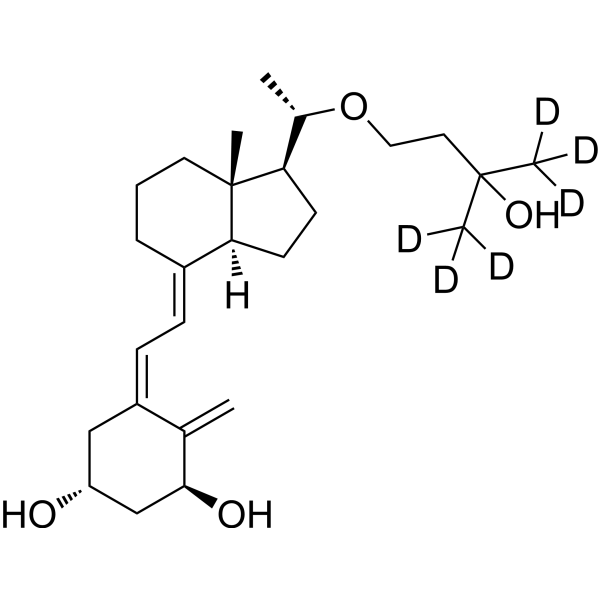
Maxacalcitol-d6
Based on 1 publication(s) in Google Scholar
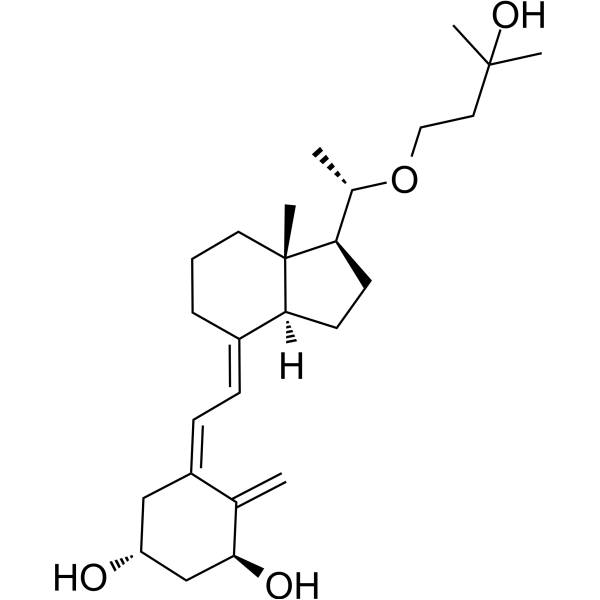
Maxacalcitol-d66 is the deuterated form of Maxacalcitol (22-Oxacalcitriol), which is a non-calcemic vitamin D3 analog and VDR ligand of VDR-like receptors.
Para uso exclusivo en investigación. No vendemos a pacientes.
- Pureza : 96.03%
- No. CAS: 2070009-38-8
- Fòrmula: C26H36D6O4
- Peso molecular:424.65
-
Almacenamiento:
4°C, protect from light, stored under nitrogen
* The compound is unstable in solutions, freshly prepared is recommended.

To place orders, for customer services and technical support, please contact: MedChemExpress USA
Tel: 609-228-6898 E-mail: [email protected] [email protected]


-
 Actividad biológica
-
Chemical Information
-
Solvente y solubilidad
- Pureza y Documentación
- Referencias
-
 Help & FAQs


Publications Citing Use of MedChemExpress (MCE) Maxacalcitol-d6
More

Actividad biológica
Descripciòn
Aplicación
1. This compound can be used as a tracer
2. This compound can be used as an internal standard for quantitative analysis by NMR, GC-MS, or LC-MS.


Chemical Information
-
No. CAS 2070009-38-8
-
Unlabeled CAS 103909-75-7
-
Appearance Solid
-
Peso molecular 424.65
-
Fòrmula C26H36D6O4
-
Color White to off-white
-
SMILES
O[C@@H](C[C@H](O)C/1=C)CC1=C\C=C2[C@@](CC[C@@H]3[C@@H](OCCC(C([2H])([2H])[2H])(C([2H])([2H])[2H])O)C)([H])[C@]3(C)CCC\2
-
Envío
Room temperature in continental US; may vary elsewhere.
-
Almacenamiento
4°C, protect from light, stored under nitrogen
* The compound is unstable in solutions, freshly prepared is recommended.


Publications (1)
-
Journal Impact Factor
-
Most Recent
-
Cell Signal
TP53 links mitochondria-endoplasmic reticulum crosstalk and ferroptosis in septic cardiomyopathy: Protective modulation by nicorandil. [Abstract]2026 Aug:144:112537. PMID: 41997516


Solvente y solubilidad
In Vitro:
DMSO : 100 mg/mL (235.49 mM; Need ultrasonic; Hygroscopic DMSO has a significant impact on the solubility of product, please use newly opened DMSO)
Please refer to the solubility information to select the appropriate solvent. The compound is unstable in solutions, freshly prepared is recommended.
Please refer to the solubility information to select the appropriate solvent. The compound is unstable in solutions, freshly prepared is recommended.
Concentration (start) × Volume (start) = Concentration (final) × Volume (final)
In Vivo:
Select the appropriate dissolution method based on your experimental animal and administration route.
- For the following dissolution methods, please ensure to first prepare a clear stock solution using an In Vitro approach and then sequentially add co-solvents:
- To ensure reliable experimental results, the clarified stock solution can be appropriately stored based on storage conditions. As for the working solution for In Vivo experiments, it is recommended to prepare freshly and use it on the same day.
- The percentages shown for the solvents indicate their volumetric ratio in the final prepared solution. If precipitation or phase separation occurs during preparation, heat and/or sonication can be used to aid dissolution.
Add each solvent one by one: 10% DMSO 40% PEG300 5% Tween-80 45% Saline
Solubility: ≥ 2.5 mg/mL (5.89 mM); Clear solution
This protocol yields a clear solution of ≥ 2.5 mg/mL (saturation unknown).
Taking 1 mL working solution as an example, add 100 μL DMSO stock solution (25.0 mg/mL) to 400 μL PEG300, and mix evenly; then add 50 μL Tween-80 and mix evenly; then add 450 μL Saline to adjust the volume to 1 mL.
Preparation of Saline: Dissolve 0.9 g sodium chloride in ddH₂O and dilute to 100 mL to obtain a clear Saline solution.
Add each solvent one by one: 10% DMSO 90% (20% SBE-β-CD in Saline)
Solubility: ≥ 2.5 mg/mL (5.89 mM); Clear solution
This protocol yields a clear solution of ≥ 2.5 mg/mL (saturation unknown).
Taking 1 mL working solution as an example, add 100 μL DMSO stock solution (25.0 mg/mL) to 900 μL 20% SBE-β-CD in Saline, and mix evenly.
Preparation of 20% SBE-β-CD in Saline (4°C, storage for one week): 2 g SBE-β-CD powder is dissolved in 10 mL Saline, completely dissolve until clear.
In Vivo Dissolution Calculator
Please enter the basic information of animal experiments:
-
-
-
-
Recommended: Prepare an additional quantity of animals to account for potential losses during experiments.
Please enter your animal formula composition:
-
%DMSO +
Recommended: Keep the proportion of DMSO in working solution below 2% if your animal is weak.
-
%+
-
+%Tween-80 + +
-
%Saline +
The co-solvents required include: DMSO, . All of co-solvents are available by MedChemExpress (MCE). , Tween 80. All of co-solvents are available by MedChemExpress (MCE).
Working solution concentration: 0.22 mg/mL
Method for preparing stock solution: mg drug dissolved in μL DMSO. Stock solution concentration: mg/mL. * The compound is unstable in solutions, freshly prepared is recommended.
1. Take μL DMSO stock solution;
2. Add μL .
μL , mix evenly;
3. Then add μL Tween 80, mix evenly;
4. Then add μL
Please ensure that the stock solution in the first step is dissolved to a clear state, and add co-solvents in sequence. You can use ultrasonic heating (ultrasonic cleaner, recommended frequency 20-40 kHz), vortexing, etc. to assist dissolution.


Pureza y Documentación
-
Ficha de datos (277 KB)
-
SDS (252 KB)
- English - EN (252 KB)
- Français - FR (252 KB)
- Deutsch - DE (252 KB)
- Norwegian - NO (252 KB)
- Español - ES (252 KB)
- Swedish - SV (252 KB)
- Italian - IT (252 KB)
- Korean - KR (252 KB)
- Portuguese - PT (252 KB)
-
Instrucciones de manejo (2659 KB)
Referencias
[3]. Inoue K, Matsui I, Hamano T, Fujii N, Shimomura A, Nakano C, Kusunoki Y, Takabatake Y, Hirata M, Nishiyama A, Tsubakihara Y, Isaka Y, Rakugi H.Maxacalcitol ameliorates tubulointerstitial fibrosis in obstructed kidneys by recruiting PPM1A/VDR complex to pSmad3.Lab Invest. 2012 Aug 27. [Content Brief]
[4]. Karashima T, Hashikawa K, Ono F, Eguchi H, Hamada T, Ishii N, Dainichi T, Yasumoto S, Tsuruta D, Hashimoto T.Successful Treatment of Bowen's Disease with Topical Maxacalcitol.Acta Derm Venereol. 2012 Jan 26. [Content Brief]


Complete Stock Solution Preparation Table
Please refer to the solubility information to select the appropriate solvent. The compound is unstable in solutions, freshly prepared is recommended.
| Optional Solvent | Concentration Solvent Mass | 1 mg | 5 mg | 10 mg | 25 mg |
|---|---|---|---|---|---|
| DMSO | 1 mM | 2.3549 mL | 11.7744 mL | 23.5488 mL | 58.8720 mL |
| 5 mM | 0.4710 mL | 2.3549 mL | 4.7098 mL | 11.7744 mL | |
| 10 mM | 0.2355 mL | 1.1774 mL | 2.3549 mL | 5.8872 mL | |
| 15 mM | 0.1570 mL | 0.7850 mL | 1.5699 mL | 3.9248 mL | |
| 20 mM | 0.1177 mL | 0.5887 mL | 1.1774 mL | 2.9436 mL | |
| 25 mM | 0.0942 mL | 0.4710 mL | 0.9420 mL | 2.3549 mL | |
| 30 mM | 0.0785 mL | 0.3925 mL | 0.7850 mL | 1.9624 mL | |
| 40 mM | 0.0589 mL | 0.2944 mL | 0.5887 mL | 1.4718 mL | |
| 50 mM | 0.0471 mL | 0.2355 mL | 0.4710 mL | 1.1774 mL | |
| 60 mM | 0.0392 mL | 0.1962 mL | 0.3925 mL | 0.9812 mL | |
| 80 mM | 0.0294 mL | 0.1472 mL | 0.2944 mL | 0.7359 mL | |
| 100 mM | 0.0235 mL | 0.1177 mL | 0.2355 mL | 0.5887 mL |


Maxacalcitol-d6 Related Classifications
HY-15329 Related Classifications
 Powered by Bioz