



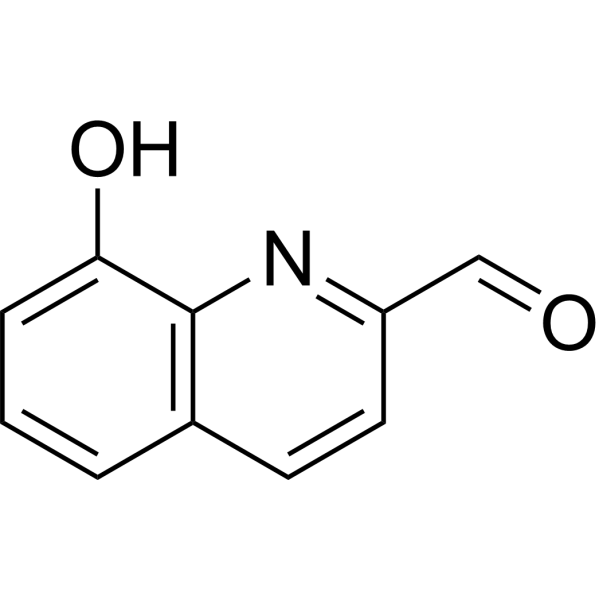
8-Hydroxyquinoline-2-carbaldehyde

Based on 1 Customer Validation
8-Hydroxyquinoline-2-carbaldehyde is a quinoline derivative with the functions of DNA intercalation, hydroxyl radical scavenging and superoxide radical scavenging. 8-Hydroxyquinoline-2-carbaldehyde serves as a precursor for synthesizing Schiff base ligands with DNA intercalation activity and antioxidant properties. 8-Hydroxyquinoline-2-carbaldehyde can be used in relevant research across multiple fields including materials science and biomedicine.
For research use only. We do not sell to patients.
- Purity: 98.0%
- CAS No.: 14510-06-6
- Formula: C10H7NO2
- Molecular Weight:173.17
-
Storage:
-20°C, sealed storage, away from moisture
* In solvent : -80°C, 6 months; -20°C, 1 month (sealed storage, away from moisture)

To place orders, for customer services and technical support, please contact: MedChemExpress USA
Tel: 609-228-6898 E-mail: [email protected] [email protected]


-
 Biological Activity
-
Chemical Information
-
Solvent & Solubility
- Purity & Documentation
- References
-
 Help & FAQs





Biological Activity
|
Cell Line

|
Type | Value | Description | References |
|---|---|---|---|---|
| HaCaT | IC50 |
19.15 μg/mL
Compound: 2a
|
Cytotoxicity against human HaCaT cells assessed as cell shrinkage after 24 hrs by SRB assay
Cytotoxicity against human HaCaT cells assessed as cell shrinkage after 24 hrs by SRB assay
|
[PMID: 24269165] |
8-Hydroxyquinoline-2-carbaldehyde is a quinoline derivative, which is synthesized via oxidation of 2-methylquinolin-8-ol using selenium dioxide as the oxidant[1].
8-Hydroxyquinoline-2-carbaldehyde undergoes condensation with aromatic acylhydrazines and diamines to yield Schiff base and fused heterocyclic products; its Schiff ligand coordinates with Yb3+ to form a centrosymmetric dinuclear eight-coordinate complex. Both the ligand and the ytterbium complex can intercalate into calf thymus DNA with high affinity, and their free radical scavenging activity is superior to that of ascorbic acid[1].
8-Hydroxyquinoline-2-carbaldehyde (compound 95) can be used as an intermediate in the synthesis of multifunctional drugs with broad biological activities[1].
MedChemExpress (MCE) has not independently confirmed the accuracy of these methods. They are for reference only.


Chemical Information
-
CAS No. 14510-06-6
-
Appearance Solid
-
Molecular Weight 173.17
-
Formula C10H7NO2
-
Color Light yellow to orange
-
SMILES
O=CC1=NC2=C(C=C1)C=CC=C2O
-
Shipping
Room temperature in continental US; may vary elsewhere.
-
Storage
-20°C, sealed storage, away from moisture
* In solvent : -80°C, 6 months; -20°C, 1 month (sealed storage, away from moisture)


Solvent & Solubility
DMSO : 100 mg/mL (577.47 mM; Need ultrasonic; Hygroscopic DMSO has a significant impact on the solubility of product, please use newly opened DMSO)
Please refer to the solubility information to select the appropriate solvent. Once prepared, please aliquot and store the solution to prevent product inactivation from repeated freeze-thaw cycles.
Storage method and period of stock solution: -80°C, 6 months; -20°C, 1 month (sealed storage, away from moisture). When stored at -80°C, please use it within 6 months. When stored at -20°C, please use it within 1 month.
Please refer to the solubility information to select the appropriate solvent. Once prepared, please aliquot and store the solution to prevent product inactivation from repeated freeze-thaw cycles.
Storage method and period of stock solution: -80°C, 6 months; -20°C, 1 month (sealed storage, away from moisture). When stored at -80°C, please use it within 6 months. When stored at -20°C, please use it within 1 month.
Concentration (start) × Volume (start) = Concentration (final) × Volume (final)


Purity & Documentation
-
Data Sheet (275 KB)
-
SDS (393 KB)
- English - EN (393 KB)
- Français - FR (393 KB)
- Deutsch - DE (393 KB)
- Norwegian - NO (393 KB)
- Español - ES (393 KB)
- Swedish - SV (393 KB)
- Italian - IT (393 KB)
- Korean - KR (393 KB)
- Portuguese - PT (393 KB)
-
Handling Instructions (2659 KB)
References
[1]. Liu YC, et al. Crystal structures, antioxidation and DNA binding properties of Yb(III) complexes with Schiff-base ligands derived from 8-hydroxyquinoline-2-carbaldehyde and four aroylhydrazines. Biometals : an international journal on the role of metal ions in biology, biochemistry, and medicine. 2009 Oct;22(5):733-51. [Content Brief]
[2]. Saadeh HA, et al. Recent Advances in the Synthesis and Biological Activity of 8-Hydroxyquinolines. Molecules (Basel, Switzerland). 2020 Sep 21;25(18):4321. [Content Brief]


Complete Stock Solution Preparation Table
Please refer to the solubility information to select the appropriate solvent. Once prepared, please aliquot and store the solution to prevent product inactivation from repeated freeze-thaw cycles.
Storage method and period of stock solution: -80°C, 6 months; -20°C, 1 month (sealed storage, away from moisture). When stored at -80°C, please use it within 6 months. When stored at -20°C, please use it within 1 month.
| Optional Solvent | Concentration Solvent Mass | 1 mg | 5 mg | 10 mg | 25 mg |
|---|---|---|---|---|---|
| DMSO | 1 mM | 5.7747 mL | 28.8734 mL | 57.7467 mL | 144.3668 mL |
| 5 mM | 1.1549 mL | 5.7747 mL | 11.5493 mL | 28.8734 mL | |
| 10 mM | 0.5775 mL | 2.8873 mL | 5.7747 mL | 14.4367 mL | |
| 15 mM | 0.3850 mL | 1.9249 mL | 3.8498 mL | 9.6245 mL | |
| 20 mM | 0.2887 mL | 1.4437 mL | 2.8873 mL | 7.2183 mL | |
| 25 mM | 0.2310 mL | 1.1549 mL | 2.3099 mL | 5.7747 mL | |
| 30 mM | 0.1925 mL | 0.9624 mL | 1.9249 mL | 4.8122 mL | |
| 40 mM | 0.1444 mL | 0.7218 mL | 1.4437 mL | 3.6092 mL | |
| 50 mM | 0.1155 mL | 0.5775 mL | 1.1549 mL | 2.8873 mL | |
| 60 mM | 0.0962 mL | 0.4812 mL | 0.9624 mL | 2.4061 mL | |
| 80 mM | 0.0722 mL | 0.3609 mL | 0.7218 mL | 1.8046 mL | |
| 100 mM | 0.0577 mL | 0.2887 mL | 0.5775 mL | 1.4437 mL |


8-Hydroxyquinoline-2-carbaldehyde Related Classifications
HY-W016840 Related Classifications
 Powered by Bioz