



Parasin I
Parasin I is a 19-amino acid histone H2A-derived peptide isolated from the skin of the catfish, and shows antimicrobial activity.
For research use only. We do not sell to patients.
- CAS No.: 219552-69-9
- Formula: C82H154N34O24
- Molecular Weight:2000.31
-
Storage:
Please store the product under the recommended conditions in the Certificate of Analysis.

To place orders, for customer services and technical support, please contact: MedChemExpress USA
Tel: 609-228-6898 E-mail: [email protected] [email protected]


-
 Biological Activity
-
Chemical Information
- Protocols
- Purity & Documentation
- References
-
 Help & FAQs


-
HY-P1568
Flagelin 22Plant Inducers -
HY-P0270
Magainin 2Antimicrobial Peptide -
HY-P0269
Magainin 1Antimicrobial Peptide -
HY-P0261
IndolicidinAntimicrobial Peptide -
HY-P1560
Allergen Gal d 4 (46-61), chickenBacterial Inhibitor -
HY-P1872
OV-1, sheepBacterial Inhibitor -
HY-P1768
Urechistachykinin I -
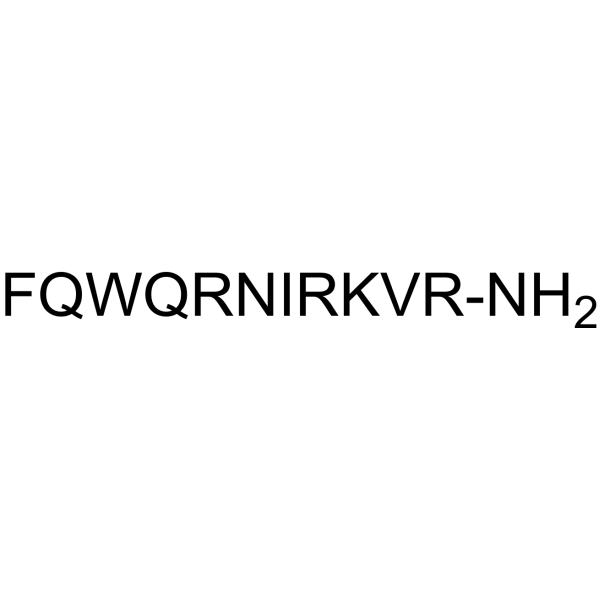
HY-P1063
LF11Bacterial Inhibitor


Biological Activity
Description
Cellular Effect
|
Cell Line

|
Type | Value | Description | References |
|---|---|---|---|---|
| CEM-SS | EC50 |
>50 μM
Compound: Parasin I
|
Antiviral activity against HIV1 3B infected in human CEM-SS cells assessed as inhibition of viral replication after 6 days by XTT assay
Antiviral activity against HIV1 3B infected in human CEM-SS cells assessed as inhibition of viral replication after 6 days by XTT assay
|
[PMID: 20086159] |
In Vitro
Parasin I with comparable antimicrobial activities localized to the cell membrane and subsequently permeabilized the outer and cytoplasmic membranes. Parasin I and its active analogs show strong cytoplasmic membrane permeabilizing activity[1]. Codon optimized parasin I fused with human lysozyme is expressed in Pichia pastoris, and has potent antibiotic activity[2].
MedChemExpress (MCE) has not independently confirmed the accuracy of these methods. They are for reference only.


Chemical Information
-
CAS No. 219552-69-9
-
Molecular Weight 2000.31
-
Formula C82H154N34O24
-
Sequence
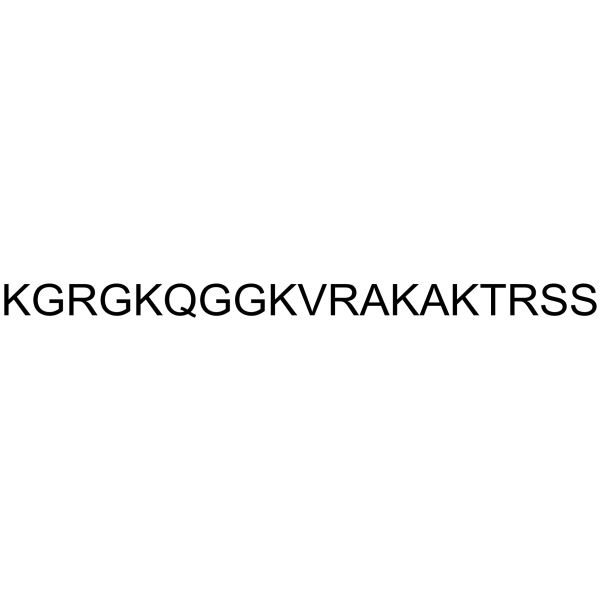
Lys-Gly-Arg-Gly-Lys-Gln-Gly-Gly-Lys-Val-Arg-Ala-Lys-Ala-Lys-Thr-Arg-Ser-Ser
-
Sequence Shortening
KGRGKQGGKVRAKAKTRSS
-
Structure Classification
-
Initial Source
Parasilurus asotus
-
Shipping
Room temperature in continental US; may vary elsewhere.
-
Storage
Please store the product under the recommended conditions in the Certificate of Analysis.


Purity & Documentation
References
[1]. Koo YS, et al. Structure-activity relations of parasin I, a histone H2A-derived antimicrobial peptide. Peptides. 2008 Jul;29(7):1102-8. [Content Brief]
[2]. Zhao H, et al. Characterization of bioactive recombinant antimicrobial peptide parasin I fused with human lysozyme expressed in the yeast Pichia pastoris system. Enzyme Microb Technol. 2015 Sep;77:61-7. [Content Brief]

Calculators
Concentration (start) × Volume (start) = Concentration (final) × Volume (final)


Parasin I Related Classifications
HY-P0324 Related Classifications
 Powered by Bioz