



Formamide-15N

Based on 1 Customer Validation
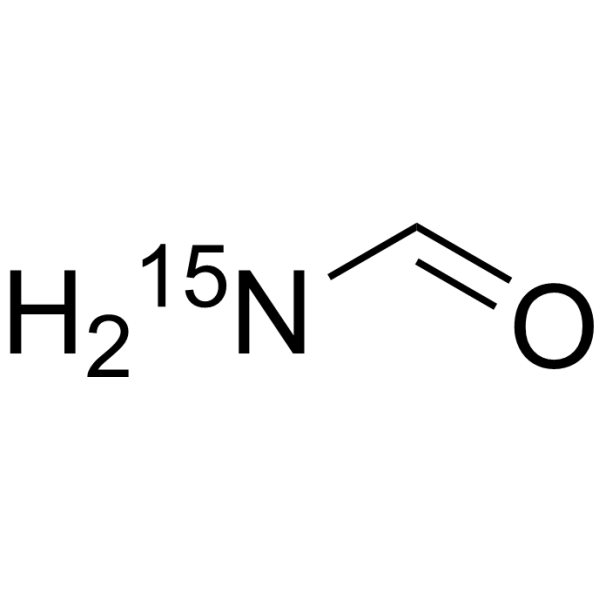
Formamide-15N is the 15N labeled Formamide (HY-Y0842). Formamide is an effective DNA denaturant that significantly reduces the stability of DNA in buffer solutions. Formamide can also be used as a decalcifying agent for rat cardiac cells. Additionally, formamide is widely used as a solvent or chemical raw material for ion compounds, resins, and plasticizers.
For research use only. We do not sell to patients.
- Purity: 99.5%
- CAS No.: 1449-77-0
- Formula: CH315NO
- Molecular Weight:46.03
-
Storage:Pure form -20°C, 3 years , 4°C, 2 years ; In solvent -80°C, 6 months , -20°C, 1 month

To place orders, for customer services and technical support, please contact: MedChemExpress USA
Tel: 609-228-6898 E-mail: [email protected] [email protected]


-
 Biological Activity
-
Chemical Information
- Purity & Documentation
- References
-
 Help & FAQs




Biological Activity
Stable heavy isotopes of hydrogen, carbon, and other elements have been incorporated into drug molecules, largely as tracers for quantitation during the drug development process. Deuteration has gained attention because of its potential to affect the pharmacokinetic and metabolic profiles of drugs[1].
MedChemExpress (MCE) has not independently confirmed the accuracy of these methods. They are for reference only.
1. This compound can be used as a tracer
2. This compound can be used as an internal standard for quantitative analysis by NMR, GC-MS, or LC-MS.


Chemical Information
-
CAS No. 1449-77-0
-
Unlabeled Cas 75-12-7
-
Appearance Liquid (Density: 0.978±0.06 g/cm3)
-
Molecular Weight 46.03
-
Formula CH315NO
-
Color Colorless to light yellow
-
SMILES
[15NH2]C=O
-
Synonyms
Methanamide-15N; Formimidic acid-15N
-
Shipping
Room temperature in continental US; may vary elsewhere.
-
Storage
Pure form -20°C 3 years 4°C 2 years In solvent -80°C 6 months -20°C 1 month


Purity & Documentation
-
Data Sheet (269 KB)
-
SDS (418 KB)
- English - EN (418 KB)
- Français - FR (418 KB)
- Deutsch - DE (418 KB)
- Norwegian - NO (418 KB)
- Español - ES (418 KB)
- Swedish - SV (418 KB)
- Italian - IT (418 KB)
- Korean - KR (418 KB)
- Portuguese - PT (418 KB)
-
Handling Instructions (2659 KB)
References
[1]. Kamineni VK, et al. Layer-by-layer nanoassembly of polyelectrolytes using formamide as the working medium. Langmuir. 2007;23(14):7423-7. [Content Brief]
[2]. Blake RD, et al. Thermodynamic effects of formamide on DNA stability. Nucleic Acids Res. 1996 Jun 1;24(11):2095-103. [Content Brief]
[3]. Costanzo G, et al. Formamide as the main building block in the origin of nucleic acids. BMC Evol Biol. 2007 Aug 16;7 Suppl 2(Suppl 2):S1. [Content Brief]
[4]. Brette F, et al. Validation of formamide as a detubulation agent in isolated rat cardiac cells. Am J Physiol Heart Circ Physiol. 2002 Oct;283(4):H1720-8. [Content Brief]
[5]. Frankfurt OS, Krishan A. Identification of apoptotic cells by formamide-induced dna denaturation in condensed chromatin. J Histochem Cytochem. 2001 Mar;49(3):369-78. [Content Brief]
[6]. Messier PE.Messier PE. Effects of formamide on neuroepithelial cells and on interkinetic nuclear migration in the chick embryo. J Embryol Exp Morphol. 1976 Feb;35(1):197-212. [Content Brief]
[7]. National Toxicology Program. Toxicology and carcinogenesis studies of formamide (Cas No. 75-12-7) in F344/N rats and B6C3F1 mice (gavage studies). Natl Toxicol Program Tech Rep Ser. 2008 Jul;(541):1-192. [Content Brief]

Calculators
Concentration (start) × Volume (start) = Concentration (final) × Volume (final)


Formamide-15N Related Classifications
HY-Y0842S3 Related Classifications
 Powered by Bioz