



PF-562271 mesylate
Based on 30 publication(s) in Google Scholar
PF-562271 mesylate (VS-6062 mesylate) is an orally active, ATP-competitive, reversible FAK/Pyk2 inhibitor, with an IC50 of 1.5 nM for FAK and 13 nM for Pyk2. PF-562271 mesylate induces tumor regression, and inhibits tumor growth, invasion and metastasis. PF-562271 mesylate exerts no effect on tumor necrosis, angiogenesis or apoptosis in an orthotopic mouse model of pancreatic ductal adenocarcinoma. When combined with Sunitinib (HY-10255A), PF-562271 mesylate reduces tumor vascularization, decreases serum alpha-fetoprotein levels and improves cachexia. PF-562271 mesylate can be used in research related to prostate cancer, breast cancer, pancreatic cancer, colon cancer, glioblastoma, lung cancer, pancreatic ductal adenocarcinoma and hepatocellular carcinoma.
Nos produits utilisent uniquement pour la recherche. Nous ne vendons pas aux patients.
- CAS No.: 939791-39-6
- Formule: C22H24F3N7O6S2
- Masse moléculaire:603.59
-
Stockage:
Please store the product under the recommended conditions in the Certificate of Analysis.


To place orders, for customer services and technical support, please contact: MedChemExpress USA
Tel: 609-228-6898 E-mail: [email protected] [email protected]


-
 Activité biologique
-
Chemical Information
- Pureté et documentation
- Références
-
 Help & FAQs


Publications Citing Use of MedChemExpress (MCE) PF-562271 mesylate
More- Nat Biomed Eng. 2025 Nov 3. [Abstract]
- Cancer Res. 2013 May 1;73(9):2873-83. [Abstract]
- Autophagy. 2026 May 29:1-15. [Abstract]
- Cell Discov. 2022 Sep 6;8(1):84. [Abstract]
- Carbohydr Polym. 2024 Feb 15:326:121637. [Abstract]
- Cell Death Dis. 2023 Feb 24;14(2):157. [Abstract]
- Cell Death Dis. 2022 Sep 10;13(9):783. [Abstract]
- Clin Cancer Res. 2019 Jul 15;25(14):4552-4566. [Abstract]
- Int J Surg. 2025 Sep 17. [Abstract]
- Am J Chin Med. 2025;53(4):1225-1240. [Abstract]
- World J Gastroenterol. 2025 Jul 28;31(28):107361. [Abstract]
- Cell Rep. 2023 Oct 5;42(10):113213. [Abstract]
- Life Sci. 2021 Apr 1:270:119112. [Abstract]
- Breast Cancer Res. 2024 Mar 19;26(1):48. [Abstract]
- Sci Rep. 2018 May 8;8(1):7228. [Abstract]
- Int J Cancer. 2015 Oct 1;137(7):1549-59. [Abstract]
- Cell Signal. 2025 Sep 10:136:112117. [Abstract]
- Environ Toxicol Pharmacol. 2023 Nov:104:104301. [Abstract]
- Eur J Cell Biol. 2024 May 28;103(2):151427. [Abstract]
- Cancer Med. 2025 Sep;14(18):e71227. [Abstract]
- Mol Biol Rep. 2026 May 14;53(1):770. [Abstract]
- Mol Biol Rep. 2025 May 14;52(1):458. [Abstract]
- J Nat Med. 2020 Sep;74(4):732-740. [Abstract]
- Anticancer Drugs. 2024 Jan 1;35(1):46-54. [Abstract]
- Res Sq. 2025 Jul 11.
- bioRxiv. 2025 May 28.
- bioRxiv. 2025 Apr 7:2025.04.01.646098. [Abstract]
- Research Square Preprint. 2023 May 23.
- Research Square Preprint. 2021 Dec.
- Practical Oncology Journal. 2015, 29(5): 444-449.
 Customer Validation & Images

-
WB
-
WB
-
WB
-
WB


Activité biologique
Description
In Vitro
PF-562271 mesylate potently inhibits purified recombinant FAK (with an IC50 of 1.5 nM) and recombinant Pyk2 (with an IC50 of 13 nM) via ATP-competitive reversible binding[1].
PF-562271 mesylate exhibits over 100-fold selectivity against most tested non-target recombinant kinases, and only shows moderate activity against a subset of cyclin-dependent kinase complexes[1].
PF-562271 (starting concentration of 1 μM; 30 min) mesylate potently and suppresses the autophosphorylation of FAKY397 in A431 epithelial cancer cells with an IC50 of 5 nM[1].
PF-562271 (1.1-3.3 μM; 48 h) mesylate alters the cell cycle progression of PC-3M cells only after incubation at the high concentration of 3.3 μM for 48 h[1].
PF-562271 mesylate is an ATP-competitive reversible inhibitor that potently inhibits the kinase activities of purified recombinant FAK (IC50 = 1.5 nM) and PYK2 (IC50 = 14 nM)[2].
PF-562271 (0.1 μM) mesylate significantly inhibits IGF-I-stimulated chemotactic migration of the PDA cell line MPanc-96, but does not affect EGF-stimulated migration of this cell line[2].
MedChemExpress (MCE) has not independently confirmed the accuracy of these methods. They are for reference only.
-
Cell Line:Inducible stable A431 epithelial carcinoma clones expressing wild-type V5-tagged FAK
-
Concentration:1 μmol/L (starting concentration, serially diluted)
-
Incubation Time:30 min
-
Result:Inhibited FAKY397 autophosphorylation with an IC50 of 5 nmol/L (2.5 ng/mL).
Showed ~4-fold lower potency for Pyk2 in comparative cell assays.
-
Cell Line:PC-3M human prostate cancer cells
-
Concentration:1.1 μmol/L; 3.3 μmol/L
-
Incubation Time:48 h
-
Result:Reduced the percentage of cells in S and G2-M phases to levels comparable to serum-starved cells at 3.3 μmol/L.
Exerted no effect on cell cycle progression at 1.1 μmol/L.
In Vivo
PF-562271 (25-50 mg/kg; p.o.; once daily, twice daily; 15 days) mesylate induces dose-dependent tumor growth inhibition in PC-3M xenografts. The efficacy of twice-daily administration is superior to that of once-daily administration at the same total daily dose, and the dose of 50 mg/kg twice daily achieves a TGI of 78% accompanied by partial tumor regression[1].
PF-562271 (50-100 mg/kg; p.o.; twice daily, once daily; continuous delivery via osmotic minipump) mesylate induces significant tumor growth inhibition in BxPc3 xenografts, with the 50 mg/kg twice daily dose achieving 86% TGI and partial tumor regression[1].
PF-562271 (12.5-50 mg/kg; p.o.; twice daily; for 29 consecutive days) mesylate induces dose-dependent tumor growth inhibition in BT474 xenografts, with the 50 mg/kg twice-daily dose achieving a 94% TGI accompanied by partial tumor regression[1].
PF-562271 (33 mg/kg; twice daily) mesylate reduces tumor volume, decreases tumor cell proliferation rate, and significantly lowers the incidence of retroperitoneal invasion and metastasis of orthotopic MPanc-96 pancreatic ductal adenocarcinoma in athymic nude mice[2].
Combination treatment with PF-562271 (15 mg/kg; p.o.; twice daily; 7 days per week) mesylate and Sunitinib (HY-10255A) administered at 20 mg/kg four times daily effectively inhibits hepatocellular carcinoma tumor growth in nude mice, reduces serum AFP and AST levels, impairs tumor angiogenesis, and induces tumor necrosis[3].
MedChemExpress (MCE) has not independently confirmed the accuracy of these methods. They are for reference only.
-
Animal Model:CD-1 Nu/Nu (female, ≈20 grams, U87MG human glioblastoma xenograft model)[1]
-
Dosage:3.3 mg/kg; 10 mg/kg; 33 mg/kg
-
Administration:p.o.; single dose
-
Result:Achieved 78% maximal inhibition of tumor phospho-FAK at 1 hour postdose, with >50% inhibition sustained for >4 hours (33 mg/kg dose).
Achieved 70% maximal inhibition of tumor phospho-FAK, with >50% inhibition sustained for <2 hours (10 mg/kg dose).
Calculated an EC50 of 93 ng/mL for total blood PF-562271 (mesylate) concentration required for half-maximal reduction of FAK phosphorylation.
-
Animal Model:CD-1 Nu/Nu (female, ≈20 grams, PC-3M human prostate xenograft model)[1]
-
Dosage:50 mg/kg (daily); 25 mg/kg (twice daily); 50 mg/kg (twice daily)
-
Administration:p.o.; daily; 15 days; p.o.; twice daily; 15 days
-
Result:Resulted in 45% tumor growth inhibition (TGI) and 37% inhibition of tumor phospho-FAK after 15 days, with a free Cₘₐₓ of 157 ng/mL (50 mg/kg daily dose).
Resulted in 61% TGI and 27% inhibition of tumor phospho-FAK after 15 days, with a free Cₘₐₓ of 25 ng/mL (25 mg/kg twice daily dose).
Resulted in 78% TGI, 52% inhibition of tumor phospho-FAK after 15 days, regressions in 3/7 mice, a free Cₘₐₓ of 96 ng/mL, and a free Cₐᵥₑ of 16 ng/mL (50 mg/kg twice daily dose).
Caused no weight loss, morbidity, or mortality.
-
Animal Model:CD-1 Nu/Nu (female, ≈20 grams, BxPc3 human pancreatic xenograft model)[1]
-
Dosage:50 mg/kg (twice daily); 100 mg/kg (daily); steady-state free concentration of 0.7 ng/mL (continuous delivery)
-
Administration:p.o.; twice daily; p.o.; daily; continuous delivery via osmotic mini-pump
-
Result:Resulted in 86% TGI, 31% inhibition of tumor phospho-FAK, regressions in 3/10 mice, and a free Cₘₐₓ of 273 ng/mL (50 mg/kg twice daily dose).
Resulted in 71% TGI and 59% inhibition of tumor phospho-FAK, with a free Cₘₐₓ of 705 ng/mL (100 mg/kg daily dose).
Resulted in 57% TGI and 37% inhibition of tumor phospho-FAK (continuous delivery via osmotic mini-pumps).
Caused no weight loss, morbidity, or mortality.
-
Animal Model:CD-1 Nu/Nu (female, ≈20 grams, BT474 human breast xenograft model)[1]
-
Dosage:12.5 mg/kg (twice daily); 25 mg/kg (twice daily); 50 mg/kg (twice daily)
-
Administration:p.o.; twice daily; 29 days
-
Result:Resulted in 37% TGI, 50% inhibition of tumor phospho-FAK, a free Cₘₐₓ of 29 ng/mL, and a free Cₐᵥₑ of 3 ng/mL (12.5 mg/kg twice daily dose).
Resulted in 59% TGI, 55% inhibition of tumor phospho-FAK, regressions in 3/8 mice, a free Cₘₐₓ of 116 ng/mL, and a free Cₐᵥₑ of 14 ng/mL (25 mg/kg twice daily dose).
Resulted in 94% TGI, 76% inhibition of tumor phospho-FAK, regressions in 4/8 mice, a free Cₘₐₓ of 180 ng/mL, and a free Cₐᵥₑ of 40 ng/mL (50 mg/kg twice daily dose).
Caused no weight loss, morbidity, or mortality.


Chemical Information
-
CAS No. 939791-39-6
-
Masse moléculaire 603.59
-
Formule C22H24F3N7O6S2
-
SMILES
O=C1NC2=CC=C(C=C2C1)NC3=NC=C(C(=N3)NCC4=CC=CN=C4N(C)S(=O)(=O)C)C(F)(F)F.O=S(=O)(O)C
-
Synonyms
VS-6062 mesylate
-
Livraison
Room temperature in continental US; may vary elsewhere.
-
Stockage
Please store the product under the recommended conditions in the Certificate of Analysis.


Publications (30)
-
Journal Impact Factor
-
Most Recent
-
Nat Biomed Eng
Nonexpansive biodegradable matrix promotes blood vessel organoid development for neurovascular repair and functional recovery in ischaemic stroke. [Abstract]2025 Nov 3. PMID: 41184604 -
Cancer Res
High-throughput tyrosine kinase activity profiling identifies FAK as a candidate therapeutic target in Ewing sarcoma. [Abstract]2013 May 1;73(9):2873-83. PMID: 23536552
PF-562271 mesylate purchased from MedChemExpress. Usage Cited in: Cancer Res. 2013 May 1;73(9):2873-83. [Abstract]
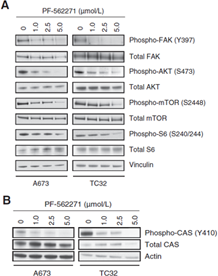
FAK inhibition downregulates the AKT/mTOR pathway and CAS activity. A, protein levels measured by Western immunoblotting for AKT/mTOR pathway proteins in A673 and TC32 cells serum-starved overnight, treated with PF-562271 for 6 hours, and then stimulated with IGF-1 for 2 hours. Vinculin is used as the loading control. B, Western immunoblots showing downregulation of phospho-CAS but not phospho-ERK in A673 and TC32 cells after treatment with PF-562271.
-
Autophagy
PTK2/FAK inhibition triggers TMED9-mediated protective autophagy in pancreatic cancer cell via enhancing ERGIC-ERES contact. [Abstract]2026 May 29:1-15. PMID: 42144738 -
Cell Discov
A positive mechanobiological feedback loop controls bistable switching of cardiac fibroblast phenotype. [Abstract]2022 Sep 6;8(1):84. PMID: 36068215 -
Carbohydr Polym
Inulin-like polysaccharide ABWW may impede CCl4 induced hepatic stellate cell activation through mediating the FAK/PI3K/AKT signaling pathway in vitro & in vivo. [Abstract]2024 Feb 15:326:121637. PMID: 38142102 -
Cell Death Dis
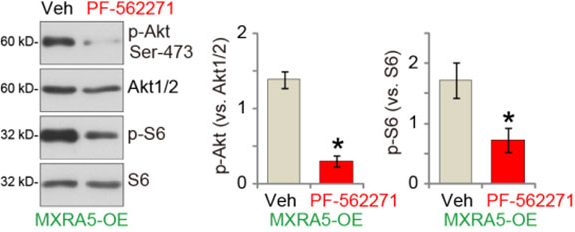
Identification of matrix-remodeling associated 5 as a possible molecular oncotarget of pancreatic cancer. [Abstract]2023 Feb 24;14(2):157. PMID: 36828810
PF-562271 mesylate purchased from MedChemExpress. Usage Cited in: Cell Death Dis. 2023 Feb 24;14(2):157. [Abstract]
PF-562271 (250 nM; 6 h) largely inhibits Akt-S6 phosphorylation in OE-MXRA5 priPC-1 cells.
-
Cell Death Dis
P130cas-FAK interaction is essential for YAP-mediated radioresistance of non-small cell lung cancer. [Abstract]2022 Sep 10;13(9):783. PMID: 36088346 -
Clin Cancer Res
High-throughput Chemical Screening Identifies Focal Adhesion Kinase and Aurora Kinase B Inhibition as a Synergistic Treatment Combination in Ewing Sarcoma. [Abstract]2019 Jul 15;25(14):4552-4566. PMID: 30979745 -
Int J Surg
Supervising the recurrence of pancreatic ductal adenocarcinoma using CtDNA-based MIR129-2 methylation detection. [Abstract]2025 Sep 17. PMID: 40961228 -
Am J Chin Med
Evodiamine Suppresses Lung Cancer Progression Through Modulating FAK/STAT3/AKT Signaling Pathway. [Abstract]2025;53(4):1225-1240. PMID: 40582716 -
World J Gastroenterol
FBP1 as a key regulator of focal adhesion kinase-mediated hepatic stellate cell activation: Multi-omics and experimental validation. [Abstract]2025 Jul 28;31(28):107361. PMID: 40741470 -
Cell Rep
Mechanotransduction in response to ECM stiffening impairs cGAS immune signaling in tumor cells. [Abstract]2023 Oct 5;42(10):113213. PMID: 37804510 -
Life Sci
Harmine inhibits the proliferation and migration of glioblastoma cells via the FAK/AKT pathway. [Abstract]2021 Apr 1:270:119112. PMID: 33508300 -
Breast Cancer Res
TMEM120B strengthens breast cancer cell stemness and accelerates chemotherapy resistance via β1-integrin/FAK-TAZ-mTOR signaling axis by binding to MYH9. [Abstract]2024 Mar 19;26(1):48. PMID: 38504374 -
Sci Rep
The mechanical microenvironment regulates ovarian cancer cell morphology, migration, and spheroid disaggregation. [Abstract]2018 May 8;8(1):7228. PMID: 29740072 -
Int J Cancer
2015 Oct 1;137(7):1549-59. PMID: 25809490
PF-562271 mesylate purchased from MedChemExpress. Usage Cited in: Int J Cancer. 2015 Oct 1;137(7):1549-59. [Abstract]
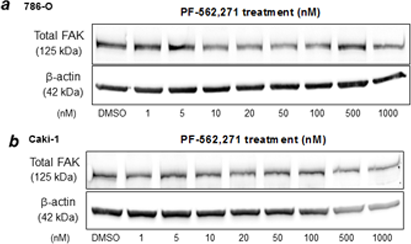
786-O (a) and Caki-1 (b) are treated for 24 and 48h with increasing concentrations of PF-562,271 and adherent cells were counted. Cell lysates are evaluated through immunoblotting for total FAK following treatment for 24h.
-
Cell Signal
Tenvermectin B, a novel macrocyclic lactone antibiotic, suppresses glioblastoma progression by targeting RhoJ. [Abstract]2025 Sep 10:136:112117. PMID: 40939916 -
Environ Toxicol Pharmacol
ZC3H4 Governs Epithelial Cell Migration through ROCK/p-PYK2/p-MLC2 Pathway in Silica-induced Pulmonary Fibrosis. [Abstract]2023 Nov:104:104301. PMID: 37866415 -
Eur J Cell Biol
The mechanical mechanism of angiotensin II induced activation of hepatic stellate cells promoting portal hypertension. [Abstract]2024 May 28;103(2):151427. PMID: 38820882 -
Cancer Med
Focal Adhesion Kinase Intersects With the BRD4-MYC Axis and YAP1 to Drive Tumor Cell Growth, Phenotypic Plasticity, Stemness, and Metastatic Potential in Colorectal Cancer. [Abstract]2025 Sep;14(18):e71227. PMID: 40959971 -
Mol Biol Rep
Piperlongumine inhibits the proliferation and migration of non-small cell lung cancer cells through the EGFR/FAK/STAT3 pathway. [Abstract]2026 May 14;53(1):770. PMID: 42133146 -
Mol Biol Rep
Ginkgetin inhibits the proliferation and migration of lung cancer cells via FAK/STAT3/AKT pathway. [Abstract]2025 May 14;52(1):458. PMID: 40366441 -
J Nat Med
2020 Sep;74(4):732-740. PMID: 32643027 -
Anticancer Drugs
2024 Jan 1;35(1):46-54. PMID: 37449977 -
-
-
bioRxiv
2025 Apr 7:2025.04.01.646098. PMID: 40291676 -
-
-
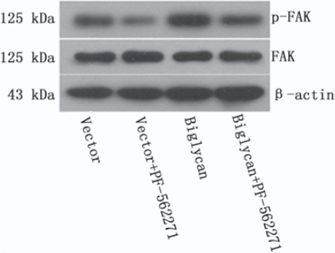
PF-562271 mesylate purchased from MedChemExpress. Usage Cited in: Practical Oncology Journal. 2015, 29(5): 444-449.
Effects and mechanism of Biglycan and FAK signaling pathway on the invasion and metastasis of colon cancer cells.


Pureté et documentation
Références
[1]. Roberts WG, et al. Antitumor activity and pharmacology of a selective focal adhesion kinase inhibitor, PF-562,271. Cancer research. 2008 Mar 15;68(6):1935-44. [Content Brief]
[2]. Stokes JB, et al. Inhibition of focal adhesion kinase by PF-562,271 inhibits the growth and metastasis of pancreatic cancer concomitant with altering the tumor microenvironment. Molecular cancer therapeutics. 2011 Nov;10(11):2135-45. [Content Brief]
[3]. Bagi CM, et al. Sunitinib and PF-562,271 (FAK/Pyk2 inhibitor) effectively block growth and recovery of human hepatocellular carcinoma in a rat xenograft model. Cancer biology & therapy. 2009 May;8(9):856-65. [Content Brief]

Calculators
Concentration (start) × Volume (start) = Concentration (final) × Volume (final)


PF-562271 mesylate Related Classifications
HY-10459A Related Classifications
 Powered by Bioz