



SNCA Protein, Human (His)
Based on 1 publication(s) in Google Scholar
Alpha-synuclein (SNCA) is a key neuronal protein that regulates synaptic activity, including vesicle transport and neurotransmitter release. As a monomer, it enhances vesicle exocytosis, promotes fusion and fusion pore expansion, and increases local Ca(2+) release. SNCA Protein, Human (His) is the recombinant human-derived SNCA protein, expressed by E. coli , with N-6*His labeled tag.
- Species: Human
- Source: E. coli
-
Storage:Stored at -20°C for 2 years from date of receipt. After reconstitution, it is stable at 4°C for 1 week or -20°C for longer (with carrier protein). It is recommended to freeze aliquots at -20°C or -80°C for extended storage.


To place orders, for customer services and technical support, please contact: MedChemExpress USA
Tel: 609-228-6898 E-mail: [email protected] [email protected]


-
 Biological Activity
-
Technical Parameters
-
Product Properties
- Documentation
- Help & FAQs




Biological Activity
Description
Alpha-synuclein (SNCA) is a key neuronal protein that regulates synaptic activity, including vesicle transport and neurotransmitter release. As a monomer, it enhances vesicle exocytosis, promotes fusion and fusion pore expansion, and increases local Ca(2+) release. SNCA Protein, Human (His) is the recombinant human-derived SNCA protein, expressed by E. coli , with N-6*His labeled tag.
Background
alpha-Synuclein (SNCA), a pivotal neuronal protein, orchestrates diverse roles in synaptic activity, including the regulation of synaptic vesicle trafficking and neurotransmitter release. As a monomer, it actively participates in synaptic vesicle exocytosis, enhancing vesicle priming, fusion, and dilation of exocytotic fusion pores, and mechanistically increases local Ca(2+) release from microdomains, crucial for ATP-induced exocytosis. In its multimeric membrane-bound state, SNCA functions as a molecular chaperone, assisting in the folding of synaptic fusion components (SNAREs) at the presynaptic plasma membrane, a process vital for maintaining normal SNARE-complex assembly during aging. SNCA also plays a crucial role in regulating dopamine neurotransmission by interacting with the dopamine transporter (DAT1) and modulating its activity. Existing as both a soluble monomer and homotetramer, a dynamic intracellular population of tetramers and monomers coexists, with the tetramer playing an essential role in maintaining homeostasis. SNCA engages in a complex network of interactions with proteins such as UCHL1, synphilin-1/SNCAIP, CALM1, STXBP1, VAMP2, SNAP25, RPH3A, RAB3A, SERF1A, and SEPTIN4, highlighting its involvement in intricate molecular processes governing synaptic function and integrity.
Verified Bioactivity
Immobilized SNCA at 1 μg/mL (100 μL/well) can bind SNCA Antibody , The ED50 for this effect is 6.552-7.551 ng/mL.
MCE Validation Data
-
Purity - SDS-PAGE
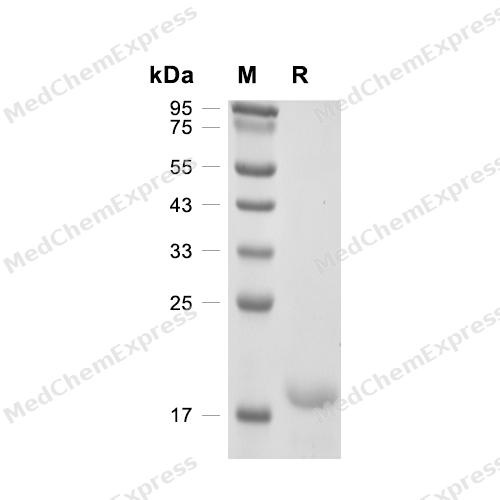
Purity - SDS-PAGE


Publications (1)
-
Journal Impact Factor
-
Most Recent
-
Drug Resist Updat
Gamma-synuclein drives bevacizumab resistance in colorectal cancer via VEGFR2 activation and angiogenesis. [Abstract]2025 Sep 9:84:101299. PMID: 40939487


Technical Parameters
-
Species Human
-
Source E. coli
-
Tag N-6*His
-
Accession
P37840-1 (M1-A140)
-
Molecular Construction
-
N-term
-
6*His
-
SNCA (M1-A140)
Accession # P37840 -
C-term
-
-
Protein Length
Full Length of Isoform-1
-
Synonyms
SNCA; Parkinson Disease (Autosomal Dominant, Lewy Body) 4; Prev. PARK1; Non-A4 Component Of Amyloid Precursor; Prev. PARK4; Non A-Beta Component Of AD Amyloid; Alpha-Synuclein; Non-A Beta Component Of AD Amyloid; NACP; Synuclein Alpha-140; PD1; I+/--Synuc
-
AA Sequence
MDVFMKGLSKAKEGVVAAAEKTKQGVAEAAGKTKEGVLYVGSKTKEGVVHGVATVAEKTKEQVTNVGGAVVTGVTAVAQKTVEGAGSIAAATGFVKKDQLGKNEEGAPQEGILEDMPVDPDNEAYEMPSEEGYQDYEPEA
-
Predicted Molecular Mass
16.7 kDa
-
Molecular Weight
Approximately 18 kDa, based on SDS-PAGE under reducing conditions.
-
Purity
≥ 95%, as determined by reducing SDS-PAGE.


Product Properties
Lyophilized powder
1.Lyophilized from a 0.22 μm filtered solution of 50 mM Tris-HCl, 300 mM NaCl, pH 7.4, 5% trehalose, 5% mannitol, 0.01% Tween 80.
2.Lyophilized from a 0.22 μm filtered solution of PBS, pH 7.4, 8% trehalose.
Please refer to the lot-specific COA for specific buffer information.
Note: For SPR assay, please replace the buffer. Primary amine components (e.g., Tris, imidazole) can affect protein-coupled chips.
<1 EU/μg, determined by LAL method.
It is not recommended to reconstitute to a concentration less than 100 μg/mL in ddH2O.
Stored at -20°C for 2 years from date of receipt. After reconstitution, it is stable at 4°C for 1 week or -20°C for longer (with carrier protein). It is recommended to freeze aliquots at -20°C or -80°C for extended storage.
Room temperature in continental US; may vary elsewhere.


Documentation
-
Data Sheet (236 KB)
-
SDS (252 KB)
- English - EN (252 KB)
- Français - FR (252 KB)
- Deutsch - DE (252 KB)
- Norwegian - NO (252 KB)
- Español - ES (252 KB)
- Swedish - SV (252 KB)
- Italian - IT (252 KB)
- Korean - KR (252 KB)
- Portuguese - PT (252 KB)
-
Handling Instructions (2659 KB)

Calculators
Concentration (start) × Volume (start) = Concentration (final) × Volume (final)


 Powered by Bioz

