



TSLP Protein, Human
Based on 1 publication(s) in Google Scholar
TSLP Protein, Human is an epithelial cell-derived cytokine which plays key role in allergic inflammation.
- Species: Human
- Source: E. coli
-
Storage:Stored at -20°C for 2 years from date of receipt. After reconstitution, it is stable at 4°C for 1 week or -20°C for longer (with carrier protein). It is recommended to freeze aliquots at -20°C or -80°C for extended storage.


To place orders, for customer services and technical support, please contact: MedChemExpress USA
Tel: 609-228-6898 E-mail: [email protected] [email protected]


-
 Biological Activity
-
Technical Parameters
-
Product Properties
- Documentation
- References
- Help & FAQs




Biological Activity
Description
TSLP Protein, Human is an epithelial cell-derived cytokine which plays key role in allergic inflammation.
Background
Thymic stromal lymphopoietin (TSLP) is an epithelial cell derived cytokine expressed in skin, gut, lungs and thymus. TSLP signals via TSLPR, a heterodimer of the IL-7 receptor alpha chain (IL-7Rα) and the TSLP receptor chain (TSLPR). Thymic stromal lymphopoietin exerts profound influence on the polarization of dendritic cells (DCs) to drive T helper (Th) 2 cytokine production. It also directly promotes T cell proliferation in response to T cell receptor (TCR) activation, and Th2 cytokine production. Thymic stromal lymphopoietin also supports B cell expansion and differentiation. Thymic stromal lymphopoietin further amplifies Th2 cytokine production by mast cells and NKT cells[1]. Multiple innate immune cells express the TSLPR and respond to TSLP. For example, Thymic stromal lymphopoietin can enhance cytokine production from mast cells, NKT cells and eosinophils. In addition, Thymic stromal lymphopoietin has very recently been shown to induce eosinophil extracellular traps (EETs), extrusions of mitochondrial DNA toxic granule molecules released in response to infection[2].
Verified Bioactivity
1.The ED50 is <0.3 ng/mL as measured by murine BaF3 pro-B cells, corresponding to a specific activity of >3.3 × 10⁶ units/mg.
2.Immobilized Human TSLP at 10 μg/mL (100 μl/well) can bind Human TSLP R-Fc .The ED50 of Human TSLP R-Fc is <0.35 μg/mL.
3. Measured by its binding ability in a functional ELISA. Immobilized Human TSLP at 5 μg/mL (100μl/well) on the plate can bind Human TSLPR. The ED50 for this effect is 18.65 ng/mL.
MCE Validation Data
-
Purity - SDS-PAGE
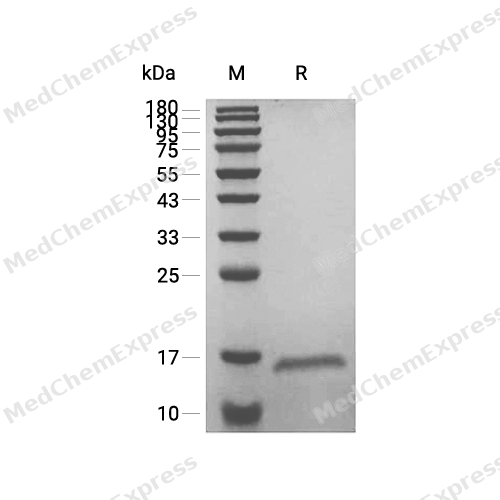
Purity - SDS-PAGE
-
Bioactivity - ELISA
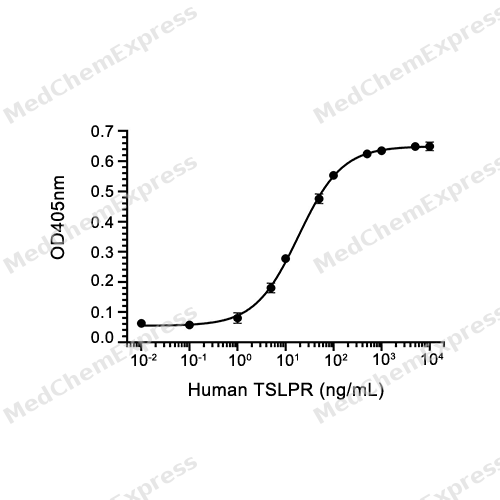
Bioactivity - ELISA


Publications (1)
-
Journal Impact Factor
-
Most Recent
-
Cancer Res
Inhibition of JNK Signaling Overcomes Cancer-Associated Fibroblast-Mediated Immunosuppression and Enhances the Efficacy of Immunotherapy in Bladder Cancer. [Abstract]2024 Dec 16;84(24):4199-4213. PMID: 39292817


Technical Parameters
-
Species Human
-
Source E. coli
-
Tag Tag Free
-
Accession
Q969D9-1 (Y29-Q159)
-
Molecular Construction
-
N-term
-
TSLP (Y29-Q159)
Accession # Q969D9-1 -
C-term
-
-
Protein Length
Full Length of Isoform-1
-
Synonyms
Thymic Stroma-Derived Lymphopoietin; Thymic Stromal Lymphopoietin; TSLP
-
AA Sequence
YDFTNCDFEKIKAAYLSTISKDLITYMSGTKSTEFNNTVSCSNRPHCLTEIQSLTFNPTAGCASLAKEMFAMKTKAALAIWCPGYSETQINATQAMKKRRKRKVTTNKCLEQVSQLQGLWRRFNRPLLKQQ
-
Predicted Molecular Mass
15.1 kDa
-
Molecular Weight
Approximately 14 kDa, based on SDS-PAGE under reducing conditions.
-
Purity
≥ 95%, as determined by reducing SDS-PAGE.


Product Properties
Lyophilized powder
1.Lyophilized from a 0.22 μm filtered solution of 20 mM PB, pH 7.4, 150 mM NaCl.
2.Lyophilized from a 0.22 μm filtered solution of PBS, pH 7.4.
Please refer to the lot-specific COA for specific buffer information.
<1 EU/μg, determined by LAL method.
It is not recommended to reconstitute to a concentration less than 100 μg/mL in ddH2O. For long term storage it is recommended to add a carrier protein (0.1% BSA, 5% HSA, 10% FBS or 5% Trehalose).
Stored at -20°C for 2 years from date of receipt. After reconstitution, it is stable at 4°C for 1 week or -20°C for longer (with carrier protein). It is recommended to freeze aliquots at -20°C or -80°C for extended storage.
Room temperature in continental US; may vary elsewhere.


Documentation
-
Data Sheet (262 KB)
-
SDS (251 KB)
- English - EN (251 KB)
- Français - FR (251 KB)
- Deutsch - DE (251 KB)
- Norwegian - NO (251 KB)
- Español - ES (251 KB)
- Swedish - SV (251 KB)
- Italian - IT (251 KB)
- Korean - KR (251 KB)
- Portuguese - PT (251 KB)
-
Handling Instructions (2659 KB)


References
[1]. He R, et al. Thymic stromal lymphopoietin. Ann N Y Acad Sci. 2010 Jan;1183:13-24. [Content Brief]
[2]. Ziegler SF, et al. The biology of thymic stromal lymphopoietin (TSLP). Adv Pharmacol. 2013;66:129-55. [Content Brief]
[3]. Liu YJ, et al. Thymic stromal lymphopoietin: master switch for allergic inflammation. J Exp Med. 2006 Feb 20;203(2):269-73. [Content Brief]

Calculators
Concentration (start) × Volume (start) = Concentration (final) × Volume (final)


 Powered by Bioz

