6 Results for "

ATP leakage

" in MedChemExpress (MCE) Product Catalog:
Products (6)

6 Results for "ATP leakage" in MCE Product Catalog:

Cat. No.: HY-W099729
CAS No.: 70445-33-9
Target:  

Bacterial

Research Areas:  

Infection Inflammation/Immunology

Ethylhexylglycerin is an antibacterial agent. Ethylhexylglycerin can induce allergic contact dermatitis. Ethylhexylglycerin inhibits the growth of various bacteria, disrupts the integrity of bacterial cell membranes, and causes proton leakage, reduced ATP levels, morphological abnormalities, and DNA aggregation. Ethylhexylglycerin serves as a skin conditioning agent, deodorant active ingredient, and preservative synergist. Ethylhexylglycerin is applicable to research related to contact dermatitis and bacterial infections .
loading...
    loading...
Cat. No.: HY-139467
CAS No.: 1072100-81-2
Target:  

SHP2 PKC

Research Areas:  

Metabolic Disease

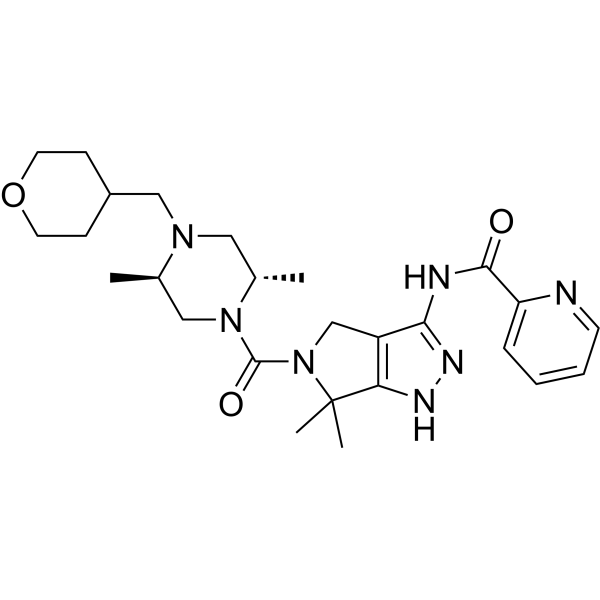
PF-04577806 is a potent, selective and ATP competitive PKC inhibitor. PF-04577806 shows potent inhibitory activity towards PKCα, PKCβI, PKCβII, PKCγ, and PKCθ with IC50s of 2.4 nM, 8.1 nM, 6.9 nM, 45.9 nM, and 29.5 nM, respectively. PF-04577806 can reverse retinal vascular leakage in diabetic rats .
loading...
    loading...
Cat. No.: HY-W856819
CAS No.: 469-22-7
Eseroline is a potent μ-opioid receptor agonist, which is the hydrolytic metabolite of Physostigmine (HY-N6608). Eseroline is a selective and competitive acetylcholinesterase (AChE) inhibitor, with its Ki values for AChE and BuChE being 0.1 μM and 200 μM respectively. Eseroline has nicotinic acetylcholine receptor allosteric enhancing ligand (nAChR-APL) activity, meaning it does not activate the receptor but significantly enhances the signal transduction of Ach triggered by the receptor. Eseroline is neurotoxic, causing cell membrane damage (LDH leakage) and energy metabolism collapse (ATP depletion). Eseroline can be used for the study of Alzheimer's disease .
loading...
    loading...
Cat. No.: HY-133621
CAS No.: 5829-48-1
Research Areas:  

Cancer

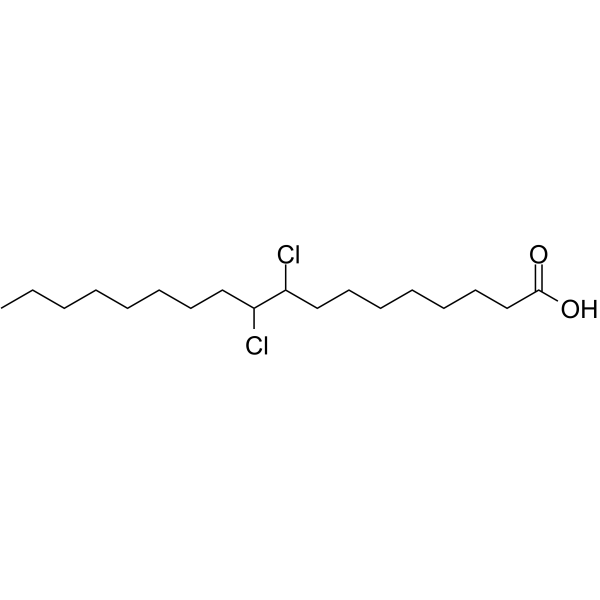
9,10-Dichlorostearic acid is a chlorinated stearic acid with antimutagenic properties. 9,10-Dichlorostearic acid can cause membrane damage by inducing leakage of adenosine triphosphate (ATP) from mammalian tumour cells in vitro .
loading...
    loading...
Cat. No.: HY-N17853
CAS No.: 511-77-3
Siaresinolic acid is a compound found in the leaves of Sabicea grisea. Siaresinolic acid shows antinociceptive and anti-inflammatory activity. Siaresinolic acid reduces nociceptive behavior by ATP-dependent potassium channel, inhibits leukocyte influx, plasma leakage, and proinflammatory mediator (TNF-α, IL-1β) production. Siaresinolic acid does not induce cytotoxicity in murine macrophages, alter locomotor activity at high doses. Siaresinolic acid can be used for the research of pleurisy and pain .
loading...
    loading...
Cat. No.: HY-179593
Target:  

Bacterial

Research Areas:  

Inflammation/Immunology

GM47-1, a naphthalene scaffold derivative, is a potent mycolic acid transporter MmpL3 inhibitor exhibiting potent bactericidal activity against Mycobacterium abscessus (Mabs) with an MIC50 of 2.1 µM. GM47-1 targets MmpL3, disrupts cell wall integrity, and induces ATP leakage and uncouples respiration. GM47-1 can be used for Mycobacterium abscessus pulmonary disease (Mabs-PD) research .
loading...
    loading...

