7 Results for "

1,4-dioxane

" in MedChemExpress (MCE) Product Catalog:
Products (7)

7 Results for "1,4-dioxane" in MCE Product Catalog:

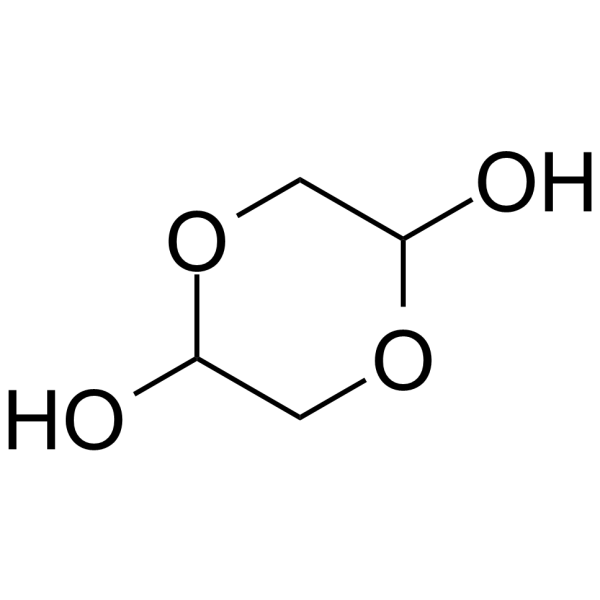
Cat. No.: HY-W004661
CAS No.: 23147-58-2
Synonyms: Hydroxy Acetaldehyde
1,4-Dioxane-2,5-diol is an endogenous metabolite.
loading...
    loading...
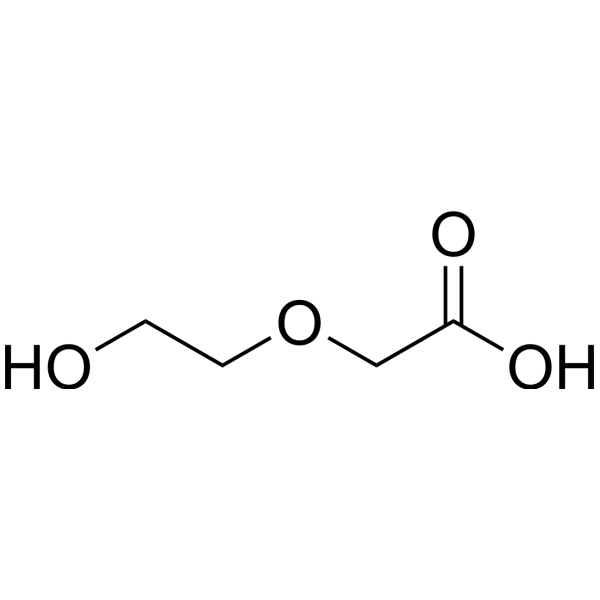
Cat. No.: HY-134611
CAS No.: 13382-47-3
Synonyms: β-hydroxyethoxyacetic acid; HEAA
Target:  

Drug Metabolite

Research Areas:  

Others

(2-Hydroxyethoxy)acetic acid (β-hydroxyethoxyacetic acid) is the main urinary metabolite of 1,4-Dioxane. (2-Hydroxyethoxy)acetic acid is a reliable and sensitive shortterm biomarker in urine .
loading...
    loading...
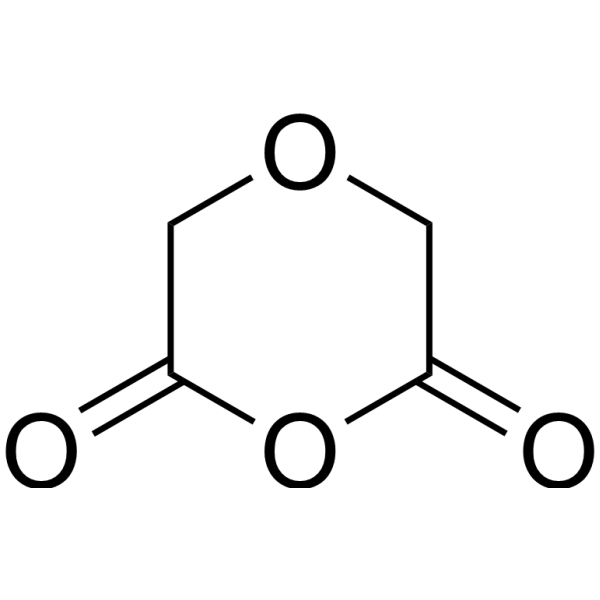
Cat. No.: HY-W074326
CAS No.: 4480-83-5
1,4-Dioxane-2,6-dione is a biochemical reagent that can be used as a biological material or organic compound for life science related research.
loading...
    loading...
Cat. No.: HY-W767601
CAS No.: 2122245-03-6
Synonyms: L-Lactide-13C2
(3S,6S)-3,6-Dimethyl-1,4-dioxane-2,5-dione- 13C2 (L-Lactide- 13C2) is the 13C-labeled L-Lactide (HY-W020691A). (3S,6S)-3,6-Dimethyl-1,4-dioxane-2,5-dione is a biochemical reagent that can be used as a biological material or organic compound for life science related research.
loading...
    loading...
Cat. No.: HY-W053546R
CAS No.: 502-97-6
Target:  

Reference Standards

1,4-Dioxane-2,5-dione (Standard) is the analytical standard of 1,4-Dioxane-2,5-dione. This product is intended for research and analytical applications.
loading...
    loading...
Cat. No.: HY-W004661R
CAS No.: 23147-58-2
Synonyms: Hydroxy Acetaldehyde (Standard)
1,4-Dioxane-2,5-diol (Standard) (Hydroxy Acetaldehyde (Standard)) is the analytical standard of 1,4-Dioxane-2,5-diol (HY-W004661). This product is intended for research and analytical applications. 1,4-Dioxane-2,5-diol is an endogenous metabolite.
loading...
    loading...
Cat. No.: HY-D3105
Target:  

Fluorescent Dye

Research Areas:  

Others

DCA is a Fluorescent probe for visualization of phase behavior in ER membranes. DCA is an ER-targeting, polarity-responsive NIR ratiometric probe, with its p-toluenesulfonamide group responsible for ER localization; its sensitivity to polarity relies on its donor-π-acceptor (D-π-A) structure, where aniline acts as the donor and dicyanomethylene acts as the acceptor, driving an intramolecular charge transfer (ICT) process upon excitation. In environments with low polarity, such as the closely packed, low water content ERₒ phase of ER membranes, DCA emits at a shorter wavelength, while in high polarity environments like the loosely packed, higher water content ERd phase, ICT leads to a red-shifted emission, allowing discrimination of the two phases via dual NIR emission colors and ratiometric imaging. Ex/Em = 488/570–620 nm and 488/665–735 nm; additional excitation/emission pairs include Ex/Em = 488/631 nm in low polarity 1,4-dioxane and Ex/Em = 488/677 nm in 1,4-dioxane with 30% water, the higher polarity condition. It shows a large Stokes shift of ~170 nm, and pH, viscosity, and biologically relevant species including Cys, GSH, H₂O₂, and metal ions do not exert marked interference on its fluorescence spectra[1].
loading...
    loading...

