9 Results for "

Dichlorobenzene

" in MedChemExpress (MCE) Product Catalog:
Products (9)

9 Results for "Dichlorobenzene" in MCE Product Catalog:

1
1 Cited Publications
Cat. No.: HY-P10579
CAS No.: 2225868-19-7
Target:  

Ephrin Receptor

Domaines de recherche:  

Cancer

123B9, a tumor-homing agent, is a potent and selective EphA2 agonist with a Kd value of 4.0 μM. 123B9 selectively targets the EphA2 tyrosine kinase receptor ligand-binding domain. 123B9 does not appreciably inhibit the ligand binding domains of the most closely related EphA3 and EphA4 receptors .
loading...
    loading...
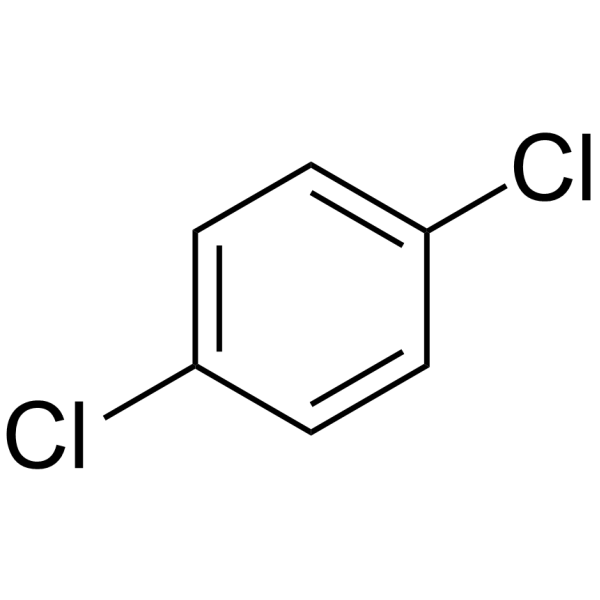
Cat. No.: HY-Y0496
CAS No.: 106-46-7
Domaines de recherche:  

Cancer

1,4-Dichlorobenzene is a non-genotoxic, orally active mitogenic/tumor-promoting carcinogen that is also widely used as a dye, resin intermediate, and deodorant, moth repellent/insecticide. 1,4-Dichlorobenzene induces liver tumors in mice and promotes the growth of spontaneous precancerous lesions, but shows no liver tumor-inducing activity in F344 rats. Exposure to 1,4-dichlorobenzene leads to elevated leukocyte counts, serum alanine aminotransferase, and blood urea nitrogen levels. Due to the hepatotoxic characteristics, 1,4-Dichlorobenzene is applicable to liver cancer-related research .
loading...
    loading...
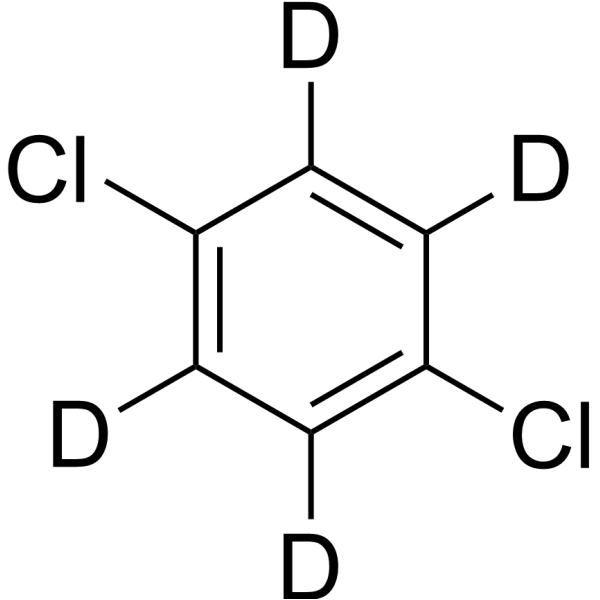
Cat. No.: HY-Y0496S
CAS No.: 3855-82-1
1,4-Dichlorobenzene-d4 is the deuterium labeled 1,4-Dichlorobenzene. 1,4-Dichlorobenzene is a non-genotoxic, orally active mitogenic/tumor-promoting carcinogen that is also widely used as a dye, resin intermediate, and deodorant, moth repellent/insecticide. 1,4-Dichlorobenzene induces liver tumors in mice and promotes the growth of spontaneous precancerous lesions, but shows no liver tumor-inducing activity in F344 rats. 1,4-Dichlorobenzene increases the levels of white blood cell count, serum alanine aminotransferase and blood urea nitrogen in occupationally exposed populations. 1,4-Dichlorobenzene is metabolized to 2,5-dichlorophenol and excreted in urine, and this metabolite can serve as a biomarker for 1,4-Dichlorobenzene exposure. Due to its specific hepatotoxic characteristics, 1,4-Dichlorobenzene is applicable to liver cancer-related research .
loading...
    loading...
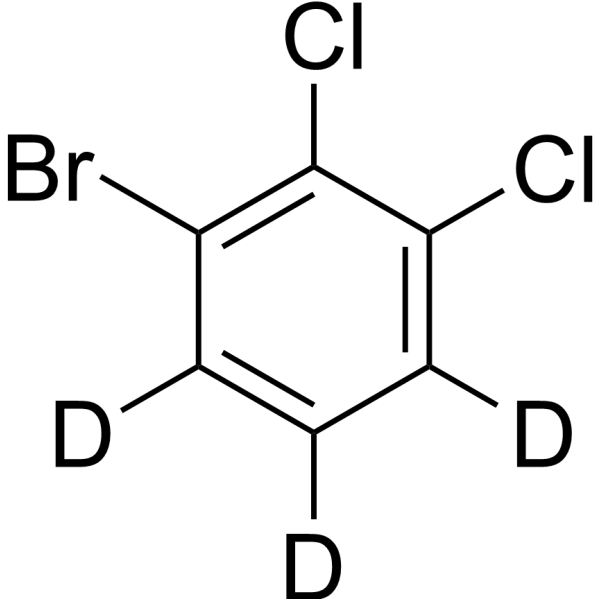
Cat. No.: HY-W009719S
CAS No.: 1219805-59-0
Synonyms: 2,3-DICHLOROBROMOBENZENE-d3
1-Bromo-2,3-dichlorobenzene-d3 is the deuterium labeled 1-Bromo-2,3-dichlorobenzene .
loading...
    loading...
Cat. No.: HY-Y0496R
CAS No.: 106-46-7
Domaines de recherche:  

Others

1,4-Dichlorobenzene (Standard) is the analytical standard of 1,4-Dichlorobenzene. This product is intended for research and analytical applications. 1,4-Dichlorobenzene is a non-genotoxic, orally active mitogenic/tumor-promoting carcinogen that is also widely used as a dye, resin intermediate, and deodorant, moth repellent/insecticide. 1,4-Dichlorobenzene induces liver tumors in mice and promotes the growth of spontaneous precancerous lesions, but shows no liver tumor-inducing activity in F344 rats. 1,4-Dichlorobenzene increases the levels of white blood cell count, serum alanine aminotransferase and blood urea nitrogen in occupationally exposed populations. 1,4-Dichlorobenzene is metabolized to 2,5-dichlorophenol and excreted in urine, and this metabolite can serve as a biomarker for 1,4-Dichlorobenzene exposure. Due to its specific hepatotoxic characteristics, 1,4-Dichlorobenzene is applicable to liver cancer-related research .
loading...
    loading...
Cat. No.: HY-W750625
CAS No.: 201595-59-7
1,4-Dichlorobenzene- 13C6 is the 13C-labeled 1,4-Dichlorobenzene. 1,4-Dichlorobenzene is used as an intermediate product in the manufacture of pigments, pesticides and disinfectants. 1,4-Dichlorobenzene is also employed as a moth control agent .
loading...
    loading...
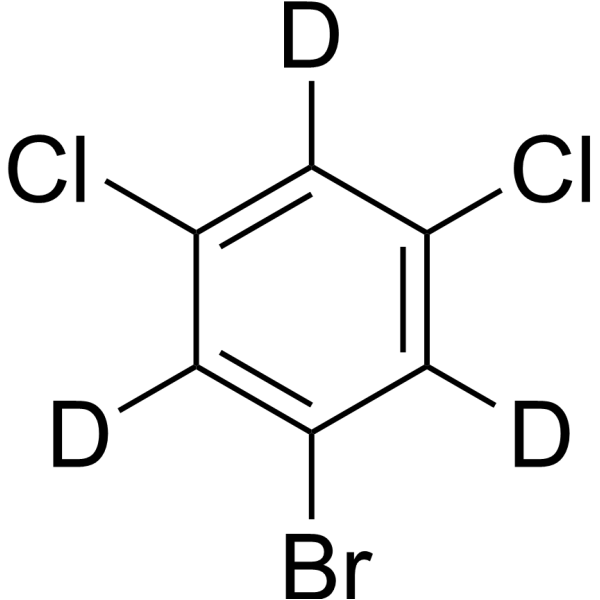
Cat. No.: HY-W012321S
CAS No.: 1219803-83-4
1-Bromo-3,5-dichlorobenzene-d3 is the deuterium labeled 1-Bromo-3,5-dichlorobenzene .
loading...
    loading...
Cat. No.: HY-P10819
Domaines de recherche:  

Cancer

S9-CMC1 TFA is a covalent peptide lysine-specific demethylase 1 (LSD1) inhibitor with an IC50 value of 2.53 μM. S9-CMC1 TFA specifically recognizes Cys360 in the enzyme-active region. S9-CMC1 TFA inhibits LSD1 activity, increasing H3K4me1 and H3K4me2 levels, leading to G1 cell cycle arrest and apoptosis and inhibiting cell proliferation. S9-CMC1 TFA significantly inhibits tumor growth in A549 xenograft animal models .
loading...
    loading...
Cat. No.: HY-W173655
CAS No.: 116802-97-2
Synonyms: 2,6-Dichloroterephthalic acid
Target:  

MOFs

Domaines de recherche:  

Others

2,6-Dichlorobenzene-1,4-dicarboxylic acid (2,6-Dichloroterephthalic acid) is a metal-organic framework (MOF).
loading...
    loading...

