



1,4-Dichlorobenzene (Standard)
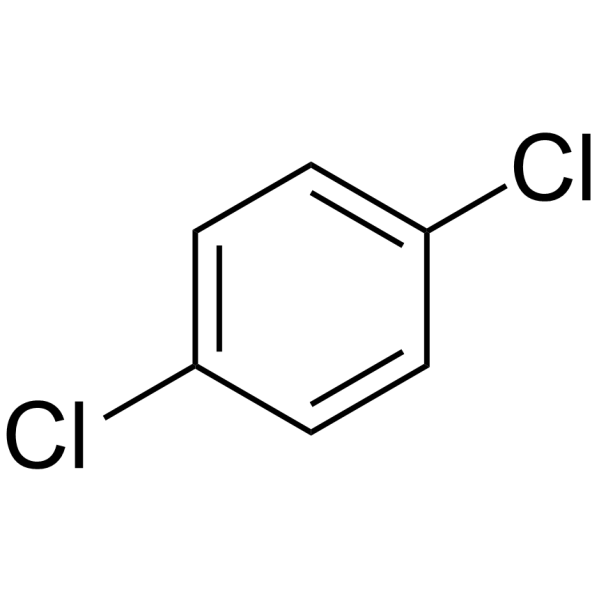
1,4-Dichlorobenzene (Standard) is the analytical standard of 1,4-Dichlorobenzene. This product is intended for research and analytical applications. 1,4-Dichlorobenzene is a non-genotoxic, orally active mitogenic/tumor-promoting carcinogen that is also widely used as a dye, resin intermediate, and deodorant, moth repellent/insecticide. 1,4-Dichlorobenzene induces liver tumors in mice and promotes the growth of spontaneous precancerous lesions, but shows no liver tumor-inducing activity in F344 rats. 1,4-Dichlorobenzene increases the levels of white blood cell count, serum alanine aminotransferase and blood urea nitrogen in occupationally exposed populations. 1,4-Dichlorobenzene is metabolized to 2,5-dichlorophenol and excreted in urine, and this metabolite can serve as a biomarker for 1,4-Dichlorobenzene exposure. Due to its specific hepatotoxic characteristics, 1,4-Dichlorobenzene is applicable to liver cancer-related research.
Nos produits utilisent uniquement pour la recherche. Nous ne vendons pas aux patients.
- Pureté : 95%
- CAS No.: 106-46-7
- Formule: C6H4Cl2
- Masse moléculaire:147.00
-
Stockage:
Please store the product under the recommended conditions in the Certificate of Analysis.


To place orders, for customer services and technical support, please contact: MedChemExpress USA
Tel: 609-228-6898 E-mail: [email protected] [email protected]


-
 Product Information
-
Chemical Information
- Pureté et documentation
-
 Help & FAQs


-
HY-Y0496
1,4-DichlorobenzeneMitogenic/Promotional Carcinogen -
HY-Y0921
(±)-1,2-PropanediolCosolvent -
HY-Y0304
Dibutyl phthalatePlasticizer -
HY-B1945
DEHPEndogenous Metabolite -

HY-112624P
Dextran T500 (MW 500,000)Biochemical Assay Reagent -
HY-112624B
Dextran T70 (MW 70,000)High MW Polysaccharid -

HY-B1952
Diethylene glycolBiochemical Assay Reagent -
HY-112624
DextranPlasma Volume Expander -

HY-W099580
HexadecaneAlkane -
HY-Y0682A
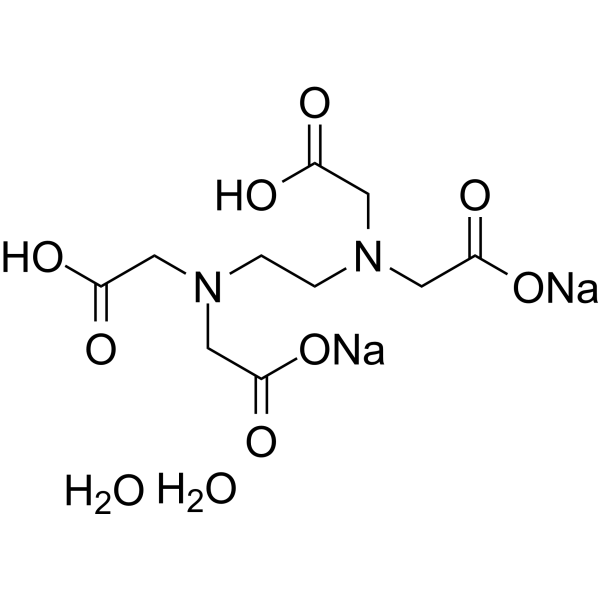
Ethylenediaminetetraacetic acid disodium dihydrateMetal Chelators -

HY-112624L
Dextran T10 (MW 10,000)Polymer of Anhydroglucose


Product Information
Information
Application
The compound is the grade of analytical standard, which is the reference standard supplied assay. It is commonly used in qualitative, quantitative and methodological research experiments in HPLC, GC and MS.


Chemical Information
-
CAS No. 106-46-7
-
Masse moléculaire 147.00
-
Formule C6H4Cl2
-
SMILES
ClC1=CC=C(Cl)C=C1
-
Livraison
Room temperature in continental US; may vary elsewhere.
-
Stockage
Please store the product under the recommended conditions in the Certificate of Analysis.


Pureté et documentation
Références
[1]. Butterworth BE, et al. A mechanism-based cancer risk assessment for 1,4-dichlorobenzene. Regul Toxicol Pharmacol. 2007;49(2):138-148. [Content Brief]
[2]. Hsiao PK, et al. Effects of occupational exposure to 1,4-dichlorobenzene on hematologic, kidney, and liver functions. Int Arch Occup Environ Health. 2009;82(9):1077-1085. [Content Brief]

Calculators
Concentration (start) × Volume (start) = Concentration (final) × Volume (final)


1,4-Dichlorobenzene (Standard) Related Classifications
HY-Y0496R Related Classifications
 Powered by Bioz