



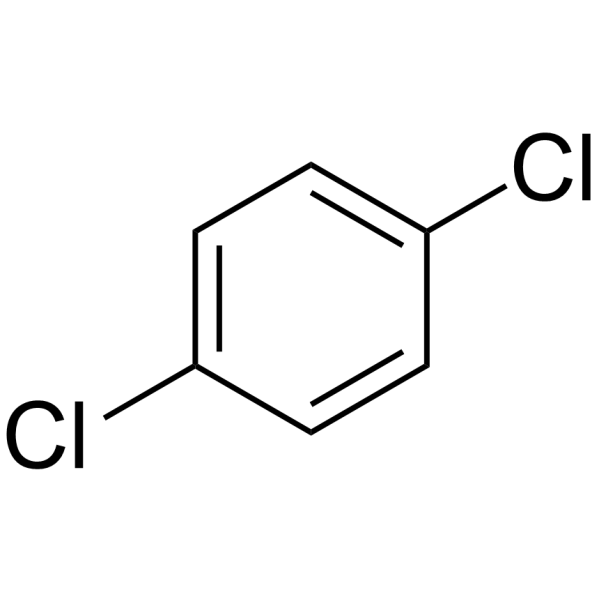
1,4-Dichlorobenzene

Based on 1 Customer Validation
1,4-Dichlorobenzene is a non-genotoxic, orally active mitogenic/tumor-promoting carcinogen that is also widely used as a dye, resin intermediate, and deodorant, moth repellent/insecticide. 1,4-Dichlorobenzene induces liver tumors in mice and promotes the growth of spontaneous precancerous lesions, but shows no liver tumor-inducing activity in F344 rats. Exposure to 1,4-dichlorobenzene leads to elevated leukocyte counts, serum alanine aminotransferase, and blood urea nitrogen levels. Due to the hepatotoxic characteristics, 1,4-Dichlorobenzene is applicable to liver cancer-related research.
For research use only. We do not sell to patients.
- Purity : 99.71%
- CAS No.: 106-46-7
- Formula: C6H4Cl2
- Molecular Weight:147.00
-
Storage:Powder -20°C, 3 years , 4°C, 2 years ; In solvent -80°C, 6 months , -20°C, 1 month

To place orders, for customer services and technical support, please contact: MedChemExpress USA
Tel: 609-228-6898 E-mail: [email protected] [email protected]


-
 Biological Activity
-
Chemical Information
-
Solvent & Solubility
- Protocols
- Purity & Documentation
- References
-
 Help & FAQs


-

HY-Y0496R
1,4-Dichlorobenzene (Standard) -
HY-Y0921
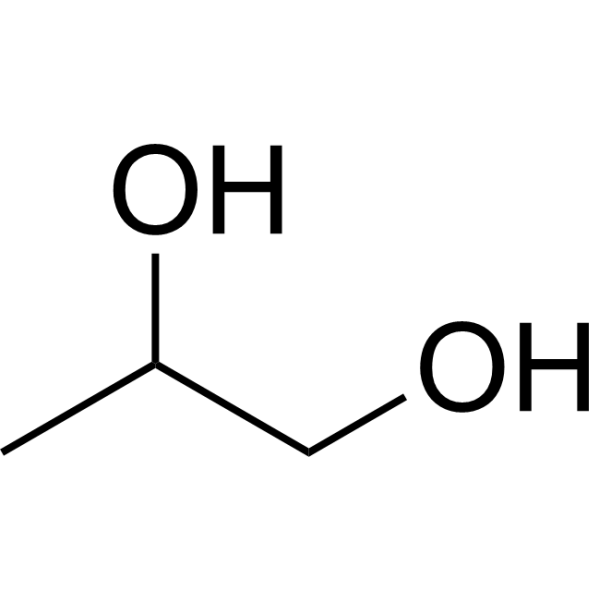
(±)-1,2-PropanediolCosolvent -
HY-Y0304
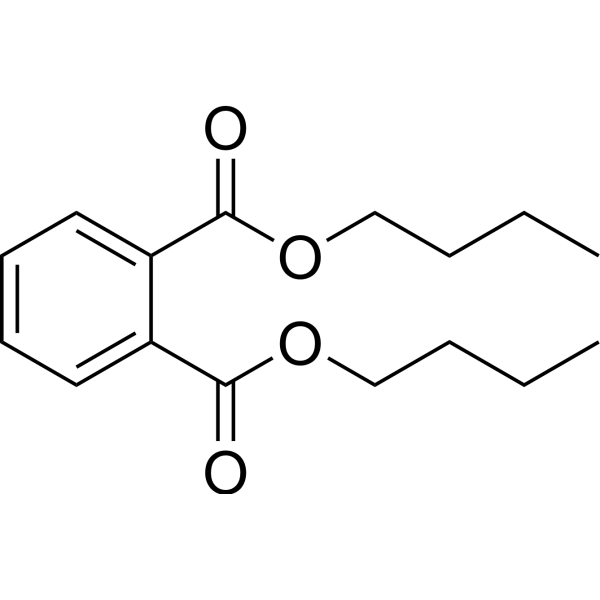
Dibutyl phthalatePlasticizer -
HY-B1945
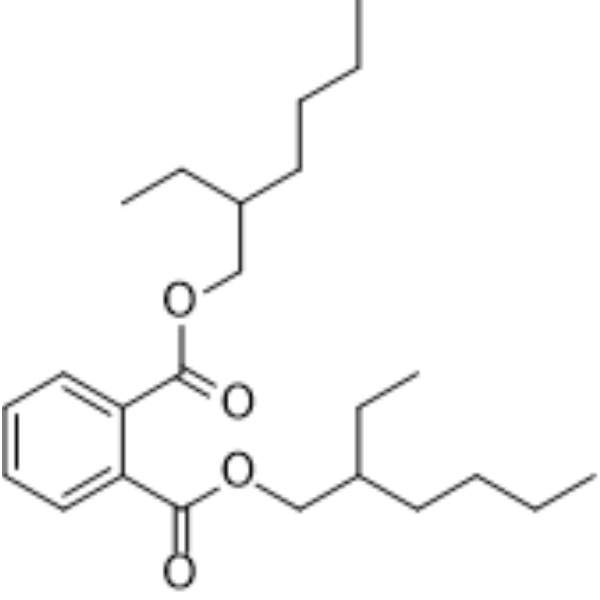
DEHPEndogenous Metabolite -

HY-112624P
Dextran T500 (MW 500,000)Biochemical Assay Reagent -
HY-112624B
Dextran T70 (MW 70,000)High MW Polysaccharid -

HY-B1952
Diethylene glycolBiochemical Assay Reagent -

HY-112624
DextranPlasma Volume Expander -

HY-W099580
HexadecaneAlkane -
HY-Y0682A
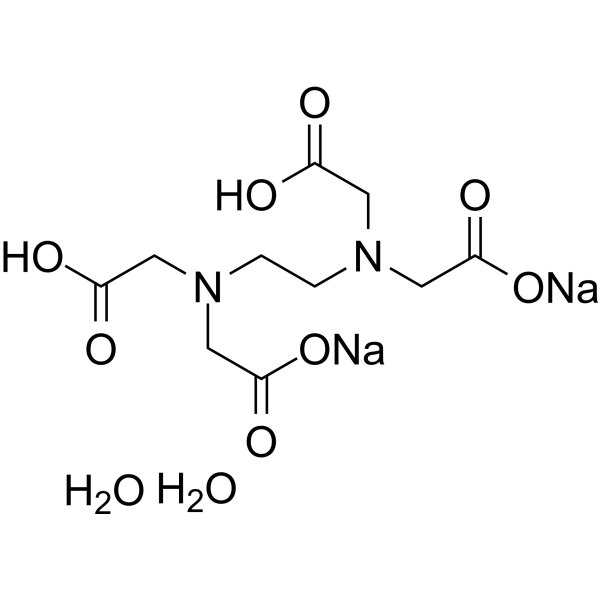
Ethylenediaminetetraacetic acid disodium dihydrateMetal Chelators -

HY-112624L
Dextran T10 (MW 10,000)Polymer of Anhydroglucose


Biological Activity
Description
In Vitro
1,4-dichlorobenzene undergoes hepatic cytochrome P450-mediated biotransformation with distinct profiles across male Wistar rats, male F344 rats, male B6C3F1 mice, and female B6C3F1 mice[2].
MedChemExpress (MCE) has not independently confirmed the accuracy of these methods. They are for reference only. Further protocols information, click here.
In Vivo
1,4-Dichlorobenzene (150-300 mg/kg/day; gavage; 5 days per week; two years) induces a dose-related increase in renal tubular cell adenocarcinomas in male F344 rats[1].
1,4-Dichlorobenzene (gavage; daily; 90 days) induces mitogenic liver growth and hepatocellular proliferation in male and female B6C3F1 mice, with liver size returning to normal after compound withdrawal[1].
1,4-Dichlorobenzene (300 ppm; inhalation; continuous; 2 years) increases the incidence of hepatocellular carcinoma and hepatoblastoma in male and female B6C3F1 mice[2].
1,4-Dichlorobenzene (1800 mg/kg; i.g.; single dose) induces a 4.5-fold elevation in serum ALT levels in male B6C3F1 mice[2].
1,4-Dichlorobenzene (300 mg/kg; p.o.; daily; 2 years) induces renal tubular adenocarcinoma and mononuclear cell leukemia in male F344 rats[2].
1,4-Dichlorobenzene (600 ppm; inhalation; continuous; 13 weeks) increases the frequency of elevated serum ALT levels in male and female BDF1 mice[2].
1,4-Dichlorobenzene (inhalation) induces hepatic cell proliferation in male and female B6C3F1 mice[2].
MedChemExpress (MCE) has not independently confirmed the accuracy of these methods. They are for reference only.
-
Animal Model:B6C3F1 mice with Liver cancer (male and female)[1]
-
Dosage:300 mg/kg/day; 600 mg/kg/day
-
Administration:gavage; 5 days per week; two years
-
Result:Induced significant increases in the frequency of hepatocellular carcinomas and adenomas in both male and female mice at 600 mg/kg/day.
Induced an increase in hepatocellular adenomas in male mice at 300 mg/kg/day.
Caused histopathological changes including hepatocellular degeneration, cell size alteration, and focal necrosis at both doses; in male mice, these nonneoplastic lesions affected over two-thirds of animals at 300 mg/kg/day.
-
Animal Model:BDF1 mice with Liver cancer (male and female)[1]
-
Dosage:20 ppm; 75 ppm; 300 ppm
-
Administration:inhalation; 6 hours per day, 5 days per week; two years
-
Result:Induced increases in hepatocellular carcinomas in both male and female mice, and an increase in hepatocellular adenomas in female mice at 300 ppm.
Caused no increases in liver tumors at 20 ppm or 75 ppm.
Induced a statistically significant 2.0-fold increase in liver weight (% body weight) relative to controls in male mice at 300 ppm.
Induced a statistically significant 3.6-fold increase in liver weight (% body weight) relative to controls in female mice at 300 ppm.
Caused no significant liver weight increases at 20 ppm or 75 ppm.


Chemical Information
-
CAS No. 106-46-7
-
Appearance Solid
-
Molecular Weight 147.00
-
Formula C6H4Cl2
-
Color White to off-white
-
SMILES
ClC1=CC=C(Cl)C=C1
-
Shipping
Room temperature in continental US; may vary elsewhere.
-
Storage
Powder -20°C 3 years 4°C 2 years In solvent -80°C 6 months -20°C 1 month


Solvent & Solubility
In Vitro:
DMSO : 100 mg/mL (680.27 mM; Need ultrasonic; Hygroscopic DMSO has a significant impact on the solubility of product, please use newly opened DMSO)
Please refer to the solubility information to select the appropriate solvent. Once prepared, please aliquot and store the solution to prevent product inactivation from repeated freeze-thaw cycles.
Storage method and period of stock solution: -80°C, 6 months; -20°C, 1 month. When stored at -80°C, please use it within 6 months. When stored at -20°C, please use it within 1 month.
Please refer to the solubility information to select the appropriate solvent. Once prepared, please aliquot and store the solution to prevent product inactivation from repeated freeze-thaw cycles.
Storage method and period of stock solution: -80°C, 6 months; -20°C, 1 month. When stored at -80°C, please use it within 6 months. When stored at -20°C, please use it within 1 month.
Concentration (start) × Volume (start) = Concentration (final) × Volume (final)
In Vivo:
Select the appropriate dissolution method based on your experimental animal and administration route.
- For the following dissolution methods, please ensure to first prepare a clear stock solution using an In Vitro approach and then sequentially add co-solvents:
- To ensure reliable experimental results, the clarified stock solution can be appropriately stored based on storage conditions. As for the working solution for In Vivo experiments, it is recommended to prepare freshly and use it on the same day.
- The percentages shown for the solvents indicate their volumetric ratio in the final prepared solution. If precipitation or phase separation occurs during preparation, heat and/or sonication can be used to aid dissolution.
Add each solvent one by one: 10% DMSO 40% PEG300 5% Tween-80 45% Saline
Solubility: ≥ 2.5 mg/mL (17.01 mM); Clear solution
This protocol yields a clear solution of ≥ 2.5 mg/mL (saturation unknown).
Taking 1 mL working solution as an example, add 100 μL DMSO stock solution (25.0 mg/mL) to 400 μL PEG300, and mix evenly; then add 50 μL Tween-80 and mix evenly; then add 450 μL Saline to adjust the volume to 1 mL.
Preparation of Saline: Dissolve 0.9 g sodium chloride in ddH₂O and dilute to 100 mL to obtain a clear Saline solution.
Add each solvent one by one: 10% DMSO 90% (20% SBE-β-CD in Saline)
Solubility: ≥ 2.5 mg/mL (17.01 mM); Clear solution
This protocol yields a clear solution of ≥ 2.5 mg/mL (saturation unknown).
Taking 1 mL working solution as an example, add 100 μL DMSO stock solution (25.0 mg/mL) to 900 μL 20% SBE-β-CD in Saline, and mix evenly.
Preparation of 20% SBE-β-CD in Saline (4°C, storage for one week): 2 g SBE-β-CD powder is dissolved in 10 mL Saline, completely dissolve until clear.
In Vivo Dissolution Calculator
Please enter the basic information of animal experiments:
-
-
-
-
Recommended: Prepare an additional quantity of animals to account for potential losses during experiments.
Please enter your animal formula composition:
-
%DMSO +
Recommended: Keep the proportion of DMSO in working solution below 2% if your animal is weak.
-
%+
-
+%Tween-80 + +
-
%Saline +
The co-solvents required include: DMSO, . All of co-solvents are available by MedChemExpress (MCE). , Tween 80. All of co-solvents are available by MedChemExpress (MCE).
Working solution concentration: 0.22 mg/mL
Method for preparing stock solution: mg drug dissolved in μL DMSO. Stock solution concentration: mg/mL.
1. Take μL DMSO stock solution;
2. Add μL .
μL , mix evenly;
3. Then add μL Tween 80, mix evenly;
4. Then add μL
Please ensure that the stock solution in the first step is dissolved to a clear state, and add co-solvents in sequence. You can use ultrasonic heating (ultrasonic cleaner, recommended frequency 20-40 kHz), vortexing, etc. to assist dissolution.

Protocols
-
Liver Cancer Modeling
Liver cancer can be classified into primary liver cancer and secondary liver cancer. Secondary liver cancer is the metastatic liver cancer. Primary liver cancer includes hepatocellular carcinoma (HCC), intrahepatic cholangiocarcinoma (ICC) and fibrolamellar HCC, of which HCC is the most common form, accounting for approximately 90% of primary liver cancers[1]. HCC mouse models include chemical agent-induced models, transplanted tumor models, and genetic engineered models.
-
Genotoxicity/Mutagenicity Study
The bacterial reverse mutation assay detects point mutations that restore amino-acid prototrophy in auxotrophic Salmonella typhimurium or Escherichia coli tester strains; after exposure to a test article, mutagenic activity is read out as an increased number of revertant colonies on minimal agar compared with the vehicle control. The assay uses tester strains with different mutation targets so that base-substitution and frameshift mutagens can be detected, and testing is performed with and without exogenous mammalian metabolic activation because some chemicals require biotransformation to become mutagenic.


Purity & Documentation
-
Data Sheet (276 KB)
-
SDS (760 KB)
- English - EN (760 KB)
- Français - FR (760 KB)
- Deutsch - DE (760 KB)
- Norwegian - NO (760 KB)
- Español - ES (760 KB)
- Swedish - SV (760 KB)
- Italian - IT (760 KB)
- Korean - KR (760 KB)
- Portuguese - PT (760 KB)
-
Handling Instructions (2659 KB)
References
[1]. Butterworth BE, et al. A mechanism-based cancer risk assessment for 1,4-dichlorobenzene. Regul Toxicol Pharmacol. 2007;49(2):138-148. [Content Brief]
[2]. Hsiao PK, et al. Effects of occupational exposure to 1,4-dichlorobenzene on hematologic, kidney, and liver functions. Int Arch Occup Environ Health. 2009;82(9):1077-1085. [Content Brief]


Complete Stock Solution Preparation Table
Please refer to the solubility information to select the appropriate solvent. Once prepared, please aliquot and store the solution to prevent product inactivation from repeated freeze-thaw cycles.
Storage method and period of stock solution: -80°C, 6 months; -20°C, 1 month. When stored at -80°C, please use it within 6 months. When stored at -20°C, please use it within 1 month.
| Optional Solvent | Concentration Solvent Mass | 1 mg | 5 mg | 10 mg | 25 mg |
|---|---|---|---|---|---|
| DMSO | 1 mM | 6.8027 mL | 34.0136 mL | 68.0272 mL | 170.0680 mL |
| 5 mM | 1.3605 mL | 6.8027 mL | 13.6054 mL | 34.0136 mL | |
| 10 mM | 0.6803 mL | 3.4014 mL | 6.8027 mL | 17.0068 mL | |
| 15 mM | 0.4535 mL | 2.2676 mL | 4.5351 mL | 11.3379 mL | |
| 20 mM | 0.3401 mL | 1.7007 mL | 3.4014 mL | 8.5034 mL | |
| 25 mM | 0.2721 mL | 1.3605 mL | 2.7211 mL | 6.8027 mL | |
| 30 mM | 0.2268 mL | 1.1338 mL | 2.2676 mL | 5.6689 mL | |
| 40 mM | 0.1701 mL | 0.8503 mL | 1.7007 mL | 4.2517 mL | |
| 50 mM | 0.1361 mL | 0.6803 mL | 1.3605 mL | 3.4014 mL | |
| 60 mM | 0.1134 mL | 0.5669 mL | 1.1338 mL | 2.8345 mL | |
| 80 mM | 0.0850 mL | 0.4252 mL | 0.8503 mL | 2.1259 mL | |
| 100 mM | 0.0680 mL | 0.3401 mL | 0.6803 mL | 1.7007 mL |


1,4-Dichlorobenzene Related Classifications
HY-Y0496 Related Classifications
 Powered by Bioz