5 Results for "

H3K18ac

" in MedChemExpress (MCE) Product Catalog:
Products (5)

5 Results for "H3K18ac" in MCE Product Catalog:

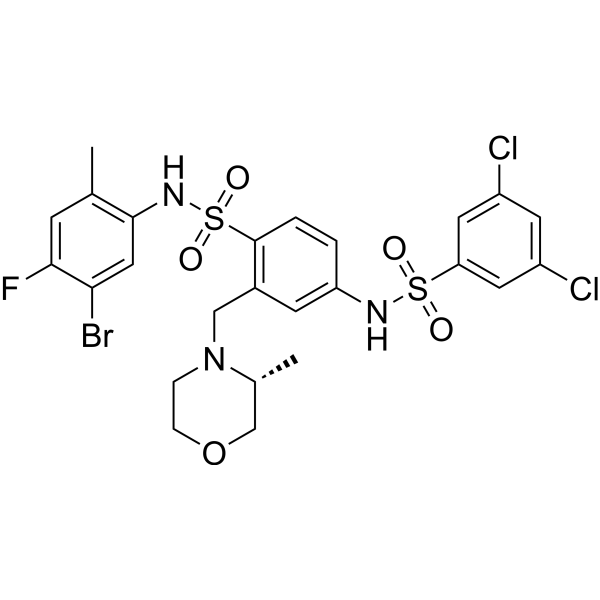
Cat. No.: HY-156757
CAS No.: 2275619-98-0
Purity:  99.68%
MDL-811 is a selective allosteric activator of SIRT6 with an EC50 of 5.7 μM. MDL-811 possesses anti-inflammatory, antitumor, and neuroprotective activities. MDL-811 can be used for the research of diseases such as colorectal cancer and ischemic stroke .
loading...
    loading...
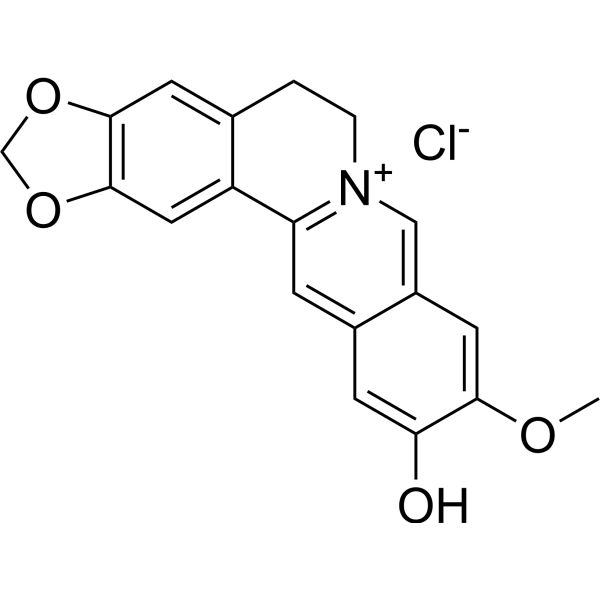
Cat. No.: HY-155229
CAS No.: 1065581-69-2
CBP/p300-IN-21 (Compound 5d) is a selective CBP/p300 inhibitor (IC50: 0.07 and 1.755 μM for p300 and CBP). CBP/p300-IN-21 decreases H3K18Ac level. CBP/p300-IN-21 inhibits growth of 4T1 tumor growth in mice .
loading...
    loading...
Cat. No.: HY-181669
CAS No.: 3034595-62-2
Research Areas:  

Cancer

P300-IN-6 is an orally active histone acetyltransferase p300 HAT domain inhibitor with human IC50 values of 7 nM. P300-IN-6 suppresses c-Myc expression, decreases H3K18ac and H3K27ac levels, and inhibits cancer cell proliferation.P300-IN-6 suppresses tumor growth in xenograft mouse models.P300-IN-6 can be used for the research of multiple myeloma .
loading...
    loading...
Cat. No.: HY-180889
CAS No.: 2257497-15-5
PROTAC BRD3 degrader-1 (compound D072) is a potent and selective PROTAC BRD3 degrader. PROTAC BRD3 degrader-1 selectively degrades BRD3 in mice, leading to the downregulation of H3K18ac without affecting BRD2 or BRD4. PROTAC BRD3 degrader-1 reduces intraocular inflammation in the experimental autoimmune uveitis (EAU) mouse mode and inhibits proinflammatory microglia in both uveitis retina and LPS (HY-D1056) treated mouse microglia cell line BV2. PROTAC BRD3 degrader-1 can be used for uveitis research .
loading...
    loading...
Cat. No.: HY-P11829
Research Areas:  

Cancer

ACTR-AD1 2L is a ACTR-AD1 peptide. ACTR-AD1 2L inhibits CBP/p300-NCOA3 complex formation, modulates gene transcription, inhibits CBP/p300 acetylase activity, reduces acetylation levels, and exhibits antiproliferative activity. ACTR-AD1 2L binds with stronger affinity to its target proteins than the wild-type peptide. ACTR-AD1 2L can be used for the research of breast cancer .
loading...
    loading...

