


23 Results for "

Magnetic nanoparticles

" in MedChemExpress (MCE) Product Catalog:
Products (23)

23 Results for "Magnetic nanoparticles" in MCE Product Catalog:

1
1 Cited Publications
Cat. No.: HY-P1116A
Target:  

Bacterial

Research Areas:  

Infection Inflammation/Immunology

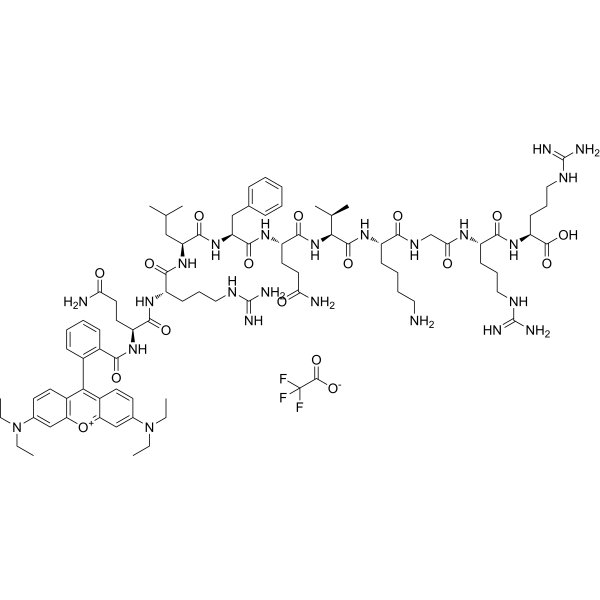
PBP10 TFA is a decapeptide. PBP10 TFA selectively binds to lipoteichoic acid (LTA), lipopolysaccharide (LPS) and phosphatidylinositol-4,5-bisphosphate (PIP2). PBP10 TFA penetrates cell membranes and possesses bactericidal, anti-inflammatory, cell motility-inhibiting and actin assembly-regulating activities. PBP10 TFA is applicable to relevant research on bacterial infections, microbe-induced inflammation, skin and soft tissue infections, as well as sepsis .
loading...
    loading...
Cat. No.: HY-164071
CAS No.: 9044-05-7
Synonyms: CM-Dextran
Target:  

Drug Derivative

Research Areas:  

Others

Carboxymethyl Dextran (CM-Dextran) is a dextran derivative and a biocompatible coating for superparamagnetic iron oxide nanoparticles. When coated on the surface of superparamagnetic nanoparticles, Carboxymethyl Dextran forms stable particles across all pH values and NaCl concentrations. Carboxymethyl Dextran can be used to prepare materials for magnetic resonance molecular imaging .
loading...
    loading...
Cat. No.: HY-W011816
CAS No.: 6920-24-7
Research Areas:  

Others

1,2-Hexadecanediol is a reducing agent. 1,2-Hexadecanediol facilitates the decomposition of the metal-organic precursor, forms an intermediate Co 2+Fe 3+-oleate complex .
loading...
    loading...
Cat. No.: HY-184629
Ultra-small magnetic iron oxide nanoparticles refer to iron oxide (Fe3O4) nanoparticles with very small size. These nanoparticles typically have a diameter of less than 10 nanometers (<10 nm), and the size observed by TEM is usually in the range of 5-10 nm.
loading...
    loading...
Cat. No.: HY-D0356
CAS No.: 3618-58-4
Eriochrome Black A is an azo dye that can be removed from water by an adsorbent made of magnetic NiFe2O4 nanoparticles.
loading...
    loading...
Cat. No.: HY-147112
CAS No.: 70622-78-5
MNP-GAL is MNPs coated with galactose. MNP-Gal can be used as substrate for the assay of NAG and beta-d-galactosidase .
loading...
    loading...
Cat. No.: HY-E70311
Synonyms: Thermomyces lanuginosus lipase
Target:  

Endogenous Metabolite

Research Areas:  

Others

1,3-specific lipase,Bacillus lanolin (Immobilized)(Thermomyces lanuginosus lipase) is a high-efficiency biocatalyst, a lipase from Thermomyces lanuginosus. 1,3-specific lipase,Bacillus lanolin (Immobilized) can be conjugated to magnetic nanoparticles and coupled to the surface of Fe(3)O(4)-COOH to obtain better temperature resistance and pH resistance. The activity unit (U) of lipase is defined as the amount of enzyme that produces 1 μmol of fatty acid per minute under experimental conditions .
loading...
    loading...
Cat. No.: HY-P11867
CAS No.: 1242439-00-4
Target:  

Wnt β-catenin

Research Areas:  

Others

UM206_L is a linear Wnt fragment peptide derived from conserved Wnt3a/Wnt5a sequences, inactive in soluble form but capable of activating canonical Wnt/β-catenin signaling when conjugated to magnetic nanoparticles and exposed to a high-gradient, time-varying magnetic field or immobilized on glass surfaces .
loading...
    loading...
Cat. No.: HY-184626
Thiol-modified magnetite nanoparticles are prepared via high-temperature pyrolysis and surface-modified with thiol functional groups. Magnetite is widely used in magnetic resonance imaging, magnetic separation, targeted drug delivery, tumor hyperthermia, cell labeling and separation, as a contrast agent, and in retinal detachment repair surgery due to its stable properties, good biocompatibility, high strength, and lack of toxicity. It is also used as a catalyst carrier, microwave absorbing material, and magnetic recording material. Xianfeng has developed numerous derivatives of magnetite, including oleic acid-modified magnetite, magnetite with different PEG ends, DMSA-modified magnetite, polylysine-modified magnetite, carboxylated dextran-modified magnetite nanoparticles, streptavidin-modified magnetite particles, thiol-modified magnetite magnetic nanoparticles, and polyethyleneimine (PEI)-modified magnetic magnetite nanoparticles, among others.
loading...
    loading...
Cat. No.: HY-184625
Polyethyleneimine (PEI)-modified magnetic iron(III) oxide (Fe3O4) nanoparticles are a composite nanomaterial that combines the properties of magnetic nanoparticles and polyethyleneimine. Polyethyleneimine is a highly branched polymer with a high density of amino groups. These amino groups stabilize the Fe3O4 nanoparticles and provide sites for further functionalization. The amino groups of PEI impart a high surface positive charge to the Fe3O4 nanoparticles, which helps enhance their interaction with negatively charged cell membranes.
loading...
    loading...
Cat. No.: HY-184638
APTS Fe2O3 Nanoparticles (Aminated ferric oxide magnetic nanoparticles) are magnetic nanomaterials modified with amino functional groups using APTS. This material consists of a ferric oxide (Fe3O4) nanoparticle core and an amino (-NH2) surface modification layer. The aminated surface helps improve the biocompatibility of the nanoparticles and reduce cytotoxicity. The amino functional groups can be further chemically modified for coupling with biomolecules such as drugs, proteins, and nucleic acids. The amino functional groups undergo protonation at different pH values, resulting in different surface charges on the nanoparticles in different pH environments.
loading...
    loading...
Cat. No.: HY-184636
PLL coated Fe2O3 nanoparticles (Polylysine-modified ferric oxide magnetic nanoparticles) consist of a polylysine (PLL)-modified ferric oxide (Fe2O3) core and pure water.
loading...
    loading...
Cat. No.: HY-184620
Ferric oxide (Fe3O4) is widely used in magnetic resonance imaging (MRI), magnetic separation, targeted drug delivery, tumor hyperthermia, cell labeling and separation, and as a contrast agent and enhancement agent in retinal detachment repair surgery due to its stable material properties, good biocompatibility, high strength, and lack of toxic side effects. It is also used as a catalyst carrier, microwave absorbing material, and magnetic recording material. Xianfeng has developed numerous derivatives of ferric oxide, including oleic acid-modified ferric oxide, PEG-terminated ferric oxide, DMSA-modified ferric oxide, polylysine-modified ferric oxide, carboxylated dextran-modified ferric oxide nanoparticles, streptavidin-modified ferric oxide particles, thiol-modified ferric oxide magnetic nanoparticles, and polyethyleneimine (PEI)-modified magnetic ferric oxide nanoparticles, among others. This wide range of modifications provides numerous options for subsequent experiments.
loading...
    loading...
Cat. No.: HY-184647
Target:  

Metal Nanoparticles

Research Areas:  

Others

Citrate-modified ferric oxide nanoparticles are functionalized nanoparticles formed by attaching citric acid to the surface of Fe3O4 nanoparticles. Due to their excellent biocompatibility and stability, Citrate-modified ferric oxide nanoparticles can be used as drug carriers for drug delivery and contrast enhancement in magnetic resonance imaging (MRI).
loading...
    loading...
Cat. No.: HY-184628
PEGylated ultrasmall iron oxide nanoparticles (high-temperature pyrolysis method) are magnetic nanomaterials synthesized by high-temperature pyrolysis. These nanoparticles typically have a diameter of less than 10 nanometers (<10 nm), and the size observed by TEM is usually in the range of 5-10 nm.
loading...
    loading...
Cat. No.: HY-184642
Titanium dioxide magnetic beads are magnetic microparticle carriers whose surface is coated with titanium dioxide nanoparticles. This material is commonly used in protein digests of biological samples for the simple, convenient, efficient, highly specific, and reproducible enrichment of phosphorylated peptides. The surface properties of titanium dioxide magnetic beads make them show no significant preference for monophosphorylated or polyphosphorylated peptides, making them ideal for single-step enrichment of phosphorylated peptides in mass spectrometry-based proteomics analysis.
loading...
    loading...
Cat. No.: HY-184630
Polylysine-modified magnetite nanoparticles are a composite material. Modifying Fe3O4 nanoparticles with PLL can form Fe3O4@PLL composite material, which combines the magnetic properties of Fe3O4 with the biocompatibility and multifunctionality of PLL.
loading...
    loading...
Cat. No.: HY-P11867A
CAS No.: 1242439-01-5
Target:  

Wnt β-catenin

Research Areas:  

Others

UM206_C is a circular Wnt fragment peptide derived from conserved Wnt3a/Wnt5a sequences, inactive in soluble form but capable of activating canonical Wnt/β-catenin signaling when conjugated to magnetic nanoparticles and exposed to a high-gradient, time-varying magnetic field or immobilized on glass surfaces .
loading...
    loading...
Cat. No.: HY-184637
DMSA Coated Fe2O3 Nanoparticles (Carboxylated ferric oxide nanoparticles) are magnetic nanomaterials with carboxyl (-COOH) groups modified on their surface. These materials typically consist of ferric oxide (Fe2O3) nanoparticles as a core, with carboxyl functional groups introduced to the surface through chemical modification. The carboxylation of the nanoparticle surface increases its negative surface charge, contributing to improved solubility and stability in water. Carboxylated ferric oxide nanoparticles exhibit good biocompatibility, making them suitable for biomedical applications.
loading...
    loading...
Cat. No.: HY-184609
Hollow mesoporous copper sulfide nanoparticles are nanomaterials with unique structures and properties. Their hollow mesoporous structure enables the encapsulation of small molecules, facilitating in vivo delivery, while their surface can be functionalized for further modification. Due to their excellent properties, hollow mesoporous copper sulfide nanoparticles are widely used in fields such as magnetic resonance imaging, biosensoring, and nanoprobe construction.
loading...
    loading...

