1. Search Result
Search Result
Results for "

NPM1 mutations

" in MedChemExpress (MCE) Product Catalog:
Cat. No. Product Name Target Research Areas Chemical Structure
  • HY-156794

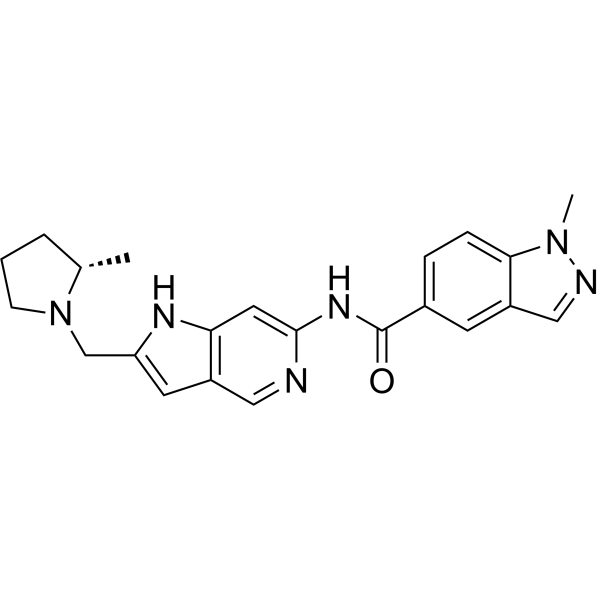
    DSP-5336

    Epigenetic Reader Domain FLT3 Cancer
    Enzomenib (DSP-5336) is an orally active Menin inhibitor (IC50=1.4 nM, Kd=6.0 nM). Enzomenib disrupts the interaction between Menin and KMT2A/MLL fusion proteins, specifically inhibits the expression of leukemia driver genes such as HOX/MEIS1, and upregulates ITGAM. Enzomenib effectively induces cell differentiation, inhibits tumor cell proliferation, and suppresses primitive cell colony formation. Enzomenib reduces disease burden and prolongs survival, but causes adverse reactions including differentiation syndrome and QTc interval prolongation. Enzomenib is used for research on relapsed/refractory acute myeloid leukemia, acute lymphoblastic leukemia, and other hematologic malignancies with mixed lineage leukemia (MLL) rearrangements or NPM1 mutations .
    Enzomenib
  • HY-162350

    Epigenetic Reader Domain Apoptosis Cancer
    TDI-11055 is a selective and orally active eleven-nineteen leukemia (ENL) inhibitor, which displaces ENL from chromatin by blocking its YEATS domain interaction with acylated histones. TDI-11055 inhibits ENL and AF9 YEATS domains with IC50 values of 50 nM and 70 nM, respectively, and no activity against GAS41 or YEATS2. TDI-11055 decreases chromatin occupancy of ENL-associated complexes, impairs transcription elongation, suppresses key oncogenic gene expression programs, and induces differentiation. TDI-11055 can be used for the research of acute myeloid leukemia .
    TDI-11055
  • HY-114162B

    SNDX-50469 mesylate

    Epigenetic Reader Domain Apoptosis Cancer
    VTP50469 mesylate is a potent, and selective Menin-MLL1 inhibitor that effectively targets MLL-rearranged and NPM1c+ leukemia. VTP50469 mesylate selectively kills cell lines with MLL rearrangements and NPM1c+ mutations. VTP50469 mesylate displaces Menin from protein complexes and inhibits MLL's chromatin occupancy at specific genes, leading to significant changes in gene expression, differentiation, and apoptosis. VTP50469 demonstrates dramatic reductions in leukemia burden in patient-derived xenograft models of MLL-r acute myeloid leukemia and MLL-r acute lymphoblastic leukemia, with some mice remaining disease-free for over a year post-treatment.
    VTP50469 mesylate
  • HY-156794A

    DSP-5336 enantiomer

    Drug Isomer FLT3 Epigenetic Reader Domain Cardiovascular Disease Cancer
    Enzomenib enantiomer (DSP-5336 enantiomer) is an enantiomer of Enzomenib (HY-156794). Enzomenib (DSP-5336) is an orally active Menin inhibitor (IC50=1.4 nM, Kd=6.0 nM). Enzomenib disrupts the interaction between Menin and KMT2A/MLL fusion proteins, specifically inhibits the expression of leukemia driver genes such as HOX/MEIS1, and upregulates ITGAM. Enzomenib effectively induces cell differentiation, inhibits tumor cell proliferation, and suppresses primitive cell colony formation. Enzomenib reduces disease burden and prolongs survival, but causes adverse reactions including differentiation syndrome and QTc interval prolongation. Enzomenib is used for research on relapsed/refractory acute myeloid leukemia, acute lymphoblastic leukemia, and other hematologic malignancies with mixed lineage leukemia (MLL) rearrangements or NPM1 mutations .
    Enzomenib enantiomer
  • HY-122670

    Pim Apoptosis AMPK DYRK STAT MDM-2/p53 Cancer
    VS-II-173 is a pan-Pim kinase inhibitor with IC50 values ​​of 0.07 μM and 0.02 μM for Pim1 and Pim3, respectively, and a residual activity of 46% for Pim2 at 1 μM. VS-II-173 also inhibits kinases such as HIPK2, PRK2, RSK1, DYRK1a and AMPKα1, selectively inhibiting acute myeloid leukemia (AML) cells with significantly lower toxicity to non-malignant cells (EC50 > 30 μM). VS-II-173 weakens the phosphorylation of substrates such as Stat5 (Y694), MDM2 (S166), Bad (S112), and 4E-BP1 (T37/46) by inhibiting Pim kinase-mediated signaling pathways, blocking pro-survival signals in AML cells and inducing apoptosis. VS-II-173 synergistically enhances anti-AML activity when combined with Daunorubicin (HY-13062A). VS-II-173 can be used in AML research, especially for AML with FLT3-ITD mutations and NPM1 mutations .
    VS-II-173

Inquiry Online

Your information is safe with us. * Required Fields.

Salutation


Country or Region *

Applicant Name *


Organization Name *

Department *


Email Address *


Product Name *

Cat. No.


Requested quantity *

Phone Number *


Remarks

Inquiry Online

Inquiry Information

Product Name:
Cat. No.:
Quantity:
MCE Japan Authorized Agent:

