



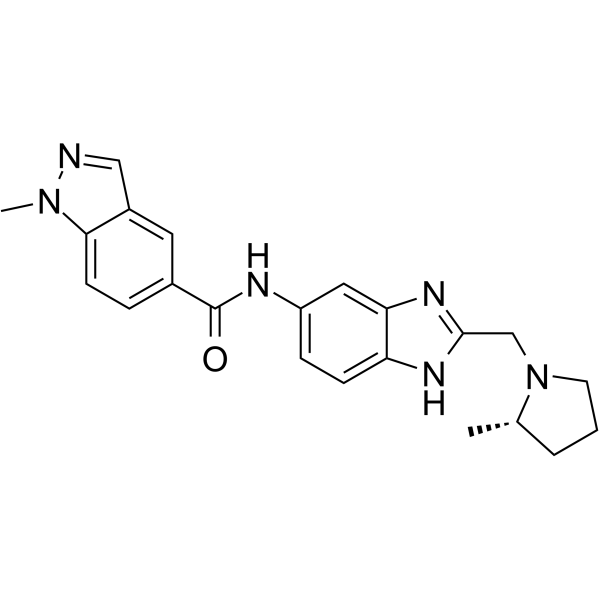
TDI-11055

Based on 1 Customer Validation
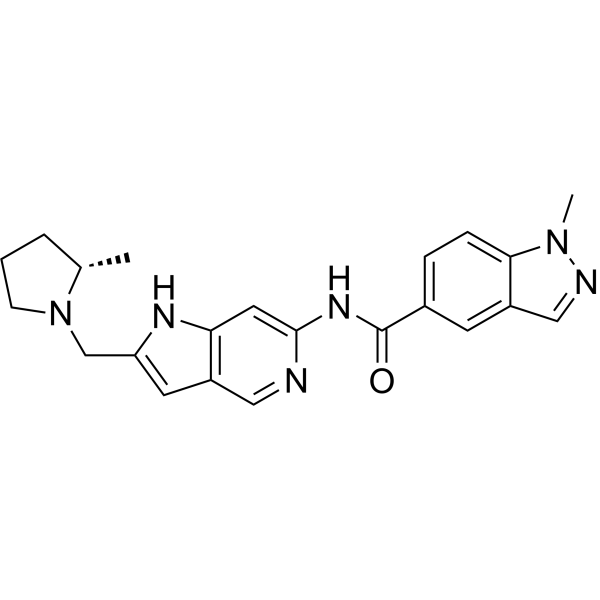
TDI-11055 is a selective and orally active eleven-nineteen leukemia (ENL) inhibitor, which displaces ENL from chromatin by blocking its YEATS domain interaction with acylated histones. TDI-11055 inhibits ENL and AF9 YEATS domains with IC50 values of 50 nM and 70 nM, respectively, and no activity against GAS41 or YEATS2. TDI-11055 decreases chromatin occupancy of ENL-associated complexes, impairs transcription elongation, suppresses key oncogenic gene expression programs, and induces differentiation. TDI-11055 can be used for the research of acute myeloid leukemia.
For research use only. We do not sell to patients.
- Purity : 99.87%
- CAS No.: 3057216-63-1
- Formula: C22H24N6O
- Molecular Weight:388.47
-
Storage:
4°C, protect from light
* In solvent : -80°C, 6 months; -20°C, 1 month (protect from light)

To place orders, for customer services and technical support, please contact: MedChemExpress USA
Tel: 609-228-6898 E-mail: [email protected] [email protected]


-
 Biological Activity
-
Chemical Information
-
Solvent & Solubility
- Protocols
- Purity & Documentation
- References
-
 Help & FAQs




Biological Activity
Description
IC50 & Target
[1]|
ENL YEATS domain 50 nM (IC50) |
ENL YEATS domain 119 nM (Kd) |
AF9 YEATS domain 70 nM (IC50) |
Cellular Effect
|
Cell Line

|
Type | Value | Description | References |
|---|---|---|---|---|
| MV4-11 | IC50 |
0.1 μM
Compound: 8; TDI-11055
|
Antiproliferative activity against human MV4-11 cells assessed as inhibition of cell growth by CellTiter-Glo Luminescent Cell Viability Assay
Antiproliferative activity against human MV4-11 cells assessed as inhibition of cell growth by CellTiter-Glo Luminescent Cell Viability Assay
|
[PMID: 38628784] |
In Vitro
TDI-11055 binds directly to the ENL YEATS domain with a Kd of 119 nM[1].
TDI-11055 (5 μM; 24 hours) displaces ENL from chromatin at target genes in MOLM-13 cells without reducing ENL protein levels[1].
TDI-11055 (8 days) potently inhibits proliferation of MLL-r and NPM1-mutated leukemia cell lines with IC50 values ranging from 0.27 to 7.2 μM, but has minimal effects on non-MLL-r cell lines[1].
TDI-11055 (1-10 μM; 72 h) inhibits the growth of MV4;11 and OCI-AML3 cells, accompanied by a slowing of cell cycle progression and a mild increase in apoptosis[1].
TDI-11055 (1-10 μM; ~7 days) impairs clonogenic potential of MLL-r MV4;11 and NPM1-mutated OCI-AML3 cells but not non-MLL-r HL60 or K562 cells[1].
TDI-11055 (5 μM; 24 hours) suppresses ENL-dependent oncogenic gene expression programs in MV4;11 cells, including MYC and HOXA cluster genes, and induces myeloid differentiation[1].
TDI-11055 (5 μM; 30 minutes, 2 hours, or 24 hours) rapidly displaces ENL from chromatin, reducing SEC/P-TEFb and DOT1L occupancy and Pol II S2P levels at top ENL-bound genes in MV4;11 cells[1].
TDI-11055 (1-10 μM; ~2 weeks) impairs clonogenic potential of MLL-r and NPM1-mutated primary AML samples but not normal hematopoietic cells[1].
TDI-11055 (8-day) inhibits the growth of MV4;11 AML cells with an IC50 of 0.10 μM in a viability assay[2].
MedChemExpress (MCE) has not independently confirmed the accuracy of these methods. They are for reference only. Further protocols information, click here.
-
Cell Line:Human leukemia cell lines (MV4;11, MOLM-13, ML2, OCI-AML2, OCI-AML3, HL60, K562, U937, Jurkat)
-
Concentration:1-100 μM
-
Incubation Time:8 days
-
Result:Inhibited proliferation of MLL-rearranged (MLL-r) cell lines MV4;11 (IC₅₀ = 0.27 μM), MOLM-13 (IC₅₀ = 0.77 μM), OCI-AML2 (IC₅₀ = 1.79 μM), ML2 (IC₅₀ = 7.2 μM) and NPM1-mutated OCI-AML3 (IC₅₀ = 0.51 μM); exerted minimal effects on non-MLL-r cell lines HL60 (IC₅₀ > 30 μM), K562 (IC₅₀ > 30 μM), U937 (IC₅₀ = 23 μM), Jurkat (IC₅₀ > 30 μM).
-
Cell Line:MV4;11 and OCI-AML3 cells
-
Concentration:1 μM, 10 μM
-
Incubation Time:72 h
-
Result:Increaseed the apoptosis percentage of MV4;11 and OCI-AML3.
Parmacokinetics
In Vivo
TDI-11055 (200 mg/kg; p.o.; q.d.; 28 days) reduces leukemia burden and prolongs survival in disseminated MV4;11 AML xenografts[1].
TDI-11055 (200 mg/kg; p.o.; q.d.; 28 days) reduces leukemia burden in MLL-r PDX-6315 AML xenografts[1].
TDI-11055 (200 mg/kg; p.o.; q.d.; 28 days) prolongs survival in OCI-AML3 NPM1-mutated AML xenografts[1].
TDI-11055 (200 mg/kg; p.o.; q.d.; 28 days) reduces leukemia burden in NPM1-mutated PDX-3055 AML xenografts[1].
TDI-11055 (200 mg/kg; p.o.; q.d. or b.i.d. (5 days on/2 days off); 28 days) reduces leukemia burden and prolongs survival in MLL-r PDX-2263 AML xenografts[1].
MedChemExpress (MCE) has not independently confirmed the accuracy of these methods. They are for reference only.
-
Animal Model:BALB/c nude (female, 6-8 weeks old) bearing MV4;11 subcutaneous transplantation model[1].
-
Dosage:100 mg/kg; 200 mg/kg
-
Administration:p.o.; b.i.d.; 8 days
-
Result:Significantly inhibited tumor growth; reduced mRNA expression of MYC, HOXA9, MEIS1, and MYB in tumors.
-
Animal Model:NOD.Cg-PrkdcscidIl2rgtm1Wjl/SzJ (NSG) (female, 6-8 weeks old)[1]
-
Dosage:200 mg/kg
-
Administration:p.o.; q.d.; 28 days
-
Result:Reduced leukemia burden (human CD45+ cells in peripheral blood); prolonged median survival from 37 to 63 days (70% increase).
Reduced leukemia burden (human CD45+ cells in peripheral blood, bone marrow, and spleen).
Prolonged median survival.
Significantly reduced leukemia burden (human CD45+ cells in bone marrow).
-
Animal Model:NOD.Cg-PrkdcscidIl2rgtm1Wjl/SzJ (NSG) (female, 6-8 weeks old)[1]
-
Dosage:200 mg/kg
-
Administration:p.o.; q.d. (for 28 days); b.i.d. (5 days on/2 days off for 28 days)
-
Result:Reduced leukemia burden (human CD45+ cells in peripheral blood); prolonged median survival from 32 to 49 days (53% increase)


Chemical Information
-
CAS No. 3057216-63-1
-
Appearance Solid
-
Molecular Weight 388.47
-
Formula C22H24N6O
-
Color White to off-white
-
SMILES
C[C@H]1CCCN1CC2=CC3=C(N2)C=C(N=C3)NC(C4=CC=C5C(C=NN5C)=C4)=O
-
Shipping
Room temperature in continental US; may vary elsewhere.
-
Storage
4°C, protect from light
* In solvent : -80°C, 6 months; -20°C, 1 month (protect from light)


Solvent & Solubility
In Vitro:
DMSO : 100 mg/mL (257.42 mM; Need ultrasonic; Hygroscopic DMSO has a significant impact on the solubility of product, please use newly opened DMSO)
Please refer to the solubility information to select the appropriate solvent. Once prepared, please aliquot and store the solution to prevent product inactivation from repeated freeze-thaw cycles.
Storage method and period of stock solution: -80°C, 6 months; -20°C, 1 month (protect from light). When stored at -80°C, please use it within 6 months. When stored at -20°C, please use it within 1 month.
Please refer to the solubility information to select the appropriate solvent. Once prepared, please aliquot and store the solution to prevent product inactivation from repeated freeze-thaw cycles.
Storage method and period of stock solution: -80°C, 6 months; -20°C, 1 month (protect from light). When stored at -80°C, please use it within 6 months. When stored at -20°C, please use it within 1 month.
Concentration (start) × Volume (start) = Concentration (final) × Volume (final)
In Vivo:
Select the appropriate dissolution method based on your experimental animal and administration route.
- For the following dissolution methods, please ensure to first prepare a clear stock solution using an In Vitro approach and then sequentially add co-solvents:
- To ensure reliable experimental results, the clarified stock solution can be appropriately stored based on storage conditions. As for the working solution for In Vivo experiments, it is recommended to prepare freshly and use it on the same day.
- The percentages shown for the solvents indicate their volumetric ratio in the final prepared solution. If precipitation or phase separation occurs during preparation, heat and/or sonication can be used to aid dissolution.
In Vivo Dissolution Calculator
Please enter the basic information of animal experiments:
-
-
-
-
Recommended: Prepare an additional quantity of animals to account for potential losses during experiments.
Please enter your animal formula composition:
-
%DMSO +
Recommended: Keep the proportion of DMSO in working solution below 2% if your animal is weak.
-
%+
-
+%Tween-80 + +
-
%Saline +
The co-solvents required include: DMSO, . All of co-solvents are available by MedChemExpress (MCE). , Tween 80. All of co-solvents are available by MedChemExpress (MCE).
Working solution concentration: 0.22 mg/mL
Method for preparing stock solution: mg drug dissolved in μL DMSO. Stock solution concentration: mg/mL. * In solvent : -80°C, 6 months; -20°C, 1 month (protect from light)
1. Take μL DMSO stock solution;
2. Add μL .
μL , mix evenly;
3. Then add μL Tween 80, mix evenly;
4. Then add μL
Please ensure that the stock solution in the first step is dissolved to a clear state, and add co-solvents in sequence. You can use ultrasonic heating (ultrasonic cleaner, recommended frequency 20-40 kHz), vortexing, etc. to assist dissolution.

Protocols
-
RT-PCR
Reverse transcription technology uses RNA as a template to synthesize DNA. RT-PCR is simple, specific and sensitive, and can be used to detect gene expression levels and expression differences in cells; detect RNA virus content; clone cDNA sequences of specific genes.
-
RNA extraction experimental
By lysing cells, releasing RNA, and removing impurities such as proteins and DNA, high-purity RNA products are finally obtained. The commonly used traditional method is the guanidine isothiocyanate/phenol/chloroform method (Trizol), which is suitable for a variety of animal materials including animal tissues, microorganisms, cultured cells, etc., and most plant materials.
-
Real Time qPCR (Q-PCR)
Real-time quantitative PCR (qPCR) quantifies an amplifiable nucleic-acid target by monitoring fluorescence during PCR cycling rather than measuring product only after amplification. The increase in fluorescence tracks accumulation of PCR product, and the quantification cycle (Cq; historically also Ct/CP) is related to the initial amount of target: samples containing more starting target generally reach the defined fluorescence threshold in fewer cycles.


Purity & Documentation
-
Data Sheet (279 KB)
-
SDS (251 KB)
- English - EN (251 KB)
- Français - FR (251 KB)
- Deutsch - DE (251 KB)
- Norwegian - NO (251 KB)
- Español - ES (251 KB)
- Swedish - SV (251 KB)
- Italian - IT (251 KB)
- Korean - KR (251 KB)
- Portuguese - PT (251 KB)
-
Handling Instructions (2659 KB)
References
[1]. Liu Y, et al. Small-Molecule Inhibition of the Acyl-Lysine Reader ENL as a Strategy against Acute Myeloid Leukemia. Cancer Discov. 2022;12(11):2684-2709. [Content Brief]
[2]. Michino M, et al. Lead Optimization of Small Molecule ENL YEATS Inhibitors to Enable In Vivo Studies: Discovery of TDI-11055. ACS Med Chem Lett. 2024;15(4):524-532. Published 2024 Mar 12. [Content Brief]


Complete Stock Solution Preparation Table
Please refer to the solubility information to select the appropriate solvent. Once prepared, please aliquot and store the solution to prevent product inactivation from repeated freeze-thaw cycles.
Storage method and period of stock solution: -80°C, 6 months; -20°C, 1 month (protect from light). When stored at -80°C, please use it within 6 months. When stored at -20°C, please use it within 1 month.
| Optional Solvent | Concentration Solvent Mass | 1 mg | 5 mg | 10 mg | 25 mg |
|---|---|---|---|---|---|
| DMSO | 1 mM | 2.5742 mL | 12.8710 mL | 25.7420 mL | 64.3550 mL |
| 5 mM | 0.5148 mL | 2.5742 mL | 5.1484 mL | 12.8710 mL | |
| 10 mM | 0.2574 mL | 1.2871 mL | 2.5742 mL | 6.4355 mL | |
| 15 mM | 0.1716 mL | 0.8581 mL | 1.7161 mL | 4.2903 mL | |
| 20 mM | 0.1287 mL | 0.6436 mL | 1.2871 mL | 3.2178 mL | |
| 25 mM | 0.1030 mL | 0.5148 mL | 1.0297 mL | 2.5742 mL | |
| 30 mM | 0.0858 mL | 0.4290 mL | 0.8581 mL | 2.1452 mL | |
| 40 mM | 0.0644 mL | 0.3218 mL | 0.6436 mL | 1.6089 mL | |
| 50 mM | 0.0515 mL | 0.2574 mL | 0.5148 mL | 1.2871 mL | |
| 60 mM | 0.0429 mL | 0.2145 mL | 0.4290 mL | 1.0726 mL | |
| 80 mM | 0.0322 mL | 0.1609 mL | 0.3218 mL | 0.8044 mL | |
| 100 mM | 0.0257 mL | 0.1287 mL | 0.2574 mL | 0.6436 mL |


TDI-11055 Related Classifications
HY-162350 Related Classifications
 Powered by Bioz