5 Results for "

Nanoformulation

" in MedChemExpress (MCE) Product Catalog:
Products (5)

5 Results for "Nanoformulation" in MCE Product Catalog:

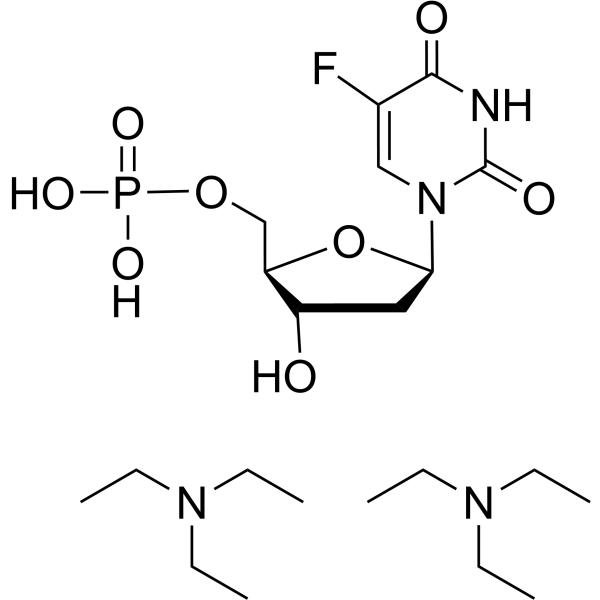
Cat. No.: HY-154508
CAS No.: 134-46-3
Purity:  99.96%
Synonyms: 2’-Deoxy-5-Fluorouridine 5’-phosphate triethylammonium
FdUMP triethylammonium (2'-Deoxy-5-Fluorouridine 5'-phosphate triethylammonium) is the active metabolite nucleotide of 5-Fluorouracil (HY-90006), with an IC50 of 1.13 μM against human Thymidylate Synthase. FdUMP triethylammonium covalently inhibits the catalytic cycle of thymidylate synthase, blocking dTMP production, which in turn leads to inhibition of DNA synthesis. FdUMP triethylammonium can serve as a core active component of nanoformulations for cancer-related research, such as colorectal cancer, esophageal cancer, and hepatocellular carcinoma .
loading...
    loading...
Cat. No.: HY-D0200
CAS No.: 1071-93-8
Synonyms: Adipodihydrazide
Research Areas:  

Others

Adipic acid dihydrazide (Adipodihydrazide) is a crosslinking agent that reacts with aldehyde groups to form pH-sensitive hydrazone bonds. Adipic acid dihydrazide can be used to prepare oxi‑HA/ADH8 injectable hydrogels for nucleus pulposus regeneration and can also be used to construct Paclitaxel (HY-B0015)-loaded nanoformulations. Adipic acid dihydrazide can serve as an intermediate for organic synthesis-related research .
loading...
    loading...
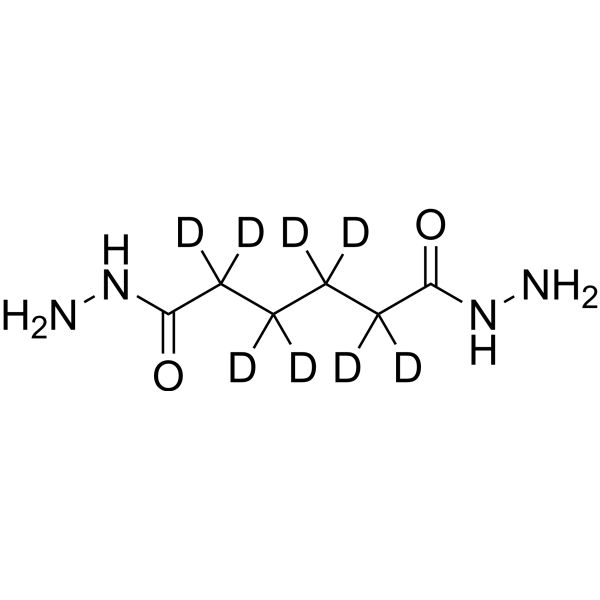
Cat. No.: HY-D0200S
CAS No.: 1202865-37-9
Synonyms: Adipodihydrazide-d8
Adipic acid dihydrazide-d8 (Adipodihydrazide-d8) is the deuterated-labeled Adipic acid dihydrazide (HY-D0200). Adipic acid dihydrazide (Adipodihydrazide) is a crosslinking agent that reacts with aldehyde groups to form pH-sensitive hydrazone bonds. Adipic acid dihydrazide can be used to prepare oxi‑HA/ADH8 injectable hydrogels for nucleus pulposus regeneration and can also be used to construct Paclitaxel (HY-B0015)-loaded nanoformulations. Adipic acid dihydrazide can serve as an intermediate for organic synthesis-related research .
loading...
    loading...
Cat. No.: HY-177840
Liposomal Curcumin is an orally active liposomal curcumin nanoformulation with antitumor, anti-neuroinflammatory, and other activities. Liposomal Curcumin mediates caspase-dependent apoptosis as well as epigenetic regulation represented by DNA hypomethylation and miR-223 upregulation through the modulation of multiple core signaling axes, including Akt/ERK‑NF‑κB, Autophagy, and endoplasmic reticulum stress. Liposomal Curcumin can be used for research on diseases such as neuroinflammation, type I diabetes, and non-small cell lung cancer .
loading...
    loading...
Cat. No.: HY-160713
CAS No.: 27297-42-3
Synonyms: NSSL-BMS
Betamethasone succinate (NSSL-BMS) is a nano-formulation that can cross the blood-brain barrier. Betamethasone succinate is prepared by encapsulating the Betamethasone (HY-13570) semi-succinate in PEG-liposomes. Betamethasone succinate utilizes the enhanced permeation and retention effects of liposomes to target and deliver the potent glucocorticoid to the inflammatory sites. Betamethasone succinate inhibits the secretion of pro-inflammatory cytokines (such as TNF-α and IL-6) while maintaining the level of anti-inflammatory cytokine TGF-β. Betamethasone succinate can be used in the research of arthritis and cerebral malaria .
loading...
    loading...

