4 Results for "

Pomalidomide-PEG6-NH2

" in MedChemExpress (MCE) Product Catalog:
Products (4)

4 Results for "Pomalidomide-PEG6-NH2" in MCE Product Catalog:

Cat. No.: HY-136161
CAS No.: 2341841-01-6
Purity:  98.01%
Research Areas:  

Cancer

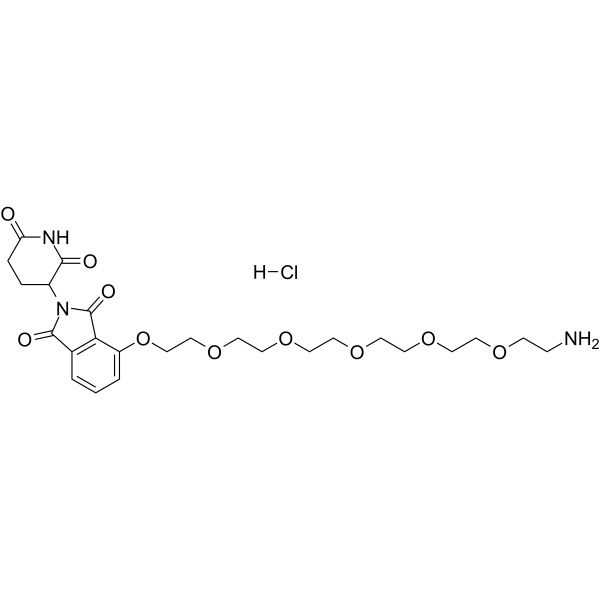
Pomalidomide-PEG6-NH2 hydrochloride is a synthesized E3 ligase ligand-linker conjugate that incorporates the Pomalidomide based cereblon ligand and 6-unit PEG linker used in PROTAC technology.
loading...
    loading...
Cat. No.: HY-P10563
CAS No.: 2580150-96-3
Synonyms: BHV-1100
Target:  

CD38 IFNAR

Research Areas:  

Cancer

Noraramtide (BHV-1100) is an antibody-recruiting molecule. Noraramtide binds to CD38 and recruits natural killer (NK) cells to mediate antibody-dependent cellular cytotoxicity. Noraramtide enhances the capacity of autologous cytokine-induced memory-like (CIML) NK cells to produce IFNγ and CD107a, thereby improving their cytotoxicity against multiple myeloma cells. Noraramtide can be used in the research of multiple myeloma .
loading...
    loading...
Cat. No.: HY-P10870
Research Areas:  

Cancer

Pep1-DNP conjugate 9 is a functionalized peptide which is composed of the DNP-Hapten and the FGFR1 binding peptide. Pep1-DNP conjugate 9 exhibits good affinity to FGFR1 with KD of 5.01 μM. Pep1-DNP conjugate 9 recruits anti-DNP antibodies to the surface of FGFR1-positive cells, inhibits the FGF2-induced proliferation in rat skeletal myoblast cells, and induces apoptosis. Pep1-DNP conjugate 9 exhibits antitumor efficacy in mouse models .
loading...
    loading...
Cat. No.: HY-169232
Target:  

PROTACs PD-1/PD-L1

Research Areas:  

Cancer

PCC16 chloride is a dual PROTAC degrader targeting DHHC3 and PD-L1, with a DC50 of 0.103 μM for PD-L1 degradation. PCC16 chloride induces DHHC3 degradation via the ubiquitin-proteasome pathway by recruiting the CRBN E3 ubiquitin ligase (E3 ubiquitin ligase). By targeting DHHC3-which is essential for PD-L1 palmitoylation and membrane stability-PCC16 chloride reduces PD-L1 levels, decreases PD-L1 membrane retention time, and impairs its immunosuppressive function. PCC16 chloride enhances anti-tumor immunity by disrupting PD-L1-mediated immunosuppression. PCC16 chloride can be used in the research of immune checkpoint blockade-resistant cancers .
loading...
    loading...

