5 Results for "

Refractive index

" in MedChemExpress (MCE) Product Catalog:
Products (5)

5 Results for "Refractive index" in MCE Product Catalog:

1
1 Cited Publications
Cat. No.: HY-B1398
CAS No.: 83-07-8
Synonyms: 4-Aminophenazone
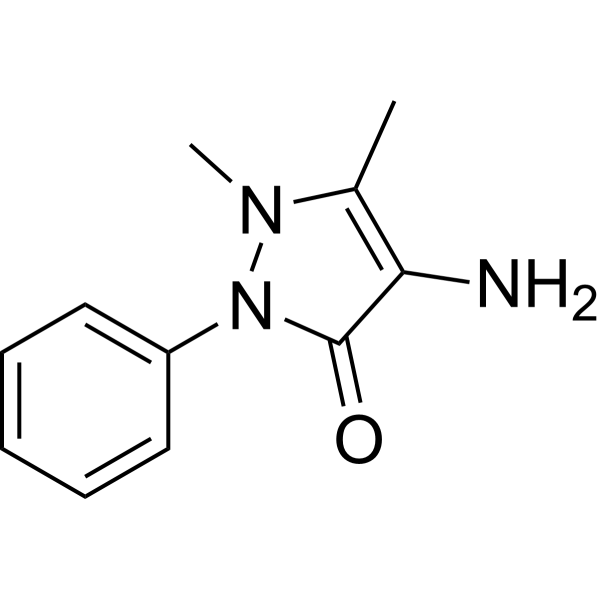
Ampyrone (4-Aminophenazone; 4-Aminoantipyrine) is a reversible and low-damage optical clearing agent and non-selective COX inhibitor based on UV absorption properties. Ampyrone can improve the optical transmittance of mouse skin and other tissues. Ampyrone can induce tissue refractive index matching by enhancing UV absorption, reduce light scattering, and achieve tissue transparency in vivo. Ampyrone reduces the synthesis of prostaglandin PGE2, thereby exerting anti-inflammatory, analgesic and antipyretic effects. Ampyrone inhibits DNA damage, cell apoptosis and immune cell phagocytosis induced by Doxorubicin (HY-15142A) and Cisplatin (HY-17394), etc., and participates in the regulation of toxicity in tumor chemotherapy .
loading...
    loading...
Cat. No.: HY-W016568
CAS No.: 529-69-1
Category:  

Natural Products Animals

Target:  

Endogenous Metabolite

Isoxanthopterin is a heterocyclic compound belonging to the pteridine family and its activity is mainly reflected in its optical properties. Isoxanthopterin can form a reflective layer in the eyes of animals, enhancing visual function. The main regulatory mechanism of isoxanthopterin involves its ability to form a crystalline structure within organisms, which achieves a high refractive index through specific hydrogen bonding patterns and molecular arrangements. Isoxanthopterin can be used for research in materials science and optical engineering .
loading...
    loading...
Cat. No.: HY-B1398R
CAS No.: 83-07-8
Synonyms: 4-Aminophenazone (Standard)
Ampyrone (4-Aminophenazone) (Standard) is the analytical standard of Ampyrone (HY-B1398). This product is intended for research and analytical applications. Ampyrone (4-Aminophenazone; 4-Aminoantipyrine) is a reversible and low-damage optical clearing agent and non-selective COX inhibitor based on UV absorption properties. Ampyrone can improve the optical transmittance of mouse skin and other tissues. Ampyrone can induce tissue refractive index matching by enhancing UV absorption, reduce light scattering, and achieve tissue transparency in vivo. Ampyrone reduces the synthesis of prostaglandin PGE2, thereby exerting anti-inflammatory, analgesic and antipyretic effects. Ampyrone inhibits DNA damage, cell apoptosis and immune cell phagocytosis induced by Doxorubicin (HY-15142A) and Cisplatin (HY-17394), etc., and participates in the regulation of toxicity in tumor chemotherapy .
loading...
    loading...
Cat. No.: HY-W103498
CAS No.: 887402-92-8
Research Areas:  

Others

N4,N4'-Diphenyl-N4,N4'-bis(9-phenyl-3-carbazolyl)biphenyl-4,4'-diamine (Compound HT-01) is a biochemical reagent. N4,N4'-Diphenyl-N4,N4'-bis(9-phenyl-3-carbazolyl)biphenyl-4,4'-diamine can be used in the research of layered semiconductor devices with low-refractive-index organic coatings .
loading...
    loading...
Cat. No.: HY-B1398S
CAS No.: 1329792-51-9
Synonyms: 4-Aminoantipyrine-d3
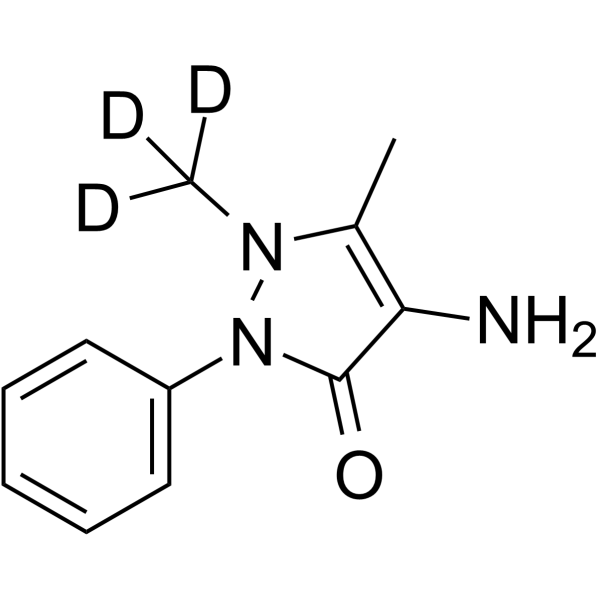
Ampyrone-d3 is the deuterium labeled Ampyrone (HY-B1398). Ampyrone (4-Aminophenazone; 4-Aminoantipyrine) is a reversible and low-damage optical clearing agent and non-selective COX inhibitor based on UV absorption properties. Ampyrone can improve the optical transmittance of mouse skin and other tissues. Ampyrone can induce tissue refractive index matching by enhancing UV absorption, reduce light scattering, and achieve tissue transparency in vivo. Ampyrone reduces the synthesis of prostaglandin PGE2, thereby exerting anti-inflammatory, analgesic and antipyretic effects. Ampyrone inhibits DNA damage, cell apoptosis and immune cell phagocytosis induced by Doxorubicin (HY-15142A) and Cisplatin (HY-17394), etc., and participates in the regulation of toxicity in tumor chemotherapy .
loading...
    loading...

