



Ampyrone
Based on 1 publication(s) in Google Scholar
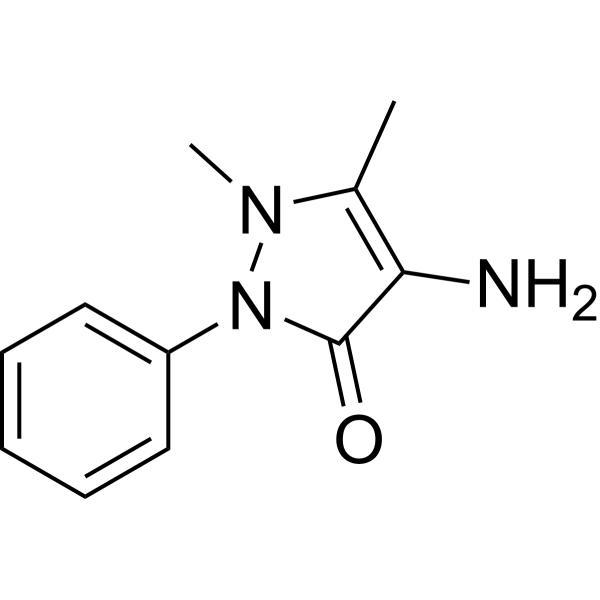
Ampyrone (4-Aminophenazone; 4-Aminoantipyrine) is a reversible and low-damage optical clearing agent and non-selective COX inhibitor based on UV absorption properties. Ampyrone can improve the optical transmittance of mouse skin and other tissues. Ampyrone can induce tissue refractive index matching by enhancing UV absorption, reduce light scattering, and achieve tissue transparency in vivo. Ampyrone reduces the synthesis of prostaglandin PGE2, thereby exerting anti-inflammatory, analgesic and antipyretic effects. Ampyrone inhibits DNA damage, cell apoptosis and immune cell phagocytosis induced by Doxorubicin (HY-15142A) and Cisplatin (HY-17394), etc., and participates in the regulation of toxicity in tumor chemotherapy.
For research use only. We do not sell to patients.
- Purity : 99.72%
- CAS No.: 83-07-8
- Formula: C11H13N3O
- Molecular Weight:203.25
-
Storage:Powder -20°C, 3 years , 4°C, 2 years ; In solvent -80°C, 2 years , -20°C, 1 year

To place orders, for customer services and technical support, please contact: MedChemExpress USA
Tel: 609-228-6898 E-mail: [email protected] [email protected]


-
 Biological Activity
-
Chemical Information
-
Solvent & Solubility
- Purity & Documentation
- References
-
 Help & FAQs


-

HY-B1398R
Ampyrone (Standard) -
HY-15027
5-Aminosalicylic Acid -
HY-15922
Luminol -
HY-W011500
TCEP hydrochloride -
![Benzo[a]pyrene](https://file.medchemexpress.com/product_pic/hy-107377.gif)
HY-107377
Benzo[a]pyrene -
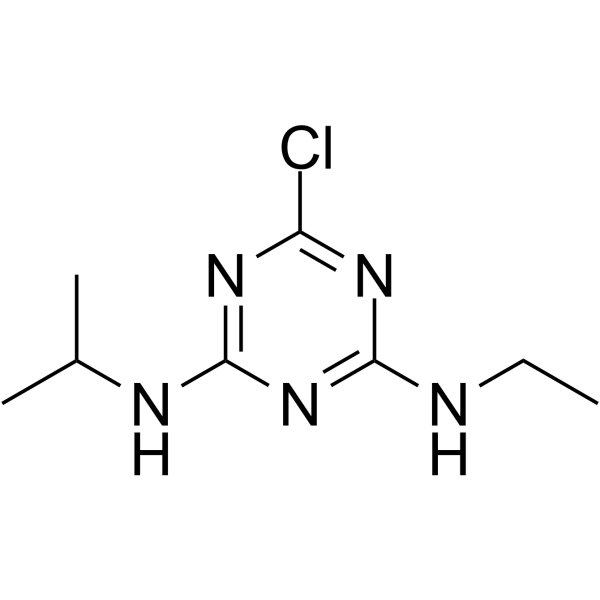
HY-N7091
Atrazine -
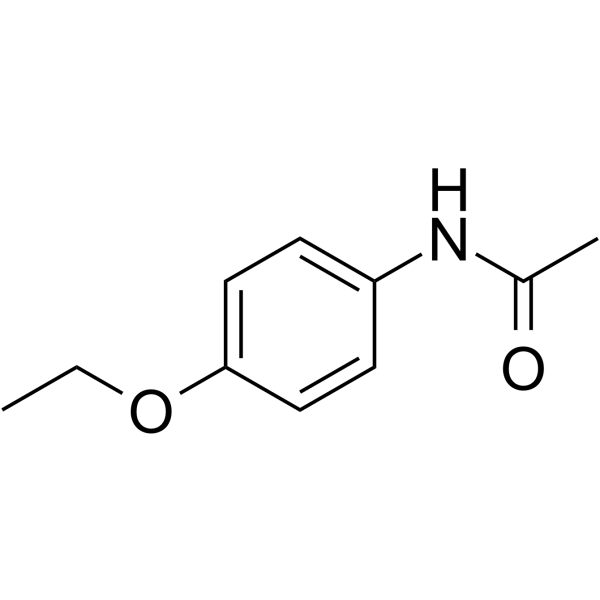
HY-B0476
Phenacetin -
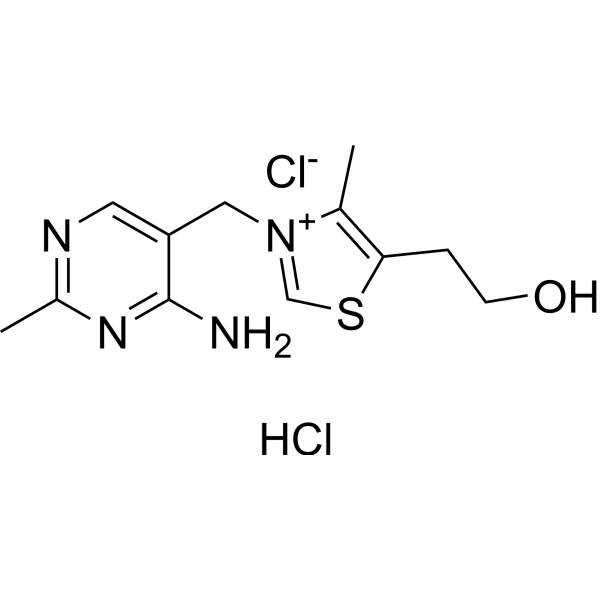
HY-N0680
Thiamine hydrochloride -
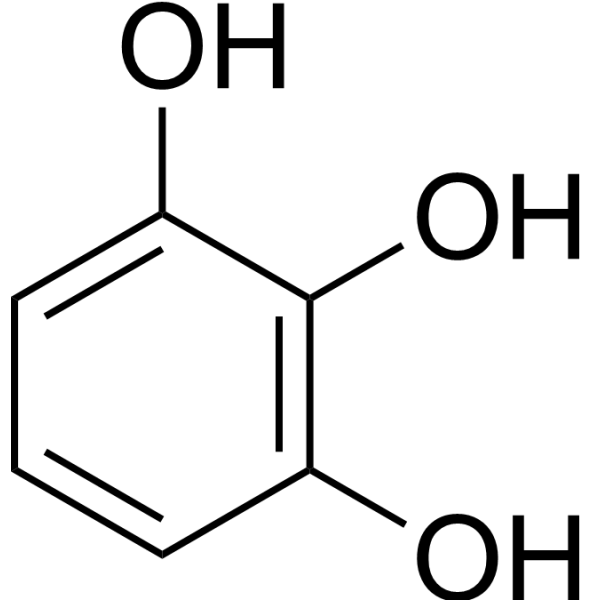
HY-N1579
Pyrogallol -
HY-W014386
3-Amino-9-ethylcarbazole -
HY-N7091R
Atrazine (Standard) -
HY-112103
6-(γ,γ-Dimethylallylamino)purine
Publications Citing Use of MedChemExpress (MCE) Ampyrone
More

Biological Activity
Description
IC50 & Target
[1]|
COX |
In Vivo
Ampyrone supports structural (such as YFP-labeled neurons) and functional (such as GCaMP calcium signals) imaging of deep tissues (such as the cerebral cortex), and is suitable for longitudinal dynamic observations in living animals, such as long-term tracking of neurons in the awake mouse brain and real-time monitoring of neural activity[2].
MedChemExpress (MCE) has not independently confirmed the accuracy of these methods. They are for reference only.
-
Animal Model:Male Mus musculus (35 g, 8-10 weeks old)[1]
-
Dosage:12-24 mg/kg
-
Administration:Intraperitoneal injection, single dose, 24 h
-
Result:Showed no genotoxicity, while co-administration with doxorubicin (24 mg/kg) or cyclophosphamide reduced DNA damage by 29.71%-62.19%.
Slight increase in micronuclei frequency was observed at 72 h with 24 mg/kg alone, but co-administration with cisplatin or doxorubicin reduced micronuclei formation by 3.22%-66.06%.
Reduced cisplatin/cyclophosphamide-induced apoptotic cells in kidneys (23.63%-47.11%) and doxorubicin-induced apoptosis in liver (18.18%-68.84%).
Co-administration with chemotherapeutic drugs decreased phagocytic cell numbers by 2.11%-63.76%, indicating immunomodulatory effects.


Chemical Information
-
CAS No. 83-07-8
-
Appearance Solid
-
Molecular Weight 203.25
-
Formula C11H13N3O
-
Color Light yellow to yellow
-
SMILES
O=C1N(C2=CC=CC=C2)N(C)C(C)=C1N
-
Synonyms
4-Aminophenazone
-
Shipping
Room temperature in continental US; may vary elsewhere.
-
Storage
Powder -20°C 3 years 4°C 2 years In solvent -80°C 2 years -20°C 1 year


Publications (1)
-
Journal Impact Factor
-
Most Recent
-
Pharmacol Res Perspect
Applicability of free drug hypothesis to drugs with good membrane permeability that are not efflux transporter substrates: A microdialysis study in rats. [Abstract]2020 Apr;8(2):e00575. PMID: 32266794


Solvent & Solubility
In Vitro:
DMSO : ≥ 50 mg/mL (246.00 mM; Hygroscopic DMSO has a significant impact on the solubility of product, please use newly opened DMSO)
H2O : 50 mg/mL (246.00 mM; Need ultrasonic)
* "≥" means soluble, but saturation unknown.
Please refer to the solubility information to select the appropriate solvent. Once prepared, please aliquot and store the solution to prevent product inactivation from repeated freeze-thaw cycles.
Storage method and period of stock solution: -80°C, 2 years; -20°C, 1 year. When stored at -80°C, please use it within 2 years. When stored at -20°C, please use it within 1 year.
* Note: If you choose water as the stock solution, please dilute it to the working solution, then filter and sterilize it with a 0.22 μm filter before use.
Please refer to the solubility information to select the appropriate solvent. Once prepared, please aliquot and store the solution to prevent product inactivation from repeated freeze-thaw cycles.
Storage method and period of stock solution: -80°C, 2 years; -20°C, 1 year. When stored at -80°C, please use it within 2 years. When stored at -20°C, please use it within 1 year.
* Note: If you choose water as the stock solution, please dilute it to the working solution, then filter and sterilize it with a 0.22 μm filter before use.
Concentration (start) × Volume (start) = Concentration (final) × Volume (final)
In Vivo:
Select the appropriate dissolution method based on your experimental animal and administration route.
- For the following dissolution methods, please ensure to first prepare a clear stock solution using an In Vitro approach and then sequentially add co-solvents:
- To ensure reliable experimental results, the clarified stock solution can be appropriately stored based on storage conditions. As for the working solution for In Vivo experiments, it is recommended to prepare freshly and use it on the same day.
- The percentages shown for the solvents indicate their volumetric ratio in the final prepared solution. If precipitation or phase separation occurs during preparation, heat and/or sonication can be used to aid dissolution.
Add each solvent one by one: 10% DMSO 40% PEG300 5% Tween-80 45% Saline
Solubility: ≥ 5 mg/mL (24.60 mM); Clear solution
This protocol yields a clear solution of ≥ 5 mg/mL (saturation unknown).
Taking 1 mL working solution as an example, add 100 μL DMSO stock solution (50.0 mg/mL) to 400 μL PEG300, and mix evenly; then add 50 μL Tween-80 and mix evenly; then add 450 μL Saline to adjust the volume to 1 mL.
Preparation of Saline: Dissolve 0.9 g sodium chloride in ddH₂O and dilute to 100 mL to obtain a clear Saline solution.
Add each solvent one by one: 10% DMSO 90% (20% SBE-β-CD in Saline)
Solubility: ≥ 5 mg/mL (24.60 mM); Clear solution
This protocol yields a clear solution of ≥ 5 mg/mL (saturation unknown).
Taking 1 mL working solution as an example, add 100 μL DMSO stock solution (50.0 mg/mL) to 900 μL 20% SBE-β-CD in Saline, and mix evenly.
Preparation of 20% SBE-β-CD in Saline (4°C, storage for one week): 2 g SBE-β-CD powder is dissolved in 10 mL Saline, completely dissolve until clear.
For the following dissolution methods, please prepare the working solution directly:
It is recommended to prepare fresh solutions and use them promptly within a short period of time.
The percentages shown for the solvents indicate their volumetric ratio in the final prepared solution. If precipitation or phase separation occurs during preparation, heat and/or sonication can be used to aid dissolution.
Add each solvent one by one: PBS
Solubility: 150 mg/mL (738.01 mM); Clear solution; Need ultrasonic
In Vivo Dissolution Calculator
Please enter the basic information of animal experiments:
-
-
-
-
Recommended: Prepare an additional quantity of animals to account for potential losses during experiments.
Working solution concentration: 0.22 mg/mL
This product has good water solubility, please refer to the measured solubility data in water/PBS/Saline for details.


Purity & Documentation
-
Data Sheet (277 KB)
-
SDS (392 KB)
- English - EN (392 KB)
- Français - FR (392 KB)
- Deutsch - DE (392 KB)
- Norwegian - NO (392 KB)
- Español - ES (392 KB)
- Swedish - SV (392 KB)
- Italian - IT (392 KB)
- Korean - KR (392 KB)
- Portuguese - PT (392 KB)
-
Handling Instructions (2659 KB)
References
[1]. Berno CR, et al. 4-Aminoantipyrine reduces toxic and genotoxic effects of doxorubicin, cisplatin, and cyclophosphamide in male mice. Mutat Res Genet Toxicol Environ Mutagen. 2016 Jul;805:19-24. [Content Brief]
[2]. Keck CHC, et al. Color-neutral and reversible tissue transparency enables longitudinal deep-tissue imaging in live mice. bioRxiv [Preprint]. 2025 Feb 27:2025.02.20.639185. [Content Brief]


Complete Stock Solution Preparation Table
Please refer to the solubility information to select the appropriate solvent. Once prepared, please aliquot and store the solution to prevent product inactivation from repeated freeze-thaw cycles.
Storage method and period of stock solution: -80°C, 2 years; -20°C, 1 year. When stored at -80°C, please use it within 2 years. When stored at -20°C, please use it within 1 year.
| Optional Solvent | Concentration Solvent Mass | 1 mg | 5 mg | 10 mg | 25 mg |
|---|---|---|---|---|---|
| DMSO / H2O | 1 mM | 4.9200 mL | 24.6002 mL | 49.2005 mL | 123.0012 mL |
| 5 mM | 0.9840 mL | 4.9200 mL | 9.8401 mL | 24.6002 mL | |
| 10 mM | 0.4920 mL | 2.4600 mL | 4.9200 mL | 12.3001 mL | |
| 15 mM | 0.3280 mL | 1.6400 mL | 3.2800 mL | 8.2001 mL | |
| 20 mM | 0.2460 mL | 1.2300 mL | 2.4600 mL | 6.1501 mL | |
| 25 mM | 0.1968 mL | 0.9840 mL | 1.9680 mL | 4.9200 mL | |
| 30 mM | 0.1640 mL | 0.8200 mL | 1.6400 mL | 4.1000 mL | |
| 40 mM | 0.1230 mL | 0.6150 mL | 1.2300 mL | 3.0750 mL | |
| 50 mM | 0.0984 mL | 0.4920 mL | 0.9840 mL | 2.4600 mL | |
| 60 mM | 0.0820 mL | 0.4100 mL | 0.8200 mL | 2.0500 mL | |
| 80 mM | 0.0615 mL | 0.3075 mL | 0.6150 mL | 1.5375 mL | |
| 100 mM | 0.0492 mL | 0.2460 mL | 0.4920 mL | 1.2300 mL |
* Note: If you choose water as the stock solution, please dilute it to the working solution, then filter and sterilize it with a 0.22 μm filter before use.


Ampyrone Related Classifications
HY-B1398 Related Classifications
 Powered by Bioz